
Posted on Dec 16, 2023

Medicaid unwinding exposed a ‘crisis’ in the system as 1.7 million Texans lost coverage

436
14
2
8
8
0
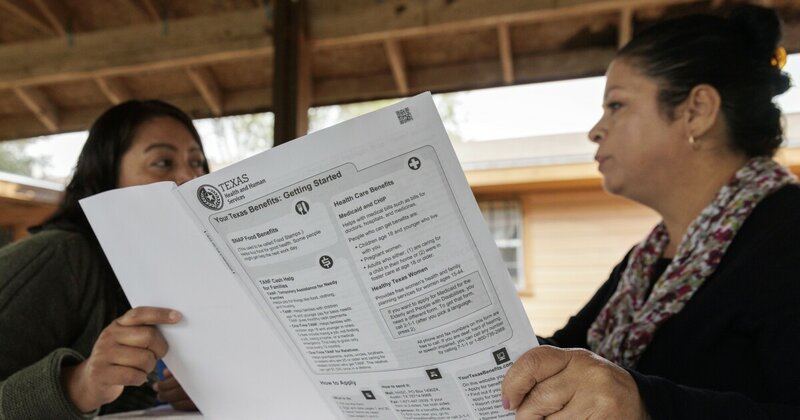
Children's Defense Fund program director Graciela Camarena assists Lucia Salazar with filling out Medicaid and SNAP application forms for her family in Pharr, Texas, Monday, Nov. 13, 2023. As the state reviews Texans' eligibility, some 1 million people have already lost Medicaid and organizations like the one Graciela works for assist people in applying again. (AP Photo/Michael Gonzalez)
Editor's note: This story has been updated to reflect the latest data from the Texas Health and Human Services Commission.
During the COVID-19 pandemic, the federal government put protections in place to make sure people could access health care, like testing, treatment, and doctors’ visits.
These protections under the Public Health Emergency (PHE) started in March 2020. The PHE also ensured people would have continuous Medicaid coverage, a comprehensive federal program that covers low-income people without having to reapply.
The PHE expired earlier this year. This meant that starting on April 1, states had to determine whether the millions of people who had been added to the Medicaid rolls in the past three years were still eligible.
The Texas Health and Human Services Commission (HHSC) manages Medicaid for the state and is overseeing this process. Since redetermination began earlier this year, about 1.7 million Texans have lost coverage—almost a million of them kids, according to the Kaiser Family Foundation.
Stacey Pogue is the senior policy analyst with the advocacy group Every Texan and has been tracking Medicaid unwinding in the state. She said since a lot of folks have never renewed before, they’re running into a lot of issues, and the stakes are high.
“Did the state send it to the wrong address?” said Pogue. “Did the notice come in your language? Do you understand it? Are the due dates on it clear? Can you get local help if you need it?
Editor's note: This story has been updated to reflect the latest data from the Texas Health and Human Services Commission.
During the COVID-19 pandemic, the federal government put protections in place to make sure people could access health care, like testing, treatment, and doctors’ visits.
These protections under the Public Health Emergency (PHE) started in March 2020. The PHE also ensured people would have continuous Medicaid coverage, a comprehensive federal program that covers low-income people without having to reapply.
The PHE expired earlier this year. This meant that starting on April 1, states had to determine whether the millions of people who had been added to the Medicaid rolls in the past three years were still eligible.
The Texas Health and Human Services Commission (HHSC) manages Medicaid for the state and is overseeing this process. Since redetermination began earlier this year, about 1.7 million Texans have lost coverage—almost a million of them kids, according to the Kaiser Family Foundation.
Stacey Pogue is the senior policy analyst with the advocacy group Every Texan and has been tracking Medicaid unwinding in the state. She said since a lot of folks have never renewed before, they’re running into a lot of issues, and the stakes are high.
“Did the state send it to the wrong address?” said Pogue. “Did the notice come in your language? Do you understand it? Are the due dates on it clear? Can you get local help if you need it?
Medicaid unwinding exposed a ‘crisis’ in the system as 1.7 million Texans lost coverage
Posted from keranews.org Children
 Medical
 Health
Edited 2 y ago
Posted 2 y ago
Responses: 2
6
6
0

PO1 William "Chip" Nagel good day Brother William, always informational and of the most interesting. Thanks for sharing, have a blessed day!
(6)
(0)
0
0
0

If you don't keep the system updated with current informationi, things go wrong.
(0)
(0)
Read This Next


 Continue with Facebook
 Continue with Google