
Posted on Sep 30, 2015


5
5
0
From "Rasmussen Reports"
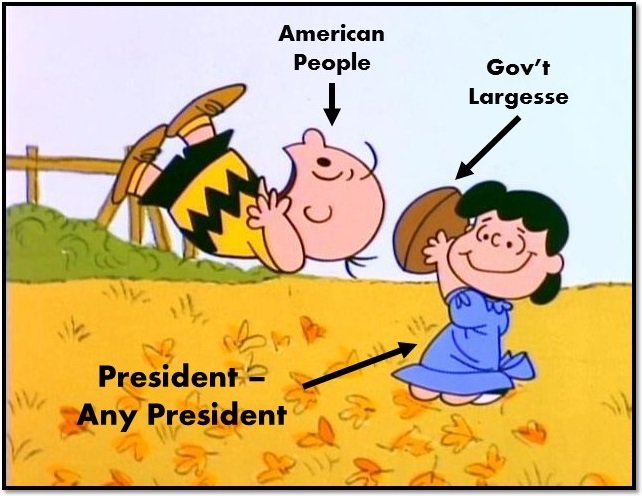
“Let the government handle it” is a common sentiment, but how do American really feel about the federal government these days? We decided to find out what America thinks.
For starters, most Americans feel the federal government plays too big a role in their lives and think, generally speaking, that there is too much government power and too little individual freedom. The freedoms granted in the Bill of Rights, such as the freedom of religion, free speech, the press and the right to bear arms are supremely important to voters, but the majority believes the federal government is a threat to those rights rather than the protector it should be. A plurality of 46%, for example, feels the government discriminates against people of religious faith.
Just 19% of voters trust the government to do the right thing all or most of the time.
http://www.rasmussenreports.com/public_content/what_america_thinks/2015_09/what_america_thinks_back_off_feds
EDITORIAL COMMENT:- Assuming that the statistics are accurate, what does that say about the health of the country?
More importantly, what can be done about it?
“Let the government handle it” is a common sentiment, but how do American really feel about the federal government these days? We decided to find out what America thinks.
For starters, most Americans feel the federal government plays too big a role in their lives and think, generally speaking, that there is too much government power and too little individual freedom. The freedoms granted in the Bill of Rights, such as the freedom of religion, free speech, the press and the right to bear arms are supremely important to voters, but the majority believes the federal government is a threat to those rights rather than the protector it should be. A plurality of 46%, for example, feels the government discriminates against people of religious faith.
Just 19% of voters trust the government to do the right thing all or most of the time.
http://www.rasmussenreports.com/public_content/what_america_thinks/2015_09/what_america_thinks_back_off_feds
EDITORIAL COMMENT:- Assuming that the statistics are accurate, what does that say about the health of the country?
More importantly, what can be done about it?
Posted in these groups:  Politics
 Government
Politics Government
Posted 10 y ago
Responses: 17
0
0
0

I am a strict Constitutional Constructionist. A restoration of the power of the States and The People is needed. That should answer your second question.
As to the first, that's a little more complicated. I would consider MOST Americans to be ... well ... herd-animals (e.g., sheep). As long as they're fed, clothed and protected, they'll follow anyone. As a nation, I believe (please note that's an "opinion" word) that we have become intellectually lazy and ethically lost. We consider "freedom" to be "as long as it doesn't hurt me, I guess the government can [insert "new" constitutional right / liberty law here]". Little do we realize that one day, we'll all wake up and wonder what the hell happened to our freedoms. On that day, we'll see the OTHER side of the herd-animal behavior... The stampede.
As to the first, that's a little more complicated. I would consider MOST Americans to be ... well ... herd-animals (e.g., sheep). As long as they're fed, clothed and protected, they'll follow anyone. As a nation, I believe (please note that's an "opinion" word) that we have become intellectually lazy and ethically lost. We consider "freedom" to be "as long as it doesn't hurt me, I guess the government can [insert "new" constitutional right / liberty law here]". Little do we realize that one day, we'll all wake up and wonder what the hell happened to our freedoms. On that day, we'll see the OTHER side of the herd-animal behavior... The stampede.
(0)
(0)
0
0
0

Big government is a cancer and yet, I'm not prepared to blame it for all the failings of the American society. Despite occasional news of a screwup (hanging chads) or local election fraud (almost any election in Chicago) We the People are represented by the candidates we have chosen. Thus, it is irrefutable that the governments in the United States have the consent of the governed. Yes there is plenty of evidence that incumbents have not been elected by a majority of the citizenry, but merely a majority of those who choose to participate. This has allowed factions with agendas inimical to We the People to exert far too much influence in the governance of the nation as well as its several states, counties, and municipalities. This inattentiveness has encouraged other minority factions to try their hand at imposing their will on We the People. For example, Islamists, a fairly insignificant minority, have scared the hell out of the majority with their crusade to impose Sharia Law via American courts. They have even enjoyed some modicum of success in a few jurisdictions. However, this also has happened only because the majority allows it to happen. We the People are easily cowed by cries of "racism" and "prejudice" especially when they are not true (After all the true racist or bigot cares little for pejoratives thrown in their direction)
(0)
(0)
COL Ted Mc
CPT Jack Durish - Captain; I'm not so sure that either apathy or feeling powerless really counts as "consent", but I'm willing to include them in "passive non-resistance".
(0)
(0)
COL Ted Mc
CPT Jack Durish - Captain; I don't think so. I don't think that the general level is YET to the level of any sort of "aggression".
"I'm not opposing what is happening because to do that would actually require me to think and/or act and I simply can't be bothered to do either." probably comes close to reality.
"I'm not opposing what is happening because to do that would actually require me to think and/or act and I simply can't be bothered to do either." probably comes close to reality.
(0)
(0)
0
0
0

Sir, it seems like you've confused "consent" as a legal construct with "contentedness" as an attitude.
I would venture that very close to all Americans would view the U.S. Government as a legitimate legal entity that, at least in abstract, rightfully represents the interests of the populace in both foreign and domestic matters. That is, technically speaking, "consent" as construed in the context of that phrase.
Whether or not it represents the populace in a way that makes people content, however, is a whole different matter. Pretty much every American's going to have some gripes with government unless they die as an infant (and thus know nothing of it) or are the ultimate cloistered recluse. Further, right now we have a rather unique, strong strain of general dis-contentedness being actively stoked (at least two, actually -- with at least one general form from each major political party) that is giving people an excuse to find gripes where there aren't actually any, or giving people courage to stand up for gripes long repressed.
I would venture that very close to all Americans would view the U.S. Government as a legitimate legal entity that, at least in abstract, rightfully represents the interests of the populace in both foreign and domestic matters. That is, technically speaking, "consent" as construed in the context of that phrase.
Whether or not it represents the populace in a way that makes people content, however, is a whole different matter. Pretty much every American's going to have some gripes with government unless they die as an infant (and thus know nothing of it) or are the ultimate cloistered recluse. Further, right now we have a rather unique, strong strain of general dis-contentedness being actively stoked (at least two, actually -- with at least one general form from each major political party) that is giving people an excuse to find gripes where there aren't actually any, or giving people courage to stand up for gripes long repressed.
(0)
(0)
COL Ted Mc
MAJ (Join to see) - Major; In Psychiatry there is a "Grey Zone" where "If you are in they won't let you out, but if you are out they won't put you in.".
In politics there is as "Grey Zone" between "Consent" and "Non-Consent" where "If there is no rebellion you won't get your gun, but if there is one you will.".
Roughly 30% of the American colonists supported the "Patriots".
Roughly 30% of the American colonists supported the "Loyalists".
Roughly 40% of the American colonists just wished that both sides would leave them alone (and tended to get screwed by BOTH sides).
In politics there is as "Grey Zone" between "Consent" and "Non-Consent" where "If there is no rebellion you won't get your gun, but if there is one you will.".
Roughly 30% of the American colonists supported the "Patriots".
Roughly 30% of the American colonists supported the "Loyalists".
Roughly 40% of the American colonists just wished that both sides would leave them alone (and tended to get screwed by BOTH sides).
(0)
(0)
MAJ (Join to see)
Sir, I'm not sure that counts as engaging my point at all... Your original question was whether the USG has the "Consent of the Governed." As such, it helps to define what is meant by that term. Comparing ourselves to colonial support is irrelevant to the question of whether the USG *currently* has such consent -- and you get your history wrong there as well (more on that in a moment).
The best definition for "consent of the governed" I've encountered is that the governed populace views the government so instantiated as a legitimate governing entity, even -- and perhaps *especially* -- if they do not agree with all its decisions. Keep in mind, that's not just the best definition *now,* but was the common understanding of the phrase *then* as well, specifically because if you needed unanimous support on every matter *no* government would ever have consent. The logic breaks down to meaningless under any other attempted definition. Talking about whether people agree or not with the decisions of the government is a matter of *contentedness* in the actions of said government, but does *not* mean that they view said government as illegitimate.
Now, the difference there is crucial, and underscores how differently we should look at things now versus the revolution as well. Today, you'd have a very difficult time finding any more than a minor smidgen of the population -- almost all of whom will be extreme-right-wing "sovereign citizen" nut-jobs -- who view the USG as *illegitimate.* As such, the nation has the requisite *consent of the governed.* Case closed.
As for your comments about the support for the American Revolution, those are known to be flawed statistics. That myth has been around for decades, and is fundamentally based on one letter from John Adams written ca. 1815. The first thing, though, is that his letter was about American views of the *French* revolution, not the *American* revolution, so it shows nothing supporting of the proposition whatsoever. However, there is much other evidence available showing the population's general support of the revolution, and that it was fairly robust, ranging from numerous other letters from other individuals (also often more closely linked in time to the actual events) all the way through to the observation that the Continental Army enjoyed a remarkable freedom of movement nearly everywhere that would have been near-impossible had the population not been far more supportive than resisting of the cause. Most credible historians on the subject agree that support for the revolution varied at different points during its course from a *low* of around 40% to a *high* of over 60%, while loyalist opposition never went higher than 30% and usually hovered closer to 20% or less. And yes, that's all the way through from the Stamp Act to the peace treaty with Britain.
The best definition for "consent of the governed" I've encountered is that the governed populace views the government so instantiated as a legitimate governing entity, even -- and perhaps *especially* -- if they do not agree with all its decisions. Keep in mind, that's not just the best definition *now,* but was the common understanding of the phrase *then* as well, specifically because if you needed unanimous support on every matter *no* government would ever have consent. The logic breaks down to meaningless under any other attempted definition. Talking about whether people agree or not with the decisions of the government is a matter of *contentedness* in the actions of said government, but does *not* mean that they view said government as illegitimate.
Now, the difference there is crucial, and underscores how differently we should look at things now versus the revolution as well. Today, you'd have a very difficult time finding any more than a minor smidgen of the population -- almost all of whom will be extreme-right-wing "sovereign citizen" nut-jobs -- who view the USG as *illegitimate.* As such, the nation has the requisite *consent of the governed.* Case closed.
As for your comments about the support for the American Revolution, those are known to be flawed statistics. That myth has been around for decades, and is fundamentally based on one letter from John Adams written ca. 1815. The first thing, though, is that his letter was about American views of the *French* revolution, not the *American* revolution, so it shows nothing supporting of the proposition whatsoever. However, there is much other evidence available showing the population's general support of the revolution, and that it was fairly robust, ranging from numerous other letters from other individuals (also often more closely linked in time to the actual events) all the way through to the observation that the Continental Army enjoyed a remarkable freedom of movement nearly everywhere that would have been near-impossible had the population not been far more supportive than resisting of the cause. Most credible historians on the subject agree that support for the revolution varied at different points during its course from a *low* of around 40% to a *high* of over 60%, while loyalist opposition never went higher than 30% and usually hovered closer to 20% or less. And yes, that's all the way through from the Stamp Act to the peace treaty with Britain.
(0)
(0)
0
0
0

The problem isn't that most of the country thinks the government meddles too much. The problem is that within that group there are VERY different ideas on what that means to the point that it's almost a meaningless assertion. For example, Gay marriage. People opposed think the government is imposing by "threatening their religious liberty." People for believe the government imposed by limiting it at all. Both sides want the government to impose their particular moral vision on the populace and both think the government has no right to take the opposing group's side.
(0)
(0)
0
0
0

COL Ted Mc
SFC Michael Hasbun - Staff; True. Now if only America had the government that "The American Ideal" and the "Founding Fathers" deserved.
(0)
(0)
SFC Michael Hasbun
The government was no more cooperative or efficient in their time than it is in ours. We seem to have this idealized utopian society in mind when we picture "back in the day" that never actually existed. We are a society of humans. Humans are a tribal, territorial species of animal with a proclivity towards violence. We cooperate well in a lot of things, but don't hesitate to abandon cooperation for personal gain. That's just our natures. We aspire to more, and succeed in limited degrees, but to expect a utopia isn't really realistic. Our government is a reflection of the society as a whole in terms of selfishness and partisanship...
(0)
(0)
COL Ted Mc
SFC Michael Hasbun - Staff; I never said that America ever actually had the government that "The American Ideal" and the "Founding Fathers" deserved - I said that I wished that it did.
(0)
(0)
0
0
0

I think that the USA certainly has some thoughtful people consenting to what it has been doing including incremental expansion of government depth and breadth of impact in our lives COL Ted Mc. However, I expect that many people lauding the expended government role are consented primarily because they believe they are getting something for nothing or at least very little of their own resources.
i hope that this nation will never get to the point where the majority of voters believe you can get something for nothing and blindly vote in people who promise them things and services with no real expectation of delivering them.
i hope that this nation will never get to the point where the majority of voters believe you can get something for nothing and blindly vote in people who promise them things and services with no real expectation of delivering them.
(0)
(0)
0
0
0

That depends on how you look at it. On the one hand, we have free and open elections so one might argue that it does. On the other hand, we have very low voter turnout and a very low percentage of those eligible to vote actually doing so. From what I've read, only about 50% of people eligible to vote actually do so one might argue that 25% of the population is running the country. But again, nobody's stopping people from voting. Perhaps the best way to look at this is to ask if you think the people who don't vote don't because they view the government as benevolent or think their vote doesn't matter.
(0)
(0)
COL Ted Mc
1LT Aaron Barr - Lieutenant; While the ELECTIONS may be "free and open" what about the NOMINATIONS? Does it matter who you vote for if there really isn't any substantive difference between the candidates (or those who actually put the candidates forward because they are sure that the candidates are going to represent THEIR interests)?
From the survey results, I don't think "view the government as benevolent" is a viable option.
From the survey results, I don't think "view the government as benevolent" is a viable option.
(0)
(0)
1LT Aaron Barr
COL Ted Mc - Strictly speaking, the nominations are free and open as well. Obviously, a complete unknown would have a better chance getting on the ballot in a local election than in running for President but even then, I routinely see other candidates on Presidential ballots. Not saying you're wrong or that we couldn't use more competition but that seems to me to be more of a practical issue in terms of people getting behind a candidate than an issue of principle. Also, the idea of the benevolence of government was intended as a joke.
(0)
(0)
COL Ted Mc
1LT Aaron Barr - Lieutenant; I agree that "STRICTLY SPEAKING the nominations are free and open" (and so are the elections).
Practically speaking, no one who doesn't have the backing of the "party movers and shakers" has a realistic chance of being nominated (or, if nominated, seeing very much "party money and/or resources" being devoted to their campaign.
Practically speaking, no one who doesn't have the backing of the "party movers and shakers" has a realistic chance of being nominated (or, if nominated, seeing very much "party money and/or resources" being devoted to their campaign.
(0)
(0)
Read This Next


 Continue with Facebook
 Continue with Google