
Posted on May 19, 2015

Questions about what I will be doing at my duty station?

21.2K
20
16
3
3
0
I am currently in AIT as a 25Q I kinda got caught up in the whole you need to pick an mos at MEPS and picked this job and still don't know exactly what I will be doing at my duty station would love some ensight.
Posted in these groups:  Signal
 25Q: Multichannel Transmission Systems Operator/Maintainer
Signal 25Q: Multichannel Transmission Systems Operator/Maintainer
Posted >1 y ago
Responses: 8
8
8
0

As a 25Q for 6 years now I can tell you first hand what you're learning in AIT is probably not going to be what your ultimately going to be doin at your unit. If your learning anything else on the LOS shelters, those are obscolete. Any time you can capitilize on the STT would be very beneficial as well as learning whether or not the equipment is recent to the upgrade that went around.
(8)
(0)
SSG (Join to see)
LOS shelters are not "obsolete." Expeditionary Signal units utilize them very frequently and can be used as an additional backbone for your network. The newer shelters turn the frequency into an IP, etc...
STT/CPN will most likely be your primary focus. As a 25Q, it ultimately depends what type of unit you will go to.
STT/CPN will most likely be your primary focus. As a 25Q, it ultimately depends what type of unit you will go to.
(0)
(0)
SPC (Join to see)
If you are sent to an ESB you will most likely be working on a CPN. The CPN has a V3 STT (TDMA only) and a V1 HCLOS. If you are lucky you will be on a JNN or SSS team which have V3 HCLOS slots for 25Q.
ESBs are receiving new equipment all the time however the best skill you can learn is signal flow. You will work on out dated equipment in AIT but they are very similar to never versions in regards to signal flow. Take advantage of all the training you can.
Hit your new unit with an open mind and take advantage of every cross training opportunity you have. Make sure you get your 8570.1 accreditation and push your unit to send you to school. Find a great leader and you will be good to go.
The signal world is pretty small so make some great contacts and don't burn any bridges. Best of luck to you.
ESBs are receiving new equipment all the time however the best skill you can learn is signal flow. You will work on out dated equipment in AIT but they are very similar to never versions in regards to signal flow. Take advantage of all the training you can.
Hit your new unit with an open mind and take advantage of every cross training opportunity you have. Make sure you get your 8570.1 accreditation and push your unit to send you to school. Find a great leader and you will be good to go.
The signal world is pretty small so make some great contacts and don't burn any bridges. Best of luck to you.
(1)
(0)
SGT (Join to see)
As a 25Q, deploy with an Expeditionary Signal Battalion, I can tell you that we are not using LOS Shelters, they are obsolete. Focus yourself working and learn how to troubleshoot an STT. When you get to your duty station identify your training NCO and ask him/her about different training that can help you complement your MOS and expand your knowledge.
(0)
(0)
4
4
0

PVT (Join to see) congrats on joining a family that are more than just a uniform, now your question I've read your comments in a signal battalion since I just got to one which is 63rd ESB you will be on a sat team usually three people sometimes 2 either way your primary will be the stt with the hclos truck as a backup system least mine is I have a background of 4 years with light infantry in fort drum so I kinda cut againist the grain for my units standards but I work around it to get along and help the mission. For you this being your first unit I will say always listen to what is said you will always learn be ready for that as well as leadership just because it's relaxed compared to infantry(no offense to any in ESB's who read this) but always remember customs, and respect all leaders NCOs go to parade rest until told otherwise officers attention until otherwise told. Make friends learn about your platoon and company and unit. A big thing always treat everyone with respect they cause trouble don't go near them a saying from my old unit (with some language omitted) "Soldiers you are who you are around, so for the love of god make good friends and good choices." Hangout with those who show they are good not just looking good but actions as well. Always be early and always do your best that's the most I can give you have a great day and welcome brother to a great group of people
(4)
(0)
SPC (Join to see)
Never a problem it's just what I've learned from almost 5 years and any advise I can give anyone I'm more than willing to share just ask sometime
(0)
(0)
2
2
0
PVT Michael Parker....first off topic, nice to see that you have the same name as one of my most revered company commanders. But seriously, you will need to be ready to work not only in the LOS shelters, but also with the STT and you should capitalize on every opportunity to learn the equipment as SGT Mathis has stated. I will add to it as well that you need to take every opportunity to get familiar with the 25 Bravo side of the house as in my second tour in Iraq, I was more 25 Bravo then our assigned MOS of 25 Quebec. That means learn as much as you can on computer hardware and software. Take the time to get certified in Microsoft systems, all of them.
Now as far as your projected assignment, watch out for a SFC Jamie Skinner. Great guy, will push you to the limit and then some. Learn from him and apply what you learn. You will do just fine.
Now as far as your projected assignment, watch out for a SFC Jamie Skinner. Great guy, will push you to the limit and then some. Learn from him and apply what you learn. You will do just fine.
(2)
(0)
PVT (Join to see)
This has been very helpful honestly thank you for this im excited to start my career and learn new things.
(0)
(0)
0
0
0
0
0
0
Hey brotha, I hope you are having a blast in the Army! If you are like any other 25Q I know, you are probably shamming about in the motor pool trying to look busy, or you are shamming in your room (Keep the door locked).
(0)
(0)
0
0
0
It's because signal corps is located in Augusta Georgia haha the Masters is there !
(0)
(0)
0
0
0
Awesome man welcome to the signal corps! Well you're in good ol Charlie 369 huh? Charlie rock hooaaah! Anyways, yeah take in what you learn about the HCLOS because of you get sent to a Signal unit you have high chances of being put on one. But like me I got thrown in a line unit and I am operating the STT and then doing Uniform stuff. As a 25 series you'll be crosstraining in everything 25. Good luck, it's a good mos to start out in.
(0)
(0)
0
0
0

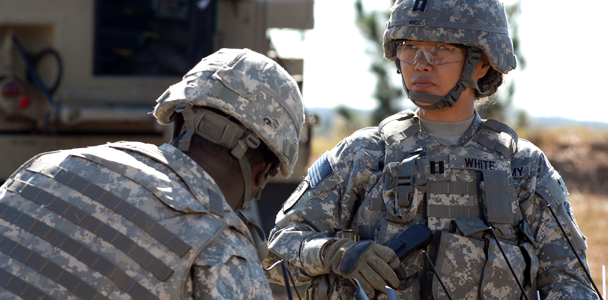
PVT (Join to see) Try this I hope it helps.
Multichannel Transmission Systems Operator-Maintainer
Careers & Jobs
Multichannel Transmission Systems Operator-Maintainer (25Q)
Overview
A multichannel transmission systems operator-maintainer works directly on equipment that communicates through more than one channel. They are responsible for the maintenance check of these devices, antennas and associated equipment.
Job Duties
•Maintenance on assigned equipment, vehicles, security devices and power generators
•Analyze BIT/BITE diagnostics to isolate faults in the Line Replaceable Units
Requirements
Those who want to serve must first take the Armed Services Vocational Aptitude Battery, a series of tests that helps you better understand your strengths and identify which Army jobs are best for you.
Training
Job training for a multichannel transmission systems operator-maintainer requires 10 weeks of Basic Combat Training and 15 weeks of Advanced Individual Training with on-the-job instruction. Part of this time is spent in the classroom and in the field.
Some of the skills you’ll learn are:
•Operating multi-channel transmission equipment and diagnostic equipment
•Performing maintenance on associated transmission vehicles
•As your career continues, you will take more classes and training
Helpful Skills
•Interest in working with radios and transmissions
•Ability to apply electronic principles and concepts
•Enjoys working on electronics and fiber optics
•Good at solving problems
Required ASVAB Score(s)
Electronics (EL) : 98, Surveillance & Communications (SC) : 98
Learn more about the ASVAB and see what jobs you could qualify for.
Compensation
Total compensation includes housing, medical, food, special pay, and vacation time. Learn more about total compensation.
Education Benefits
In the Army, qualified students can earn full-tuition, merit-based scholarships, allowances for books and fees, plus an annual stipend for living expenses. Learn more about education benefits.
Future Civilian Careers
The skills you learn will help prepare you for a career with companies that produce communications and electronic equipment.
PARTNERSHIP FOR YOUTH SUCCESS (PaYS) Program
Those interested in this job may be eligible for civilian employment, after the Army, by enrolling in the Army PaYS program. The PaYS program is a recruitment option that guarantees a job interview with military friendly employers that are looking for experience and trained Veterans to join their organization. Find out more about the Army PaYS Program at http://www.armypays.com.
•AAI CORPORATION
•EATON CORPORATION
•L-3 Communications Linguist Operations & Technical Support
•Comcast Cable Communications, Inc
•CISCO SYSTEMS
•CDW, LLC
•CoxCom, Inc.
•T-Mobile
Related Jobs
Cable Systems Installer-Maintainer (25L)
Cable systems installer-maintainers are primarily responsible for the maintenance of cable/wire communications systems, communication security devices and other associated equipment. This equipment needs to consistently work in order for the Army to direct the movement of its troops
Microwave Systems Operator-Maintainer (25P)
Microwave systems installer-maintainers are primarily responsible for installing, operating and maintaining microwave communications systems. They also work with associated antennas, multiplexing and communications security equipment.
Network Switching Systems Operator-Maintainer (25F)
Network switching systems operator-maintainer performs maintenance on electronic switches, control centers, combat radios and other equipment associated with networks. They also use computers to troubleshoot the system when errors occur.
Radio Operator-Maintainer (25C)
Radio operator-maintainers are responsible for the maintenance of radio communication equipment. This equipment needs to consistently work in order for the Army to direct the movement of its troops.
Satellite Communication Systems Operator-Maintainer (25S)
Satellite communication systems operator-maintainers are responsible for making sure that the lines of communication are always up and running. They maintain the multichannel satellite communications for the entire Army.
Signal Support Systems Specialist (25U)
Signal support systems specialists are primarily responsible for working with battlefield signal support systems and terminal devices. This equipment needs to consistently work in order for the Army to direct the movement of its troops.
This was found on goarmy.com
Multichannel Transmission Systems Operator-Maintainer
Careers & Jobs
Multichannel Transmission Systems Operator-Maintainer (25Q)
Overview
A multichannel transmission systems operator-maintainer works directly on equipment that communicates through more than one channel. They are responsible for the maintenance check of these devices, antennas and associated equipment.
Job Duties
•Maintenance on assigned equipment, vehicles, security devices and power generators
•Analyze BIT/BITE diagnostics to isolate faults in the Line Replaceable Units
Requirements
Those who want to serve must first take the Armed Services Vocational Aptitude Battery, a series of tests that helps you better understand your strengths and identify which Army jobs are best for you.
Training
Job training for a multichannel transmission systems operator-maintainer requires 10 weeks of Basic Combat Training and 15 weeks of Advanced Individual Training with on-the-job instruction. Part of this time is spent in the classroom and in the field.
Some of the skills you’ll learn are:
•Operating multi-channel transmission equipment and diagnostic equipment
•Performing maintenance on associated transmission vehicles
•As your career continues, you will take more classes and training
Helpful Skills
•Interest in working with radios and transmissions
•Ability to apply electronic principles and concepts
•Enjoys working on electronics and fiber optics
•Good at solving problems
Required ASVAB Score(s)
Electronics (EL) : 98, Surveillance & Communications (SC) : 98
Learn more about the ASVAB and see what jobs you could qualify for.
Compensation
Total compensation includes housing, medical, food, special pay, and vacation time. Learn more about total compensation.
Education Benefits
In the Army, qualified students can earn full-tuition, merit-based scholarships, allowances for books and fees, plus an annual stipend for living expenses. Learn more about education benefits.
Future Civilian Careers
The skills you learn will help prepare you for a career with companies that produce communications and electronic equipment.
PARTNERSHIP FOR YOUTH SUCCESS (PaYS) Program
Those interested in this job may be eligible for civilian employment, after the Army, by enrolling in the Army PaYS program. The PaYS program is a recruitment option that guarantees a job interview with military friendly employers that are looking for experience and trained Veterans to join their organization. Find out more about the Army PaYS Program at http://www.armypays.com.
•AAI CORPORATION
•EATON CORPORATION
•L-3 Communications Linguist Operations & Technical Support
•Comcast Cable Communications, Inc
•CISCO SYSTEMS
•CDW, LLC
•CoxCom, Inc.
•T-Mobile
Related Jobs
Cable Systems Installer-Maintainer (25L)
Cable systems installer-maintainers are primarily responsible for the maintenance of cable/wire communications systems, communication security devices and other associated equipment. This equipment needs to consistently work in order for the Army to direct the movement of its troops
Microwave Systems Operator-Maintainer (25P)
Microwave systems installer-maintainers are primarily responsible for installing, operating and maintaining microwave communications systems. They also work with associated antennas, multiplexing and communications security equipment.
Network Switching Systems Operator-Maintainer (25F)
Network switching systems operator-maintainer performs maintenance on electronic switches, control centers, combat radios and other equipment associated with networks. They also use computers to troubleshoot the system when errors occur.
Radio Operator-Maintainer (25C)
Radio operator-maintainers are responsible for the maintenance of radio communication equipment. This equipment needs to consistently work in order for the Army to direct the movement of its troops.
Satellite Communication Systems Operator-Maintainer (25S)
Satellite communication systems operator-maintainers are responsible for making sure that the lines of communication are always up and running. They maintain the multichannel satellite communications for the entire Army.
Signal Support Systems Specialist (25U)
Signal support systems specialists are primarily responsible for working with battlefield signal support systems and terminal devices. This equipment needs to consistently work in order for the Army to direct the movement of its troops.
This was found on goarmy.com
(0)
(0)
Read This Next


 Continue with Facebook
 Continue with Google