

Recalling a life event that occured 50 years ago using a word closely resembling what occured, is it a lie if you didnt know the difference?

WASHINGTON, Nov 6 (Reuters) - Republican presidential candidate Ben Carson's recollection of being offered a scholarship to the prestigious U.S. Military Academy at West Point was questioned on Friday, potentially damaging the credibility of the 64-year-old retired neurosurgeon.
Also on Friday, Carson's account of how he attempted to stab a friend in his troubled youth came under renewed scrutiny.
Carson, a favorite of conservative activists, who is tied with Donald Trump at the top of Republican primary polls a year before the November 2016 presidential election, has often recounted both tales from his 1990 autobiography on the campaign trail, as he trumpets his rise from poverty in inner-city Detroit to the highest echelons of medicine.
On Friday, Carson's campaign said he never sought admission to West Point, while Carson himself gave a slightly different account of the stabbing incident, describing the boy he lunged at as a close relative instead of a friend.
"These are little things that get at his credibility," said John Feehery, a Republican strategist who is not working for any of the 2016 presidential candidates. "He's coming in there as an outsider who is honest and a breath of fresh air. If his whole life story is undermined by these little inaccuracies it could have a negative effect."
Carson told Fox News his account of the West Point scholarship offer "could have been more clarified." He is planning to participate in a live interview on Sunday morning on CBS's "Face The Nation," where he will likely face tough questions.
"Voters care about candidate integrity," said Laura Stoker, a political science professor at the University of California, Berkeley. "But people - especially those who already favor Carson - will resist allegations until information is definitive."
Carson's supporters seemed unperturbed, and doubted whether the candidate had been inaccurate.
"If I had a general come up to me when I was 17 years old and try to convince me to go to West Point and he told me my expenses would be paid, I don't think it would be so far-fetched to think he offered me a scholarship," said Warren Galkin, 86, of Warwick, Rhode Island, who has given money to a political action committee supporting Carson's campaign.
WEST POINT SCHOLARSHIP
In his autobiography, "Gifted Hands," Carson wrote that as a high school student he dined with General William Westmoreland in 1969. "Later I was offered a full scholarship to West Point," he wrote, saying that he turned it down. "As overjoyed as I felt to be offered such a scholarship, I wasn't really tempted."
Carson's campaign said on Friday that his grades and conversations with officials of the ROTC, which provides preliminary military training for students interested in becoming officers, constituted a de facto acceptance to the academy, which provides full scholarships to all of its students. But it said Carson never actually applied or was admitted to West Point.
"His Senior Commander was in touch with West Point and told Dr. Carson he could get in, Dr. Carson did not seek admission," Carson's campaign spokesman Doug Watts told Reuters in an email.
"Dr. Carson, as the leading ROTC student in Detroit, was told by his Commanders that he could get an Appointment to the Academy," Watts said. "He never said he was admitted or even applied."
West Point on Friday said there was no record of Carson completing an application for admission. It is possible someone nominated him for the academy, but that would only have been an early step in the multi-part process of admission.
"Candidate files where admission/acceptance was not sought are retained for three years; therefore we cannot confirm whether anyone during that time period was nominated to West Point if they chose not to pursue completion of the application process," West Point spokeswoman Theresa Brinkerhoff said in an email to Reuters.
"No one can enter the academy without completing the entire admission process," she added.
The differing accounts of Carson's West Point scholarship were first reported by political news website Politico, in a story headlined "Ben Carson admits fabricating West Point scholarship."
Carson's campaign contested that interpretation.
"The Politico story is an outright lie," Watts said in an email to Reuters. "The campaign never 'admitted to anything.'"
CARSON HITS BACK
The fracas over West Point came only hours after Carson attacked the media for questioning his accounts of a violent past.
"This is a bunch of lies," Carson told CNN on Friday. "This is what it is, it's a bunch of lies attempting, you know, to say that I'm lying about my history. I think it's pathetic."
Carson, who is popular with evangelical voters, often speaks on the campaign trail about flashes of violence during his youth, casting the lessons he learned from that period as evidence he has the strength of character to be president.
In his autobiography, the renowned brain surgeon wrote that as a teen, he tried to stab a friend named Bob in the stomach with a knife, but the boy's belt buckle blocked the knife.
On Thursday on the campaign trail, when pressed by reporters about the incident and also in an interview with Fox News, Carson said that Bob's name, along with some other names in the autobiography, were pseudonyms that he used to protect the privacy of the people he was writing about.
He described Bob in the book as a friend and classmate. In the Fox News interview and on CNN, Carson said the boy was a "close relative."
 Politics
 ROTC
ROTC United States Military Academy (USMA West Point)


Ms. Clinton has as much RIGHT to run for office as you do (assuming that you are 35 years old or older, are a natural born citizen of the United States of America, and have lived in the United States of America for fourteen years.
[ASIDE - Charles Manson has the same "constitutional right" to run for the office of President of the United States of America as do you and Ms. Clinton - in fact, getting elected and pardoning himself is probably the only way that he is ever going to get out of jail while still alive.]
If the only difference between Ms. Clinton and you is that you "would never do anything like that" is that she "was handed everything is life" then that is the same difference that you have from George W Bush, George HW Bush, John F Kennedy, Franklin D Roosevelt, Calvin Coolidge, William H Taft, Theodore Roosevelt, Benjamin Harrison, James Buchanan, Franklin Pierce, Zachary Taylor, James K Polk, John Tyler, William H Harrison, John Q Adams, James Monroe, James Madison, Thomas Jefferson, John Adams, and George Washington (bearing in mind that "everything" was a lot less the further back in time you go).
No, the fact that you would have been in the brig and Ms. Clinton would not have been simply means that you would not have had the financial resources to prove that you had not committed a "crime". If you had had the same financial resources as Ms. Clinton has you would NOT have been in the brig.
As Ms. Clinton has NOT been convicted of a crime then she is NOT a "criminal" - according to law. BTW, there is no "constitutional bar" to someone who has a criminal conviction from running for the office of President.
http://www.thesmokinggun.com/documents/celebrity/george-w-bush-dui-arrest-record
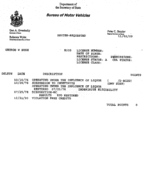
George W. Bush DUI Arrest Record
This is the 1976 Maine police document recording the arrest of George W. Bush for driving under the influence of alcohol. Bush, who was 30 at the time,was popped over the Labor Day weekend near his fa
I won't comment on whether or not it was inappropriate to go after Mr. Nixon for the crimes that the slimy little weasel committed (or authorized) but I do note that it was rather important to him that he receive a Presidential Pardon even though he had not actually been charged with any criminal offences.
-Sgt Howard
I did say that if you were accused of doing what she is accused of doing you would be convicted (mainly because you don't have enough money to mount the type of defence she could).
Please consult the National Registry of Exonerations to see a listing of the people who have been cleared after being convicted. They couldn't afford the same type of defence that Ms. Clinton could have mounted either.
You might also want to consider that the number could well have been higher except that the courts have consistently ruled that new evidence cannot be presented afte someone has already been executed - no matter how compelling that evidence is - due to the fact that admitting that the state had executed an innocent person would harm the legal/judicial system (and [EDITORIAL ADDITION] potentially open both up to humongous law suits).
https://en.wikipedia.org/wiki/National_Registry_of_Exonerations

National Registry of Exonerations - Wikipedia, the free encyclopedia
The National Registry of Exonerations is a project of the University of Michigan Law School that was co-founded in 2012 with the Center on Wrongful Convictions at Northwestern University School of Law to provide detailed information about known exonerations in the United States since 1989. There are presently 1,584 cases listed on the registry.[1] An additional 1,170 other cases were identified but are not included in the count because these...

Ben Carson has stood by his claim about turning down the opportunity to attend West Point. Some say he lied about the facts; others say it is understandable that a then-17 year old might have not fully understood the circumstances or that it is understandable that decades later things as he remembered them may not have actually happened.
If you read the Bateman piece I've attached and still believe Carson to be a paragon of honesty, then I'd suggest that you try to understand this discussion by applying West Point's honor code. Carson seems to think he had what it takes to go to West Point; if the controversies surrounding his dubious statements offer any indication, it seems likely hat had Carson actually attended West Point, he would probably have been kicked out for honor violations. Bateman does a grand job of explaining Carson's dishonest tendencies. Let's look at this from a West Point honor code perspective.
The honor code states "A cadet will not lie, cheat, or steal nor tolerate those who do." Fairly straight-forward---lying, cheating, stealing, all unacceptable. Carson wrote, many times, and continues to assert that a specific event happened at a specific time, ie, that Westmoreland offered him a full ride scholarship to West Point one day in Detroit. History shows that Westmoreland was not in Detroit on the day Carson claims. U.S. Law shows that the process to get into West Point doesn't involve a general making such an offer. As Bateman discussed, it is much more complicated than that. So, on the face of it, Carson lied. A lie is a non-truth. This is pretty black and white. But many have suggested that intent matters. So let's look at intent.
West Point helpfully has a guide to help cadets determine if an action violates the honor code; the guide is called the three rules of thumb. Here it is:
Does this action attempt to deceive anyone or allow anyone to be deceived?
Does this action gain or allow the gain of a privilege or advantage to which I or someone else would not otherwise be entitled?
Would I be satisfied by the outcome if I were on the receiving end of this action?
For the first question, Carson voluntarily used this West Point scholarship story in his memoir, written in 1990 and used to propel him to fame and money over the last three decades. While his statements might not intentionally directly deceive anyone, they do allow others to be deceived, as readers could easily be led to believe that Carson had actually applied and been accepted and nominated to West Point, based in his statements alone, and his continued support of those statements.
For the second question, clearly this action allowed Carson to gain privilege or advantage. It helped him sell books, which made him a lot of money. It forms part of his rags-to-riches story. Only those actually nominated to and accepted by West Point are entitled the privilege of saying so.
The third question is a bit harder, but again Carson fails. I'm sure he'd take offense if someone claimed to be a magical neurosurgeon from Yale without actual pay being one.
So, by this West Point test, Carson lied.
Why does this matter? He is running for President! Framed by Carson's other apparent lies or mis-truths as explained by him over the years in the telling of his personal story (which is what he's been doing for the better part of three decades, nothing but telling his personal story), the West Point lie suggests Carson has an uneasy relationship with the truth. Combine this with his uneasy relationship with basic science and fact (no, the pyramids weren't granaries! No, tithing historically isn't what Carson thinks it was!), and Carson appears to be worryingly disconnected from reality.
Now, a great deal of comments on this thread make the argument that Carson's lie about West Point pales in comparison to alleged Hilary Clinton lies about her emails or other issues. To me, this misses the point. Clinton's actions deserve scrutiny.......on their own terms. Is it ok for Carson to lie just because Clinton may have? Shouldn't we hold both of them accountable?
Lots of comments about the left and the liberal media using Carson's West Point lie as an opportunity to write hit pieces on him. Guess what? This is what the media does--it helps vet candidates. It's not just the media that are taking shots at Carson on this---GOP darling Trump is hitting hard, as well. And to suggest that Carson is being unfairly targetted is nonsense. The media has done a fabulous job through the years of pursuing both liberals and conservatives (think Bill Clinton; John Edwards; and the dozens of other Democrats and Republicans whose indiscretions have been uncovered and reported by the press). Also---the vetting of Carson is just getting started. The longer he stays in the race, the more we will learn about him. If his past week is any indication, we will be seeing a lot more of a defensive Carson explaining how what he said or claims to have done wasn't a lie.
https://en.m.wikipedia.org/wiki/List_of_United_States_Military_Academy_alumni
That's a list of distinguished West Point graduates. Carson claiming to have turned down attending Weat Point is a self-aggrandize get attempt to place himself among this group.
Maybe it's just men of a certain age that have an issue with the truth---best I can tell, had Carson gone to Weat Point and graduated, he would have been classmates with convicted felon and liar David Patreaus, Class of 1974.
Final comment----none of this will have an impact on the GOP primary process. The GOP nomination is largely determined by moderate Republicans in blue states, not by the GOP primary voters in Iowa, and not by leaders in national polls this early in the process. Carson doesn't offer moderate Republicans much; they are much more likely to support Rubio or Kasich. However, if Carson does end up somehow winning the Republican nomination, his penchant for not telling the truth will be a factor in the general election. The future Democratic nominee would be oh-so-happy for Carson to win the GOP nomination. Simply, he is unelectable, only partially because he seems unable to distinguish fact from fiction in his personal life.
Ben Carson Debunked: Inside His Made-Up West Point Story
He claimed time and again—as recently as last Friday–that he was offered entrance to the military academy in 1969. Here's proof that he's not telling the truth.

What we should be discussing even more than the candidates themselves, are their positions on real issues. Neither Carson or Trump have any military experience, instead of hearing about how they went through ROTC or prep School, I'd like to know who they would appoint as Secretary of Defense and if they believe we should be spending more or less for Defense.


I guess that that means that you don't recall that I was (and continue to be) equally as dismissive of the use of the term "factually correct" statements when used by anyone to describe anything especially when coupled with the term "exaggeration for the sake of emphasis".
BOTH the article and Mr. Carson's book contain large amounts of "factually correct" statements which can only be described as "exaggeration for the sake of emphasis". In other words, they aren't quite "true" and most certainly are designed to create an impression that an unembroidered and truthful statement would not.
Sgt James Howard - Sergeant; When you "look into" the statements you will have to look under several layers of hype, self-created memories, and self-aggrandizement before you actually get to the kernel that is "the truth". I have less of a problem with someone who is actively lying than with someone who believes their own lies (which means that, technically, they aren't actually lying because they are telling what they BELIEVE to be "the truth").
For example, I don't think that President Bush "lied" about Iraq - because I think that he actually believed what he was saying (the fact that what he believed is what he wanted to believe doesn't really enter into the picture). This isn't, of course, the same thing as "telling the truth".


 Continue with Facebook
 Continue with Google