

12
12
0
<p>I was asked a very interesting question by a civilian, due to today's holiday: What is a veteran? Is it somebody that was "just" in the military, or someone that actually deployed?"</p><p> </p><p>While there are various legal standards that define the word "veteran" in specific terms, I could see where the confusion lies. Is a veteran anyone to have ever worn the uniform? Must you be a combat veteran to receive benefits?</p><p> </p><p>While various regulations and laws spell this out, I'd like to know - what do YOU consider to be a veteran, especially in the context of Veteran's Day?</p>
 Deployment
 Holidays
 History (Major)
Posted 12 y ago
Responses: 50

2
2
0

To go on the logic that a person who served in the military is not a veteran unless they served in combat is absurd. I served from 1982 - 1992, during this time we had a 100 hour war in Iraq, a little skirmish in Grenada and a little bigger skirmish in Panama. I deployed to Sudan and Honduras in support of other efforts. During my time in the military we waged a different "war". It was a war of bluff and counter bluff with the former Soviet Union. They blinked, we won and down came the Berlin wall and the Soviet Union ceased to exist as we knew it. Does my experience make me any less worthy of being called a veteran...I think not. I truly applaud the sacrifices made by those who have served in combat and feel they deserve a status beyond what I have earned, but I am a veteran non the less. I signed my name on the line and agreed to go where my country needed me with no questions or hesitation, and I would do it all over again today if I could.<br>
(2)
(0)
SGT (Join to see)
That's how I feel. I was in from 95-00, and while I "deployed" to Bosnia, it was long after the fighting was over. Had more been going on during my five years, I would have had more experience, perhaps even combat.
I definitely give a little extra respect for those who were in combat, but I don't hold anyone's "Veteran-ness" against those that weren't. I and many many others like me signed on that line to give whatever was asked of us. I just wasn't asked to give very much.
I definitely give a little extra respect for those who were in combat, but I don't hold anyone's "Veteran-ness" against those that weren't. I and many many others like me signed on that line to give whatever was asked of us. I just wasn't asked to give very much.
(0)
(0)
2
2
0

So if I was within 100 meters of an exploding mortar or was in the chow hall when it was mortared, but never "left the wire", I'm not considered a Combat Veteran?
(2)
(0)
SSG Lisa Rendina
SPC Kumar,
That was a very well thought-out response, but I see no reason to down vote. Yes, Congress and the VA will differ, however, this would mean that anyone who has served after WWII has not served during a time of war as Congress has not declared war since the US became involved in WWII. The argument most commonly referencing whether or not a person is a Combat Vet has to do with did a person deploy to a conflict area, did they remain on the base the entire time, or did they leave the wire. Many combat arms Soldiers will argue that if a person never left the wire (a Fobbit) then perhaps they are not qualified as a Combat Veteran. Many will also argue that a person who deployed and was a Fobbit is still more of a Veteran than a person who never deployed, but maybe not as much as someone who spent most of their time outside the wire.
My response was to a poster who insinuated that if a person deployed but never left the wire to risk engagement through direct fire, that person is not a Combat Veteran.
(2)
(0)
SSG Lisa Rendina
CPL Fittizi,
Yes, yours was the post I was referring to. The Army gives a CAB (Combat Action Badge) to non-Infantry Soldiers. But, like with any other award someone must put you in for it. Oh well. Just my .02 cents, but I (and many of those stationed on the same base) may never have received direct fire, but we were targeted daily with indirect. We all have different jobs, roles, functions, and thus assignments. I am proud to have served either way.
(2)
(0)
2
2
0
During the NAM war, there were those whom went in country (Combat), and their were those whom never went in country. Due to the given circumstances of that time. Both were entitled to certain benefits that make those whom were not in country to the same. This was because of all the trauma that was going on not only here in the USA but in NAM as well. Yet the VA calls then Veterans. I on the other hand am a Post Vietnam Vet, but I'm not entitled to those same benefits Like PTSD. I did have the exact same VA benefits as those during NAM but I don't qualify for PTSD. To the VA I'm considered a Veteran because I served. Now here is another, to qualify for membership of the Veterans of foreign wars you must have served combat or a conflict. While the Korean War is still on, it is still a combat zone even though their is currently no fighting. I served a tour in Korea and was a member of the Veterans of foreign wars. This is a question that sometimes still makes me think at time. So I guess the answer with my response.
(2)
(0)
SSG Laureano Pabon
Perhaps I misstated something, the topic was not VA benefits, rather what is a Veteran. The comments I put were all different situations to what a veteran back in 1976 was considered. But that was then and this is now. I too was asked the same question, and the one that answered it had no knowledge of the military. I am a cold war veteran, but I'm also an Army non combat Veteran. So to conclude the Nam Part, since I saw how badly these Veterans were treated, I for one learned a great deal not just knowing the few, but working with the many. But the combat Veterans and soldiers that are serving from the Iraq war on forward, you showed all the people in the civilian sector, something new. To appreciate, the soldiers whom are serving and those that served. So to me every one that served time pass Basic, AIT and earned the title to be called a soldier, when you ETS or retire, you will be called a Veteran
(2)
(0)
1
1
0

1
1
0

Pure rubbish from whomever stated that ridiculous requirement to be a "veteran." If you served your country honorably during your term of service, then you're a veteran. Doesn't matter if you were in combat, wounded, sat at a desk, cooked food, dug trenches, painted and chipped, etc. The military is a team, and if that team is to accomplish its goals, then all have to pull together to do that.
(1)
(0)
1
1
0

If you served you're a veteran. If you served and were deployed to a hostile fire zone, you're a combat zone veteran. If in that hostile fire zone you actively engaged in combat you're a combat veteran.
At least that is how I personally see it, and the VA makes such distinctions as well.
At least that is how I personally see it, and the VA makes such distinctions as well.
(1)
(0)
1
1
0

Anyone who was honorably discharged for their service they signed up for.
(1)
(0)
1
1
0
I feel that anyone who put on the uniform is a veteran even if not in a conflict. But i also feel that the person who was only in for a week or month the was put out on a etoh or other medical should not be classed as a veteran or get the right of a veteran. as far as the NG/RES. type units they should be given the same rights and respect as someone from AD. We all sign the line for what ever reason but in a whole it is to support this country and what we all stand for in the whole picture. so why do we not hold the president to the same thing,(serve first then and we should only let a veteran be able to become our commander and chief .
(1)
(0)
1
1
0

Anyone who put on the uniform. Regardless they signed to join and they knew there is a probability of going to war. Just because they did not deploy does not take away from their service, so as long as they completed their enlistment or tour, or were honorably discharged then they are a Veteran to me.
I say this because my father served one enlistment from 1980-1984 as an Infantrymen in the Army. He did not deploy but he was ready if he was needed to deploy. Every time I have ever thanked him for his service he tells me that he didn't really serve because he didn't go to war like me, he then thanks me. I have to remind him that he signed up and was ready to leave for war if needed - so he is a Veteran.
I say this because my father served one enlistment from 1980-1984 as an Infantrymen in the Army. He did not deploy but he was ready if he was needed to deploy. Every time I have ever thanked him for his service he tells me that he didn't really serve because he didn't go to war like me, he then thanks me. I have to remind him that he signed up and was ready to leave for war if needed - so he is a Veteran.
(1)
(0)
1
1
0

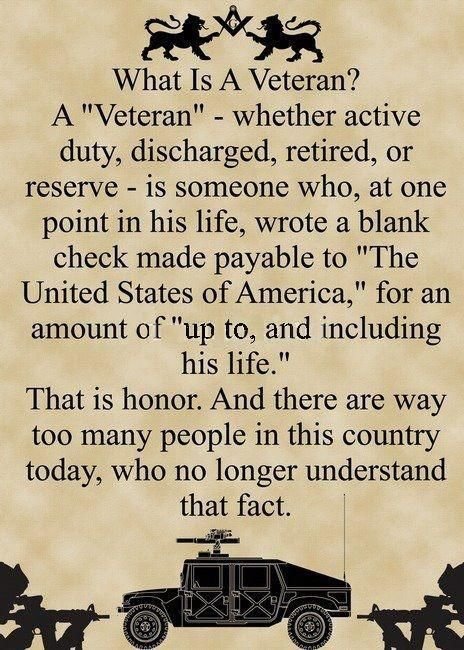
Someone who at one point signed a check in the amount of "up to and including my life"
(1)
(0)
Read This Next


 Continue with Facebook
 Continue with Google