
Posted on Sep 3, 2015

What is the difference between a Specialist and a Corporal in the Army? Inquiring Marine minds want to know.

252K
994
500
51
51
0
 CPL
CPL SPC
SPC Rank
Rank
Responses: 252
1
1
0

1
1
0

1
1
0

Ok here is the history lesson...kinda long (and I apologize for the earlier attempt at meme humor since most of them didn't even post properly and were cropped to a point of being unable to read). I'm breaking this up into sections and will post each portion of the info into the following comments. Hope this helps! Enjoy!!
From 1920 to 1942, there was a rank designated "private/specialist" (or simply, "specialist") that was graded in six classes (the lowest being sixth class and the highest being first class). They were considered the equal of a private first class (PFC), but drew additional specialist pay in relationship to the specialist level possessed on top of their base PFC (grade six) pay. The classes only indicated experience, not seniority, and a private/specialist did not outrank a PFC.
Officially, specialists wore the single chevron of a PFC, because no special insignia was authorized to indicate their rank. Unofficially, a private/ specialist could be authorized, at his commander's discretion, to wear one to six additional rockers (one rocker for sixth class, and a maximum of six rockers for first class) under their rank chevron to denote specialty level.
From 1920 to 1942, there was a rank designated "private/specialist" (or simply, "specialist") that was graded in six classes (the lowest being sixth class and the highest being first class). They were considered the equal of a private first class (PFC), but drew additional specialist pay in relationship to the specialist level possessed on top of their base PFC (grade six) pay. The classes only indicated experience, not seniority, and a private/specialist did not outrank a PFC.
Officially, specialists wore the single chevron of a PFC, because no special insignia was authorized to indicate their rank. Unofficially, a private/ specialist could be authorized, at his commander's discretion, to wear one to six additional rockers (one rocker for sixth class, and a maximum of six rockers for first class) under their rank chevron to denote specialty level.
(1)
(0)
PFC Aaron Knapp
On 8 January 1942, the rank of technician was introduced to replace the private/specialist rank, which was discontinued by 30 June 1942. This gave technical specialists more authority by grading them as non-commissioned officers rather than senior enlisted personnel. They were parallel to pay grades of the time, going in seniority from technician fifth grade, technician fourth grade, and technician third grade. A technician was paid according to his grade, was outranked by the corresponding non-commissioned officer grade but was senior to the next lowest pay grade, and had no direct supervisory authority outside of his specialty. To reduce the confusion this caused in the field, an embroidered “T” insignia was authorized for wear under the chevrons on 4 September 1942. The rank was finally discontinued on 1 August 1948.
(0)
(0)
PFC Aaron Knapp
On 1 July 1955, four grades of specialist were established: specialist three (E-4), specialist two (E-5), specialist one (E-6), and master specialist (E-7). In 1958 the DoD added two additional pay grades to give enlisted soldiers more opportunities to progress to a full career with additional opportunities for promotion. Thus the recognition was changed to six specialist ranks, and the pay grade was tied into the rank designation: specialist four (E-4), specialist five (E-5), specialist six (E-6), specialist seven (E-7), specialist eight (E-8) and specialist nine (E-9).[3] CSM Daniel K. Elder goes on to explain, "In 1968 when the Army added the rank of command sergeant major, the specialist ranks at E-8 and E-9 were abolished",because they were notional rather than actual. "In 1978 the specialist rank at E-7 was discontinued and in 1985, the specialist ranks at E-5 and E-6 were discontinued."
These specialist ranks were created to reward personnel with higher degrees of experience and technical knowledge. Appointment to either specialist or non-commissioned officer status was determined by military occupational specialty. Different military occupational specialties had various transition points; for example, in the band career field (excluding special bands at D.C. and West Point) a bandsman could not achieve non-commissioned officer status until pay grade E-6 was attained. In some military occupational specialties, a soldier was appointed either a specialist or non-commissioned officer depending on which particular position or "slot" that he filled in his organization. A cook was a specialists, while a mess steward held the rank of sergeant (E-5 through E-7).
These specialist ranks were created to reward personnel with higher degrees of experience and technical knowledge. Appointment to either specialist or non-commissioned officer status was determined by military occupational specialty. Different military occupational specialties had various transition points; for example, in the band career field (excluding special bands at D.C. and West Point) a bandsman could not achieve non-commissioned officer status until pay grade E-6 was attained. In some military occupational specialties, a soldier was appointed either a specialist or non-commissioned officer depending on which particular position or "slot" that he filled in his organization. A cook was a specialists, while a mess steward held the rank of sergeant (E-5 through E-7).
(0)
(0)
PFC Aaron Knapp
Specialist grades paralleled the corresponding grades of non-commissioned officer (E-4 through E-7) only in terms of pay. The specialist grades, although they outranked the enlisted grades (E-1 to E-3), were outranked by all non-commissioned officers (E-4 to E-9) and lacked the authority conferred on them. This is the major differentiation between a specialist and a "hard striper".
When the so-called "super grades" (E-8 and E-9) were introduced in 1958, the specialist grade titles were changed to specialist four through specialist seven and the new grades specialist eight and specialist nine were added.
Only the lowest specialist grade survives today, as the higher grades were gradually phased out. Specialist 8 and specialist 9 were eliminated in 1968.[4] specialist 7 was abolished in 1978 and specialist 5 and specialist 6 in 1985. At that time, the rank of specialist 4 simply became known as "specialist," which is how it is referred to today. While the official abbreviation was changed from "SP4" to "SPC" upon the elimination of the SP5 and SP6 ranks, the SIDPERS database was initially authorized to continue using SP4 until such time as the change could be made at little or no additional expense in conjunction with other system upgrades.[5] The continued use of SP4 on automatically produced documents (transfer orders, leave and earnings statements, unit manning reports, inter alia), hampered the adoption of the new abbreviation (and, to a lesser extent, the absence of "-4" in the non-abbreviated rank) by individual soldiers who viewed the computer-produced documents as the final word on what the proper term was. While uncommon, SP4 is still used. One reason for the continuance of the use of the "4" is that some soldiers see the SPC as looking too similar to SFC, sergeant first class, and the "4" differentiates it better. Nevertheless, SPC is the Army's official abbreviation.[2]
Today, the rank of specialist is the typical rank to which privates first class are promoted after two years of service, although PFCs may be waived into the rank of specialist after 18 months' time in service and six months' time in grade. It is granted far more often than corporal (E-4), which is now reserved for personnel who have either passed the Warrior Leader Course or have been assigned low-level supervisory (with two or more soldiers under direct command).
When the so-called "super grades" (E-8 and E-9) were introduced in 1958, the specialist grade titles were changed to specialist four through specialist seven and the new grades specialist eight and specialist nine were added.
Only the lowest specialist grade survives today, as the higher grades were gradually phased out. Specialist 8 and specialist 9 were eliminated in 1968.[4] specialist 7 was abolished in 1978 and specialist 5 and specialist 6 in 1985. At that time, the rank of specialist 4 simply became known as "specialist," which is how it is referred to today. While the official abbreviation was changed from "SP4" to "SPC" upon the elimination of the SP5 and SP6 ranks, the SIDPERS database was initially authorized to continue using SP4 until such time as the change could be made at little or no additional expense in conjunction with other system upgrades.[5] The continued use of SP4 on automatically produced documents (transfer orders, leave and earnings statements, unit manning reports, inter alia), hampered the adoption of the new abbreviation (and, to a lesser extent, the absence of "-4" in the non-abbreviated rank) by individual soldiers who viewed the computer-produced documents as the final word on what the proper term was. While uncommon, SP4 is still used. One reason for the continuance of the use of the "4" is that some soldiers see the SPC as looking too similar to SFC, sergeant first class, and the "4" differentiates it better. Nevertheless, SPC is the Army's official abbreviation.[2]
Today, the rank of specialist is the typical rank to which privates first class are promoted after two years of service, although PFCs may be waived into the rank of specialist after 18 months' time in service and six months' time in grade. It is granted far more often than corporal (E-4), which is now reserved for personnel who have either passed the Warrior Leader Course or have been assigned low-level supervisory (with two or more soldiers under direct command).
(0)
(0)
PFC Aaron Knapp
so I obviously copy and pasted this info but it gives the history of the rank and how it can to be in its current form in the U.S. Army. There is a bunch more info on its use in the Navy and Marines but being as how I'm an Army Vet I will let those Vets get the information on their branches. But upon reading this I realized the rank was originally created for people with technical experience in a certain field, as I stated in one of my other posts, so I hope you found this information as informative as I did. Sorry if I cluttered the post up as that was not my intention. And again as for the crappily placed memes if I could figure a way to delete those posts from my phone I would. I will try later from my PC to do so. I hope this helps!
(0)
(0)
1
1
0

PFC Aaron Knapp


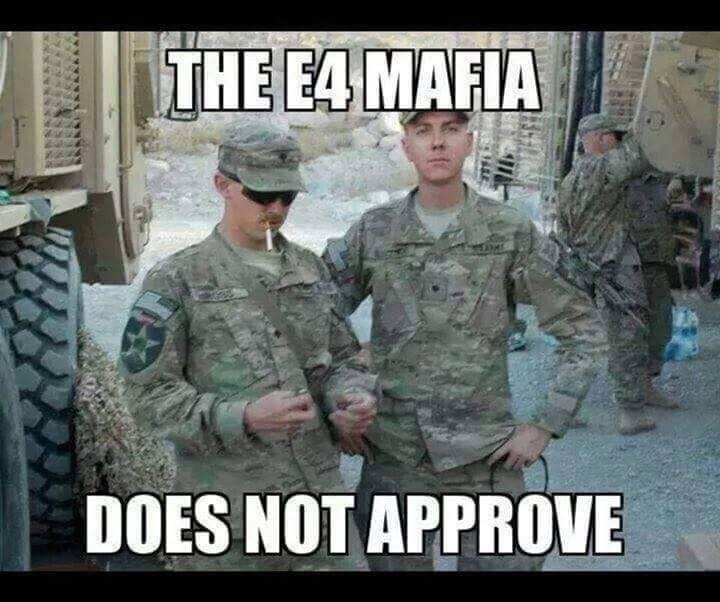
Last one...trying to keep these in my own comments and for some reason it's not letting me delete or edit them. Some reason the quality is transferring poorly and pics are being cropped off. That being said I'm sure most of us have seen these before.. Sorry if the humor was lost along the way. But as stated by others some Specialists were sham artists but many were future NCOs and made good use of the rank. I will say I never understood the Specialist/Corporal rank in the Army. Very few were awarded the Corporal rank and it seemed more of a hold over from WWII than anything. Same rank yet more responsibility? I always felt like the Spec 4 rank should have been more of a job related rank (like he is a Specialist in a field) and the Corporal rank as the Jr NCO he was being groomed to be but that's my take. I am going to research some history on the question and get back to this topic (and just like that I turned trying to be funny into informative and serious...I need to learn to Sham a conversation better lol)
(1)
(0)
1
1
0

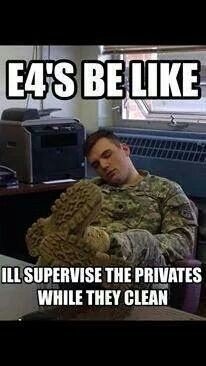
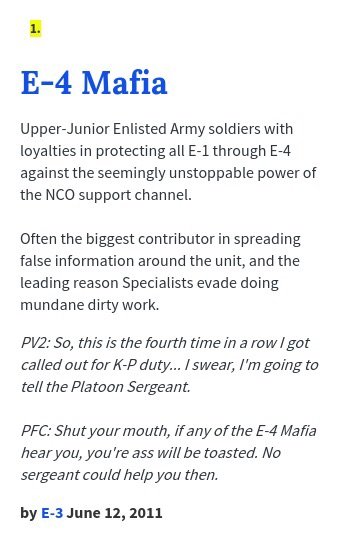
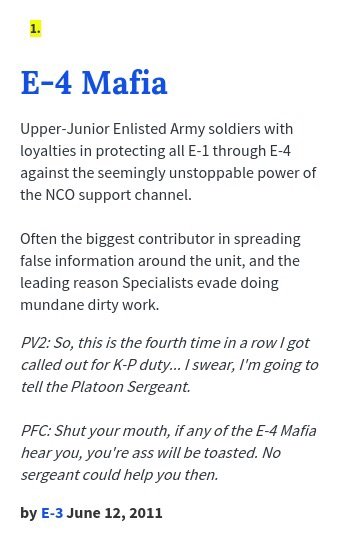
Ok I will now supply the Nemes that will explain everything...enjoy! (I do this for humor only, I usually keep my discussions serious, but for this question several Memes should answer the question and make you laugh...)
(1)
(0)
PFC Aaron Knapp
PFC Aaron Knapp - and it didn't.... http://www.urbandictionary.com/render_definition.php?defid=5882853
There is the link lol
There is the link lol
(0)
(0)
1
1
0
Both are pay grade E-4, however corporals are usually a combat arms position while Specialists are Medics, Supply etc....
(1)
(0)
1
1
0

Good question. As you probably already know, they're both E4s. The only difference is that the Corporal is an NCO while the Specialist is not. The Corporal will be evaluated as an NCO (NCOERs) where as the Specialist won't. The Corporal will (should) be placed in a position of higher leadership than that of a Specialist.
(1)
(0)
1
1
0

A Specialist is a new E4 (non NCO) who begins to learn the basics of leadership, as ina squad leader, e.g. The first big career move is to attend WLC (Warrior Leaders Course) in order to learn from seasoned NCOs. A Corporal is a junior NCO (and a more rare rank) for a soldier who has strong leadership skills and has stepped up his/her game and has shown leadership traits that go above and beyond a Specialist. If there isn't enough time in grader and/or time in service for consideration of promotion to E5, the rank of Corporal signifies the soldier merits the rank of Sergeant and is taking on responsibilities that he/she will be expected to use upon promotion.
(1)
(0)
1
1
0
In the early '70 I was in the ADA (Hawk) all E-4 & E-5s were Specialist. I've even seen Spec-6s & at least one Spec-7 cooks. Only Corporals were in the Signal Corp, a separate unit
(1)
(0)
1
1
0
Read This Next


 Continue with Facebook
 Continue with Google