
Posted on Nov 17, 2014

What is the most challenging position/ assignment you have ever had?

10.6K
33
21
4
4
0
This discussion is meant to share tough experiences with others.
For me, it is a tie. When I made Sgt., my first position was plt. sgt. of the chapter and medboard plt. It was rough beyond words, especially because I had no idea what I was doing. Thankfully, I had a ssg show me some ways to help get these Soldiers onto their next step in life.
My other one is my current assignment. I work in the ISAF Combined Joint Operations Center (CJOC) as a Public Affairs Officer. It is an O-3 billet and I can see why. I am responsible for monitoring all forms of social media as well as news sites for any news pertaining to Afghanistan. It ends up being a 25ish page report that goes out daily. I also respond to media queries and prepare numerous other daily reports. It is a mentally draining assignment, but I have learned a lot from it. The main thing I learned is there is a lot more going on in Afghanistan than I ever knew of.
For me, it is a tie. When I made Sgt., my first position was plt. sgt. of the chapter and medboard plt. It was rough beyond words, especially because I had no idea what I was doing. Thankfully, I had a ssg show me some ways to help get these Soldiers onto their next step in life.
My other one is my current assignment. I work in the ISAF Combined Joint Operations Center (CJOC) as a Public Affairs Officer. It is an O-3 billet and I can see why. I am responsible for monitoring all forms of social media as well as news sites for any news pertaining to Afghanistan. It ends up being a 25ish page report that goes out daily. I also respond to media queries and prepare numerous other daily reports. It is a mentally draining assignment, but I have learned a lot from it. The main thing I learned is there is a lot more going on in Afghanistan than I ever knew of.
Posted in these groups:  Assignments
Assignments
Posted 11 y ago
Responses: 14
0
0
0

My most challenging assignment was as a non-qual on my first boat. The main reason it was challenging is because qualifying Submarines IS hard, but it was made worse by my attitude, lol...
A little background for the attitude: I was prior service Army when I joined the Navy. Because of this, I had a "staff" position at bootcamp and was the class leader in Nuclear Field Machinist's Mate "A" school and was promoted to PO3 upon completion. I washed out of Nuclear Power School and went to Basic Enlisted Submarine School. Because I was prior-service AND a Petty Officer, I was class-leader. When I went to Torpedoman's Mate "C" School, same story. I was DEFINITELY a "Full Bird Third", lol. THEN I got to my first boat.
In the Submarine community, if you're not qualified, it doesn't matter if you're a Chief (E-7), your opinion is invalid, lol... "If you don't have your Dolphins, you ain't shit..." This is a phenomenon I was not aware of and when I got to my boat, I had E-1's or 2's trying to give me an order and I was like, "Um, I'm a Petty Officer in the United States Navy, better recognize..." Uh... If I could have only had a chat with myself back then, life could've been SO much easier for me, lol...
A little background for the attitude: I was prior service Army when I joined the Navy. Because of this, I had a "staff" position at bootcamp and was the class leader in Nuclear Field Machinist's Mate "A" school and was promoted to PO3 upon completion. I washed out of Nuclear Power School and went to Basic Enlisted Submarine School. Because I was prior-service AND a Petty Officer, I was class-leader. When I went to Torpedoman's Mate "C" School, same story. I was DEFINITELY a "Full Bird Third", lol. THEN I got to my first boat.
In the Submarine community, if you're not qualified, it doesn't matter if you're a Chief (E-7), your opinion is invalid, lol... "If you don't have your Dolphins, you ain't shit..." This is a phenomenon I was not aware of and when I got to my boat, I had E-1's or 2's trying to give me an order and I was like, "Um, I'm a Petty Officer in the United States Navy, better recognize..." Uh... If I could have only had a chat with myself back then, life could've been SO much easier for me, lol...
(0)
(0)
PO3 (Join to see)
CPO Don Alfera Yes Chief, great memories, but I don't know if I could do it again, especially now... I also got my Golden Dragon (and Shellback and Order of Magellan in '98 and my Bluenose in '99 on a different boat). I got to see so many amazing sights around the world and I'll always be grateful for that (it made my history and anthropology degrees MUCH easier because I had BEEN to the places the Professors were talking about, lol).
(0)
(0)
0
0
0

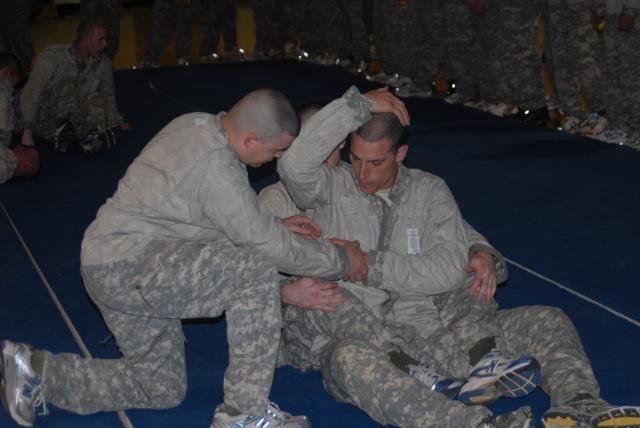
Drill Sergeant duty was the most challenging and rewarding position I have held thus far. I was fortunate to be surrounded by awesome Drill Sergeants as well as Command teams at all levels. I can't believe they still have the article up (not to toot my own horn) ;-) from when I was selected to represent Ft. Knox as the Drill Sergeant of the present. Below is the picture and article if you care to read it. (Bravo Company "Bonecrushers" 2-46 IN, 2007-2009).
FORT KNOX, Ky. -- Staff Sgt. Mark Gomez recently completed the Senior Leaders Course (formerly known as the Advanced NCO Course) at Fort Gordon, Ga. He finished as the honor graduate by maintaining a grade point average of 97 percent, in addition to passing his physical training and field training exercise with flying colors.
On top of those, he won the Distinguished Leadership award, which is something his classmates voted on.
Gomez is a drill sergeant in Company B, 2nd Battalion, 46th Infantry on Fort Knox, and he loves it.
"I can't think of anything else I'd rather be doing," Gomez said. "It's been a dream of mine ever since I was in basic; I love training new Soldiers."
With two tours to Iraq under his belt, Gomez is a qualified instructor and believes that experience helps him to train young Soldiers.
"(Soldiers in training) understand you know what you're talking about; they have more respect for you," he explained. "They know you functioned in combat situations, so they need to learn from you."
Gomez deployed with the 75th Field Artillery Brigade as well as the 555th Combat Engineer Brigade. He said the strongest NCO influence in his career came from a now-retired NCO .
"My last NCO at the 'Triple Nickel' taught me how to take care of Soldiers and train them while still taking care of myself and my career," Gomez said. "He taught me to balance Army life with civilian life."
The 27-year-old enlisted in the Army right out of high school, so he's been in nine years. The father of three children, Gomez said his wife is very supportive, even though being "on the trail" takes extra hours away from the family. She stays busy through the unit family readiness group, friends and their children.
In spite of the toll it takes on the family, Gomez is proud of his work.
"An NCO's job is rewarding; it's almost like being a teacher. You see (SITs) graduate and know how much you impacted them," he said. "They come in as civilians and walk across the stage as Soldiers. That is really rewarding."
He cites another example of an NCO's reward.
"One of my Soldiers from a combat tour in Iraq is now a coworker in the same company," Gomez said, "and he's also a drill (sergeant). I was his first NCO. I think I was a good influence."
No job, however, is without its drawbacks. If he could make one change in the NCO Corps, Gomez said, he would pump up the knowledge base.
"NCOs need more time to get together and go over NCO business to ensure everybody is training to standards," Gomez said. "Many NCOs today are very young; promotions come faster and perhaps some younger NCOs are in leadership jobs without the NCO knowledge they should have. Perhaps we just need some fine tuning of NCO knowledge."
That NCO knowledge, of course, is necessary to accomplish an NCO's most important job.
"The most important thing NCOs do is to take care of Soldiers and train them, set an example for them, be a good mentor, and show them what 'right' looks like," Gomez said.
According to Lt. Col. Matthew Coleman, the 2-46 Battalion commander, Gomez is a professional NCO who carries out his mission extremely well. "He is what 'right' looks like," Coleman said.
FORT KNOX, Ky. -- Staff Sgt. Mark Gomez recently completed the Senior Leaders Course (formerly known as the Advanced NCO Course) at Fort Gordon, Ga. He finished as the honor graduate by maintaining a grade point average of 97 percent, in addition to passing his physical training and field training exercise with flying colors.
On top of those, he won the Distinguished Leadership award, which is something his classmates voted on.
Gomez is a drill sergeant in Company B, 2nd Battalion, 46th Infantry on Fort Knox, and he loves it.
"I can't think of anything else I'd rather be doing," Gomez said. "It's been a dream of mine ever since I was in basic; I love training new Soldiers."
With two tours to Iraq under his belt, Gomez is a qualified instructor and believes that experience helps him to train young Soldiers.
"(Soldiers in training) understand you know what you're talking about; they have more respect for you," he explained. "They know you functioned in combat situations, so they need to learn from you."
Gomez deployed with the 75th Field Artillery Brigade as well as the 555th Combat Engineer Brigade. He said the strongest NCO influence in his career came from a now-retired NCO .
"My last NCO at the 'Triple Nickel' taught me how to take care of Soldiers and train them while still taking care of myself and my career," Gomez said. "He taught me to balance Army life with civilian life."
The 27-year-old enlisted in the Army right out of high school, so he's been in nine years. The father of three children, Gomez said his wife is very supportive, even though being "on the trail" takes extra hours away from the family. She stays busy through the unit family readiness group, friends and their children.
In spite of the toll it takes on the family, Gomez is proud of his work.
"An NCO's job is rewarding; it's almost like being a teacher. You see (SITs) graduate and know how much you impacted them," he said. "They come in as civilians and walk across the stage as Soldiers. That is really rewarding."
He cites another example of an NCO's reward.
"One of my Soldiers from a combat tour in Iraq is now a coworker in the same company," Gomez said, "and he's also a drill (sergeant). I was his first NCO. I think I was a good influence."
No job, however, is without its drawbacks. If he could make one change in the NCO Corps, Gomez said, he would pump up the knowledge base.
"NCOs need more time to get together and go over NCO business to ensure everybody is training to standards," Gomez said. "Many NCOs today are very young; promotions come faster and perhaps some younger NCOs are in leadership jobs without the NCO knowledge they should have. Perhaps we just need some fine tuning of NCO knowledge."
That NCO knowledge, of course, is necessary to accomplish an NCO's most important job.
"The most important thing NCOs do is to take care of Soldiers and train them, set an example for them, be a good mentor, and show them what 'right' looks like," Gomez said.
According to Lt. Col. Matthew Coleman, the 2-46 Battalion commander, Gomez is a professional NCO who carries out his mission extremely well. "He is what 'right' looks like," Coleman said.
(0)
(0)
0
0
0
Not sure about challenging, but being a Permissive Action Link (PAL) operator and Emergency Action Message (EAM) B Team member in a Pershing missile firing battery on QRA status in Germany during the late 70's & early 80's was the most stressful position I had. There was a time when an EAM message came down as a actual launch message and we started preparations for launch. Luckily, higher command came down with a correction. I'm sure it contributed to the start of my premature grey hair at age 22!
(0)
(0)
0
0
0

The most challenging position I held in 20 years was as the BN FDC Chief and BN Training NCOIC in my next to last unit. As the FDC Chief, I was responsible for 7 subordinates, 2 M577A2 tracks, 3 HMMWV, and all other equipment, including generators, radios, antennas, OVM/BII, etc, not to mention weapons and all the soldiers individual equipment and barracks rooms ready for inspection. The problem was that the job of training nco kept me in the S-3 office from 0430 to 1900 at least 5 days a week when not in the field. This made it really hard to supervise and train my soldiers. Luckily, I had a great SGT and some great soldiers working for me.
Now if the question would have said anything about the worst assign/posting, I would have said Recruiting. I was a recruiter for 3 years and it was absolutely the worst, most miserable 3 years of my life. As a recruiter, you have no control over anything, example; you find someone that wants to join, doesn't tell you about an injury and fails the physical, it is your fault. Or they pass the physical but tell someone at the MEPPS that they have a felony that they didn't tell you about, your fault, or they have no problems, pick an MOS, join, and swear in. They ship out to basic training in 3 months, during which time, they get a job and fall in love, this causes them to change their mind and they refuse to ship. You guessed it, your fault, and there is nothing you can do about it because by law, the only thing that you can do is tell them they don't have to go. Now if they go to the MEPPS and swear in the 2nd time, and then don't get on the bus, it's not your fault and they can get in trouble, but until that 2nd swearing in, they do not have to go.
The best assignment I had was my last, I was in an AC/RC unit, active component/reserve component. We trained and evaluated reserve and guard units and also worked with FEMA (Federal Emergency Management Agency) on the MSCA (Military Support to Civilian Authorities). Both of these jobs were educational, fun, and fulfilling.
Now if the question would have said anything about the worst assign/posting, I would have said Recruiting. I was a recruiter for 3 years and it was absolutely the worst, most miserable 3 years of my life. As a recruiter, you have no control over anything, example; you find someone that wants to join, doesn't tell you about an injury and fails the physical, it is your fault. Or they pass the physical but tell someone at the MEPPS that they have a felony that they didn't tell you about, your fault, or they have no problems, pick an MOS, join, and swear in. They ship out to basic training in 3 months, during which time, they get a job and fall in love, this causes them to change their mind and they refuse to ship. You guessed it, your fault, and there is nothing you can do about it because by law, the only thing that you can do is tell them they don't have to go. Now if they go to the MEPPS and swear in the 2nd time, and then don't get on the bus, it's not your fault and they can get in trouble, but until that 2nd swearing in, they do not have to go.
The best assignment I had was my last, I was in an AC/RC unit, active component/reserve component. We trained and evaluated reserve and guard units and also worked with FEMA (Federal Emergency Management Agency) on the MSCA (Military Support to Civilian Authorities). Both of these jobs were educational, fun, and fulfilling.
(0)
(0)
Read This Next


 Continue with Facebook
 Continue with Google