

1
1
0

Can you name this general?
Posted 10 y ago
Responses: 8

2
2
0
This is General Frank Andrews. General Andrews was a strong proponent of the B-17 Flying Fortress, which the ground generals were determined to not support. As late as 1940, ground generals tried to kill any 4 engine bomber purchases.
General Andrews took a position requiring strong moral courage. He spoke out about the short sitedness of the Army in trying to stick with tactical bombers. For this he was reduced back to his permanent rank and transferred to the same post General Mitchell was sent to – right before he was court martialed.
With the ascension of General Marshall to the Chief of Staff of the Army, General Andrews was called back to Washington where he played a vital role during the early part of the war. It was he who would have led the Invasion of Europe as Marshall’s protégé. Unfortunately he was killed in a plane crash in 1943.
Gen. Andrews was a native of Nashville, Tennessee.
General Andrews took a position requiring strong moral courage. He spoke out about the short sitedness of the Army in trying to stick with tactical bombers. For this he was reduced back to his permanent rank and transferred to the same post General Mitchell was sent to – right before he was court martialed.
With the ascension of General Marshall to the Chief of Staff of the Army, General Andrews was called back to Washington where he played a vital role during the early part of the war. It was he who would have led the Invasion of Europe as Marshall’s protégé. Unfortunately he was killed in a plane crash in 1943.
Gen. Andrews was a native of Nashville, Tennessee.
(2)
(0)
Capt Walter Miller
Had the Army ground generals got their way, the Army Air Corps would have resembled the Luftwaffe. And one of the strategic failures of the Germans that is often cited is their lack of a strategic bomber force.
Walt
Walt
(1)
(0)
Capt Walter Miller
Andrews was passed over for appointment as Chief of the Air Corps following the death of Maj. Gen. Oscar Westover in September 1938, partly because of his aggressive support for strategic bombing.[1] He became a trusted air adviser to George C. Marshall, newly appointed as deputy chief of staff of the Army in 1938, but Andrews pushed too hard for the taste of more senior authorities.
In January 1939, after president Franklin D. Roosevelt had publicly called for a large expansion of the Air Corps, Andrews described the United States as a "sixth-rate airpower" at a speech to the National Aeronautic Association, antagonizing isolationist Secretary of War Harry Woodring, who was then assuring the public of U.S. air strength. At the end of Andrews’ four-year term as Commanding General of GHQAF on March 1, he was not reappointed, reverted to his permanent rank of colonel, and was reassigned as air officer for the Eighth Corps Area in San Antonio, the same exile to which Billy Mitchell had been sent. Possibly expected to retire, he instead was recalled to Washington just four months later by Marshall after President Roosevelt named Marshall to serve as Chief of Staff following Craig's retirement. His first senior staff selection, Marshall's choice of Andrews and its permanent promotion to brigadier general prompted furious opposition from Woodring and others, over which Marshall prevailed after threatening to resign his new post. As Assistant Chief of Staff for Operations (G-3), he was in charge of readying the entire Army in the run-up to America’s inevitable involvement in the war.[2]
In January 1939, after president Franklin D. Roosevelt had publicly called for a large expansion of the Air Corps, Andrews described the United States as a "sixth-rate airpower" at a speech to the National Aeronautic Association, antagonizing isolationist Secretary of War Harry Woodring, who was then assuring the public of U.S. air strength. At the end of Andrews’ four-year term as Commanding General of GHQAF on March 1, he was not reappointed, reverted to his permanent rank of colonel, and was reassigned as air officer for the Eighth Corps Area in San Antonio, the same exile to which Billy Mitchell had been sent. Possibly expected to retire, he instead was recalled to Washington just four months later by Marshall after President Roosevelt named Marshall to serve as Chief of Staff following Craig's retirement. His first senior staff selection, Marshall's choice of Andrews and its permanent promotion to brigadier general prompted furious opposition from Woodring and others, over which Marshall prevailed after threatening to resign his new post. As Assistant Chief of Staff for Operations (G-3), he was in charge of readying the entire Army in the run-up to America’s inevitable involvement in the war.[2]
(1)
(0)
Capt Walter Miller
At the Casablanca Conference in January 1943, Lieut. Gen. Andrews was appointed commander of all United States forces in the European Theater of Operations, replacing Dwight D. Eisenhower. In his memoirs, Gen. Henry H. Arnold, commander of the Army Air Forces in World War II, expressed the belief that Andrews would have been given the command of the Allied invasion of Europe — the position that eventually went to Gen. Eisenhower.[3] Gen. Marshall would say, late in life, that Andrews was the only general he had a chance to groom for a possible Supreme Allied Command later in the war.[4]
(1)
(0)
2
2
0

Capt Walter Miller
Har Har. And the answer should have been 'yes' or 'no'. Right?
This is a Hell of a way to get 2 points.
Walt
This is a Hell of a way to get 2 points.
Walt
(1)
(0)
1
1
0

LTG Andrews was a big proponent of the four-engine bomber, the B-17 at the time.
Joint base Andrews is named after him, as is the movie theater in NAS Keflavik near where his plane crashed.
Joint base Andrews is named after him, as is the movie theater in NAS Keflavik near where his plane crashed.
(1)
(0)
1
1
0

1
1
0
Interesting information, 'the only officer Gen. Marshall had an opportunity to groom'? I thought Ike had been groomed before his accession? Capt Walter Miller
(1)
(0)
Capt Walter Miller
Ike was not a popular choice to command Overlord. Obviously General Marshall had to work with the people he had, but had Gen. Andrews not been killed, you would not have heard of Eisenhower probably.
Walt
Walt
(0)
(0)
Capt Walter Miller
At one point Gen. Marshall was going to come to England to command Overlord. That was a promise President Roosevelt made him. But as the time approached, FDR told Gen. Marshall he simply couldn't be spared from his CoS post.
Walt
Walt
(0)
(0)
Capt Walter Miller
Ike's rise to prominence was pronounced. At one point he wrote his old buddy George Patton in re: Maybe he, Ike could command a brigade in 2nd AD under Patton.
Walt
Walt
(0)
(0)
MAJ Rene De La Rosa
Actually, Eisenhower was "tutored" by Fox Conner. He introduced him to the 5 paragraph operations order, which he utilized as the D-Day Commander out of rote memory. Conner was the mentor to that whole generation of officers, but Eisenhower stood out.
(1)
(0)
0
0
0
0
0
0

Lt. Gen. Andrews (in the middle) inspects a radio set at the Command Post of the Provisional Maneuver Force in Puerto Rico, November 1941. Next to him are generals: James Lawton Collins and Harry C. Ingles.
(0)
(0)
Capt Walter Miller
More off the wall trivia from Walt:
James Lawton Collins was the father of Apollo 11 astronaut Michael Collins.
James Lawton Collins was the father of Apollo 11 astronaut Michael Collins.
(0)
(0)
0
0
0
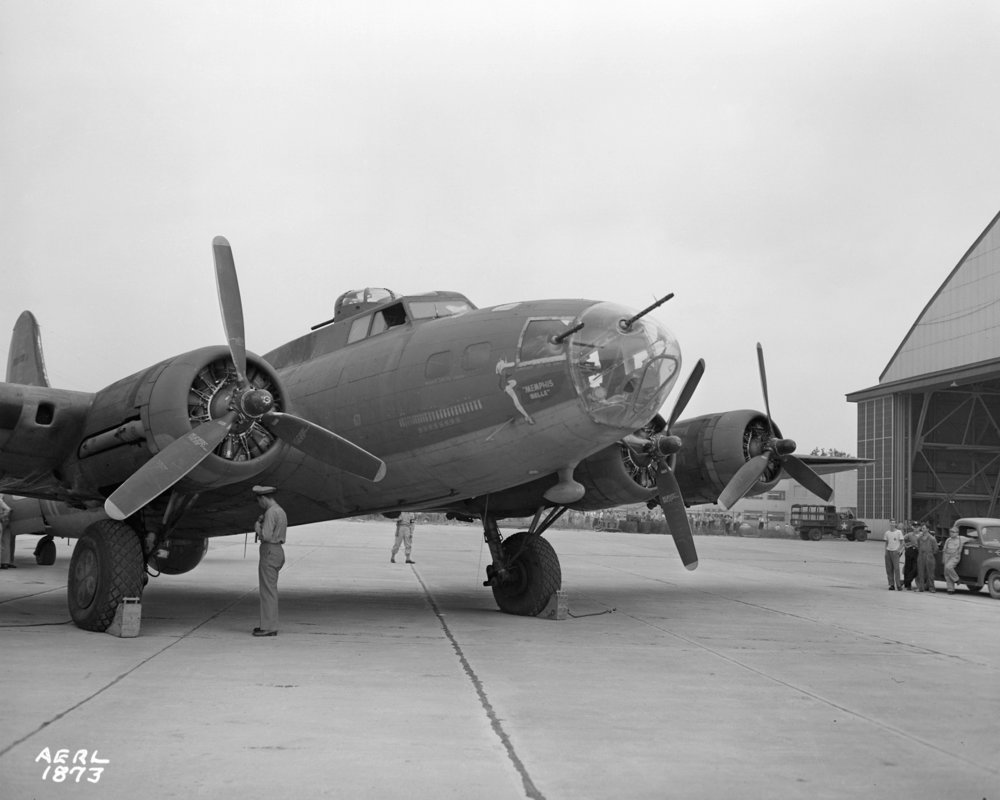
One of the ‘off the wall’ trivia thing about the death of General Andrews is that he was flying back to the ‘States on a B-24 called “Tough Stuff.” “Tough Stuff” was the first US bomber to complete 25 missions (some from England but many from North Africa). The plane and crew was being brought back to the ‘States for a bond tour. They missed some approaches due to bad weather in Iceland. On the last try, they flew into a mountain.
Instead, B-17 ‘Memphis Belle’ completed its 25th Mission just a few weeks later and did a big time bond tour and was the subject of a very well-known news reel/documentary film.
Walt
Instead, B-17 ‘Memphis Belle’ completed its 25th Mission just a few weeks later and did a big time bond tour and was the subject of a very well-known news reel/documentary film.
Walt
(0)
(0)
Capt Walter Miller
Yes, you usually see a caveat -- MB was the first bomber to complete 25 missions and return to the US.
'Hell's Angels' from the 303rd BG was first to 50 missions and 75 missions.
Walt
'Hell's Angels' from the 303rd BG was first to 50 missions and 75 missions.
Walt
(0)
(0)
Read This Next


 Continue with Facebook
 Continue with Google