
Your Response was posted! Click here to see it.
Posted on Mar 10, 2021

Why are Airmen 3-4X more likely to commit suicide than the civilian population when the Air Force screens for risk factors prior to entry?

6.56K
68
28
8
8
0
Common risk factor include:
Mental Health Issues
Criminal History
Substance Abuse Disorder
History of Abuse
Financial Issues
You might recognize these, because they are exactly what the military looks for before letting someone enlist/commission. Our suicide rate is equivalent to the prison population of the US (.04%), and 4X higher than the US suicide rate (.01%). If we are screening for these issues, shouldn’t we theoretically have a lower suicide rate than the civilian population? How do we have the same numbers as the prison population which consists of nothing but risk factors? I believe the common public outlook on military suicide is that it is largely due to combat stress or PTSD. However, we are having our highest numbers in peacetime. What would our suicide rate look like without screening?
Most interestingly, our training almost always paints the signs (social withdrawal, marital issues, alcohol abuse) as being tied to the individual, and not the military as a whole. I hadn’t realized this until a fellow NCO talked about it during an open discussion. He shared with us that he went through a period of time himself many years ago where he was contemplating suicide. He said: “Sitting through this training does even more damage for an Airman because it paints this issue as a problem with them, not a problem with our culture and environment. Like they’re somehow defective and everything is A-okay with the way things are going around them.”
Mental Health Issues
Criminal History
Substance Abuse Disorder
History of Abuse
Financial Issues
You might recognize these, because they are exactly what the military looks for before letting someone enlist/commission. Our suicide rate is equivalent to the prison population of the US (.04%), and 4X higher than the US suicide rate (.01%). If we are screening for these issues, shouldn’t we theoretically have a lower suicide rate than the civilian population? How do we have the same numbers as the prison population which consists of nothing but risk factors? I believe the common public outlook on military suicide is that it is largely due to combat stress or PTSD. However, we are having our highest numbers in peacetime. What would our suicide rate look like without screening?
Most interestingly, our training almost always paints the signs (social withdrawal, marital issues, alcohol abuse) as being tied to the individual, and not the military as a whole. I hadn’t realized this until a fellow NCO talked about it during an open discussion. He shared with us that he went through a period of time himself many years ago where he was contemplating suicide. He said: “Sitting through this training does even more damage for an Airman because it paints this issue as a problem with them, not a problem with our culture and environment. Like they’re somehow defective and everything is A-okay with the way things are going around them.”
 Suicide
 Mental Health
 Resiliency
Posted 5 y ago
Responses: 11
7
7
0

There's an argument for causation vs correlation here.
Is the Air Force the cause? Or is it the type of person that joins the Air Force that's the bigger variable?
Perhaps the issue is that the people who join the Air Force are the type that want the benefits of joining the military, with no expectation of hardship or difficulty (that's your reputation as a branch, get over it). It's entirely likely that the Air Force is blameless, and those individuals wouldn't have succeeded in the other, harder braches either...
Is the Air Force the cause? Or is it the type of person that joins the Air Force that's the bigger variable?
Perhaps the issue is that the people who join the Air Force are the type that want the benefits of joining the military, with no expectation of hardship or difficulty (that's your reputation as a branch, get over it). It's entirely likely that the Air Force is blameless, and those individuals wouldn't have succeeded in the other, harder braches either...
(7)
(0)
SFC Michael Hasbun
TSgt (Join to see) - I don't think it's as mysterious as you think it is. The Navy/Marine Corps have the second largest Air Force in the world in their aviation component, and the Army Aviation BDE's are much larger than a great many countries Air Force's as well.
All the branches do air operations. It's normal to us too...
All the branches do air operations. It's normal to us too...
(1)
(0)
TSgt (Join to see)
SFC Michael Hasbun - We work alongside all 3 lol I'm aware. Sortie generation rates per aircraft are much higher for the AF, for obvious reasons. I always wanted to get an Army assignment because I know for a fact they get to close their airfields on nights/weekends/holidays while the AF is open 24/7 on most bases. Navy can put up some crazy numbers with their carriers though, I've seen them pull over 100 sorties a day for a week straight during exercises.
(0)
(0)
SFC Casey O'Mally
TSgt (Join to see) - As for why suicide rates go up when deployments go down, it is because all of those folks who have those invisible psychic wounds finally have a chance to wind down and decompress.
Think of it like a deep knife wound, with the knife still in place. Running around the battlefield with a knife in you is going to cause the wound to get worse and worse. But the SEVERE danger comes when you pull the knife out. Going through that battle trauma and getting those psychic wounds is bad. But while you are running around the battlefield, making those injuries slowly worse and worse, at least you aren't releasing the pressure an allowing them to wreak havoc. Once those folks get back and have time to let their guard down, THAT is when things get really real, really quick.
And it isn't necessarily a post-deployment thing, it is a post-deployment "period" things. For a long time, most units were coming back off of deployment, reconstituting, and immediately spinning back up into deployment prep and re-deploying. I was stationed on Hawaii for 42 months - I spent 11 on island. The rest was either actively deployed to combat, or off island for extended periods of training. My time at Fort Knox was the opposite - I arrived when the unit had 4 months left of deployment, so I didn't deploy with them. When I PCSed 23 months later, the unit had been deployed for 5 months, but I already had a mission critical assignment locked in, so I didn't deploy with them. They spent 13 months back stateside between their 12 month deployments. Soldiers in those situations of back to back deployments rarely truly decompress. It is only once they go to that "take a knee" assignment where deployment is no longer on the immediate horizon, or they start looking at ETS / Retirement that they allow themselves to really let their guards down.
I came about 5 feet from death on my third Iraq. I luckily picked the right side of a HESCO barrier to huddle against as 107mm rockets impacted about 30 feet away. Had I been on the opposite side, there is a high probability I would not have survived. An even higher probability that I would have been either severely injured or dead. I was lucky enough to escape with just a concussion. From there I PCSed to the Fort Knox unit, where I was VERY busy working a job two ranks above my pay grade because - Rear D, and then knee deep in training the unit for their upcoming deployment. Once they left, I was again knee deep in rear D. Once I PCSed to my "take a knee" assignment, and I got "settled" there, THAT is when depression set in. I was not suicidal, and I did not attempt suicide - but I wouldn't have jumped out of the way of a bullet or speeding train, either. Luckily, I recognized the issues and went and got help, and I am doing pretty OK these days (as long as I remember to take my meds).
The easiest way to keep someone from committing suicide is make sure they don't have the time to do it - and the Army has gotten VERY good at making sure Soldiers have no free time - until they do.
Think of it like a deep knife wound, with the knife still in place. Running around the battlefield with a knife in you is going to cause the wound to get worse and worse. But the SEVERE danger comes when you pull the knife out. Going through that battle trauma and getting those psychic wounds is bad. But while you are running around the battlefield, making those injuries slowly worse and worse, at least you aren't releasing the pressure an allowing them to wreak havoc. Once those folks get back and have time to let their guard down, THAT is when things get really real, really quick.
And it isn't necessarily a post-deployment thing, it is a post-deployment "period" things. For a long time, most units were coming back off of deployment, reconstituting, and immediately spinning back up into deployment prep and re-deploying. I was stationed on Hawaii for 42 months - I spent 11 on island. The rest was either actively deployed to combat, or off island for extended periods of training. My time at Fort Knox was the opposite - I arrived when the unit had 4 months left of deployment, so I didn't deploy with them. When I PCSed 23 months later, the unit had been deployed for 5 months, but I already had a mission critical assignment locked in, so I didn't deploy with them. They spent 13 months back stateside between their 12 month deployments. Soldiers in those situations of back to back deployments rarely truly decompress. It is only once they go to that "take a knee" assignment where deployment is no longer on the immediate horizon, or they start looking at ETS / Retirement that they allow themselves to really let their guards down.
I came about 5 feet from death on my third Iraq. I luckily picked the right side of a HESCO barrier to huddle against as 107mm rockets impacted about 30 feet away. Had I been on the opposite side, there is a high probability I would not have survived. An even higher probability that I would have been either severely injured or dead. I was lucky enough to escape with just a concussion. From there I PCSed to the Fort Knox unit, where I was VERY busy working a job two ranks above my pay grade because - Rear D, and then knee deep in training the unit for their upcoming deployment. Once they left, I was again knee deep in rear D. Once I PCSed to my "take a knee" assignment, and I got "settled" there, THAT is when depression set in. I was not suicidal, and I did not attempt suicide - but I wouldn't have jumped out of the way of a bullet or speeding train, either. Luckily, I recognized the issues and went and got help, and I am doing pretty OK these days (as long as I remember to take my meds).
The easiest way to keep someone from committing suicide is make sure they don't have the time to do it - and the Army has gotten VERY good at making sure Soldiers have no free time - until they do.
(1)
(0)
SFC Casey O'Mally
SSG Nathan Stryker - Thanks. I try VERY hard to discuss real shit in relatable, understandable language. I am glad that my post was able to help you take a bit of a look at your own experiences.
(Pay it forward!)
(Pay it forward!)
(1)
(0)
6
6
0

The short answer is that Service Members are withholding information for fear of damaging their careers or being judged due to the stigma of mental health within the military. You also have the issue with Military Mental Health Providers misdiagnosing SM's with anxiety instead of more appropriate terms due to the same stigma of mental health damaging careers. During my med board process I discovered that my Therapist labeled me as having anxiety because he didn't like diagnosing PTSD because it would draw attention. The VA had to confirm my PTSD diagnosis and make a formal statement in my records because what they were saying went against previous notations.
(6)
(0)
5
5
0
4
4
0

I have a USAF friend who has PTSD and tried suicide once. You do understand that folks die in the USAF in combat right. He maintained F-111's had for several years in UK. His "plane went to bomb Libya- and didn't come home. There he sits odd duck out, his crew of sometime missing. Spouses, kids, family upset. and in the back of his mind forever- "Was this a MT prolem" or AA fire??.
(4)
(0)
3
3
0

TSgt (Join to see)
Rates are pretty comparable across the Army Marines and Navy, though the Army has the highest suicide rate by a small margin.
(1)
(0)
(0)
(0)

TSgt (Join to see) There are different approaches to the problem of suicide. A key element needs to include having resiliency training so that individuals are better prepared to handle the stresses of life.
(3)
(0)
2
2
0

14.8 is civilian rate 25 t0 26 is AF rate, (Per 100K)) Where is the 3-4 times coming from ?
(2)
(0)
1
1
0

I also think statistically the fact the military doesn't weed out the "strange ones" contributes to the numbers.
See............ anywhere else you apply for employment the interviewer can say regardless of on paper qualifications, "hmm......... this guy is a little off, and I know in my heart of hearts he's not going to fit in. So, I'm NOT going to hire him (no one can force me otherwise) even though he's a College Track Star with a 3.8 GPA college degree, and ASVAB lines scores 115+ across the board.
No where else in the world are you:
HIRED by someone that has no idea what you will be doing
TRAINED by a guy you aren't going to work for
WORK for a guy that didn't ask for you
Anyone that meets the standard gets hired (presuming they take any MOS).If they have a screw loose that's not the recruiter's problem. He's at least two degrees of separation from the solder after TRADOC.
See............ anywhere else you apply for employment the interviewer can say regardless of on paper qualifications, "hmm......... this guy is a little off, and I know in my heart of hearts he's not going to fit in. So, I'm NOT going to hire him (no one can force me otherwise) even though he's a College Track Star with a 3.8 GPA college degree, and ASVAB lines scores 115+ across the board.
No where else in the world are you:
HIRED by someone that has no idea what you will be doing
TRAINED by a guy you aren't going to work for
WORK for a guy that didn't ask for you
Anyone that meets the standard gets hired (presuming they take any MOS).If they have a screw loose that's not the recruiter's problem. He's at least two degrees of separation from the solder after TRADOC.
(1)
(0)
TSgt (Join to see)
That’s a pretty good point Captain, I know a few people who would have been better off had their recruiter been honest with them about how their personality would fit in within the military.
Perhaps a more robust psychological profile is needed to determine mental fitness at entry. Then again, it’s a difficult balance to maintain because we need the bodies to maintain our strength.
Perhaps a more robust psychological profile is needed to determine mental fitness at entry. Then again, it’s a difficult balance to maintain because we need the bodies to maintain our strength.
(0)
(0)
1
1
0

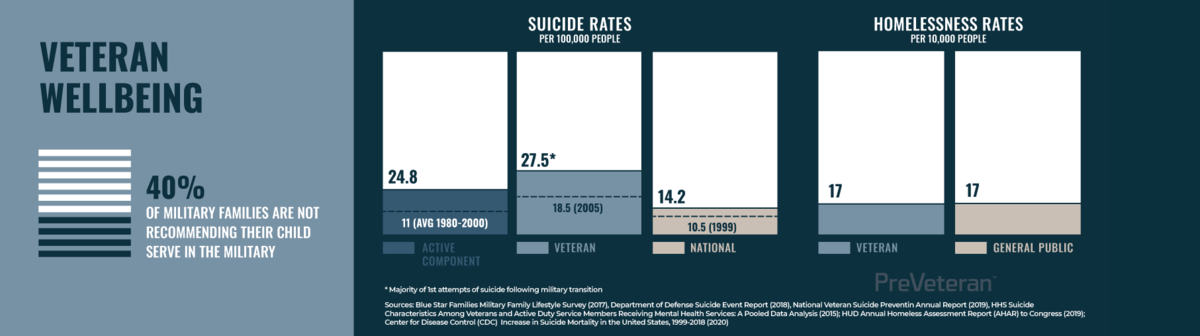
If you look at the overall numbers, suicide has increased across the board over the past 20 years. Here is a graphic we put together that shows the relative differences over the years. These are the most recent numbers from the 2019 DoDSER and 2020 VA reports. As you can see, the number of DoD-related suicides has more than 2X in 20 years while the veteran rates are still significant but have not grown at the same rate.
(1)
(0)
1
1
0
Just because the military screens for issues prior to joining does not mean those issues cannot arise AFTER joining. And I would argue that military life lends itself PARTICULARLY well to mental health issues and abuse. It lends itself reasonably well to financial issues and substance abuse. So... yeah... maybe you answered your own question.
(1)
(0)
Read This Next


 Continue with Facebook
 Continue with Google