

1
1
0
Everyone loves debating the 2nd Amendment to the U.S. Constitution. I want to discuss a recent event and hear some interpretations from my brothers and sisters in arms.
The whole Cliven Bundy incident. Ok, the guy's a racist schmuck. Let's not go into that. I want to know why people are defending a man who is breaking the law and doing so by exercising their rights as they perceive them: Standing against law enforcement, armed, and willing to defend/engage. They have said they would put women up as human shields and have threatened law enforcement officers.
Whatever your opinion on the subject, Bundy has broken the law and continues to do so. The courts have spoken.
He has a well-regulated militia guarding his cattle. Is this what the 2nd Amendment was all about? Protecting a citizen (Who doesn't recognize the American Government yet parades about carrying the flag) who violates the law?
Sean Hannity was a big supporter before it turned out he was a racist pig. What's the deal with defending a criminal???
I don't understand the defense. It is indefensible... why???????????????
Thoughts?
The whole Cliven Bundy incident. Ok, the guy's a racist schmuck. Let's not go into that. I want to know why people are defending a man who is breaking the law and doing so by exercising their rights as they perceive them: Standing against law enforcement, armed, and willing to defend/engage. They have said they would put women up as human shields and have threatened law enforcement officers.
Whatever your opinion on the subject, Bundy has broken the law and continues to do so. The courts have spoken.
He has a well-regulated militia guarding his cattle. Is this what the 2nd Amendment was all about? Protecting a citizen (Who doesn't recognize the American Government yet parades about carrying the flag) who violates the law?
Sean Hannity was a big supporter before it turned out he was a racist pig. What's the deal with defending a criminal???
I don't understand the defense. It is indefensible... why???????????????
Thoughts?
Posted in these groups:  2nd Amendment
 Militia
2nd Amendment Militia
Posted >1 y ago
Responses: 13

0
0
0

To Cornett and SSG at Campbell: I think if you actually do some research you can find that individual states have the right to maintain a "well-regulated" (Key words) militia. Not any individual who is POed. Bundy is a POed individual and not part of any government. As a matter of fact, Alexander Hamilton wrote in Federalist Paper number 29 "If a well-regulated militia be the most natural defence of a free country, it ought certainly to be under the regulation and at the disposal of that body which is constituted the guardian of the national security...confiding the regulation of the militia to the direction of the national authority...[but] reserving to the states...the authority of training the militia." Bo you really want anyone with excess cash forming their own militia? The mafia? The Bloods and Crips? Bill Gates? Nancy Pelozi? Bundy should be tried for insurrection and tax evasion. Bundy does not have ANY right to form a militia...unless he is elected Governor.
(0)
(0)
SFC (Join to see)
I think people always have the right to form a common defense. What would you call a neighborhood watch (because it sounds a lot to me like a militia, even if they are usually unarmed)? What if a crime is taking place and two armed neighbors step in to help? What is a large armed crowd of protesters? What about private security companies or private military contractors? At what point does a gathering become a militia?
I think it's much easier to focus on the legality and justification of the actions taken rather than try to decide whether or not a militia has a right to form. So yes, I think the mafia, the bloods, and Nancy Pelosi have a right to form a militia. I don't think they have a right to use that militia to take actions that are illegal.
I think it's much easier to focus on the legality and justification of the actions taken rather than try to decide whether or not a militia has a right to form. So yes, I think the mafia, the bloods, and Nancy Pelosi have a right to form a militia. I don't think they have a right to use that militia to take actions that are illegal.
(1)
(0)
SPC Elijah J. Henry, MBA

LTC Barry Hull, I think you have all your facts straight, and yet I'm not sure you're on the right track.
Individual States have not only a right, but also a *duty* to maintain well-regulated Militia.
Indeed, as you suggest, armed groups that call themselves Militia are not true, Constitutional Militia. They are simply private, paramilitary groups, with no legal standing. See http://www.newswithviews.com/Vieira/edwin61.htm
"Bundy should be tried . . . ." is an opinion, one with which I disagree.
I am not aware of Bundy forming anything like a Militia. He got into this situation, and people showed up to provide assistance. I don't think was training them, or assigning ranks, or even recruiting them.
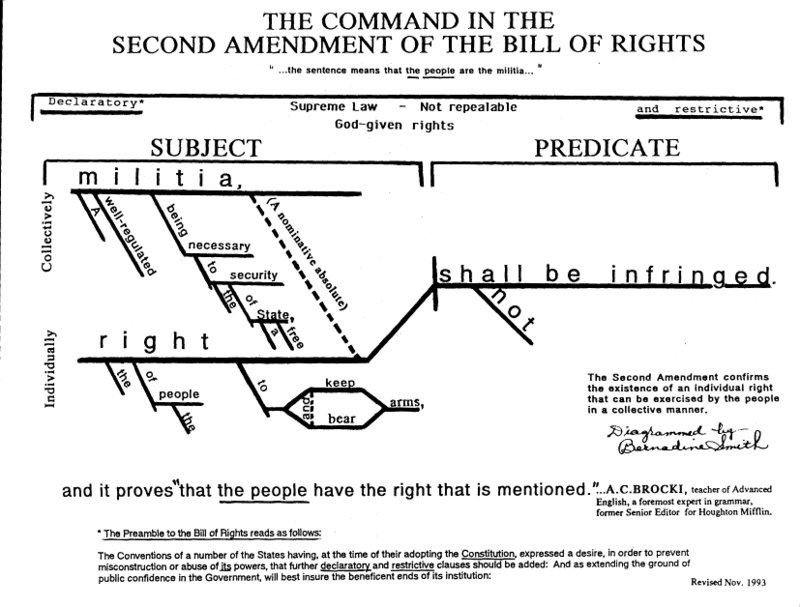
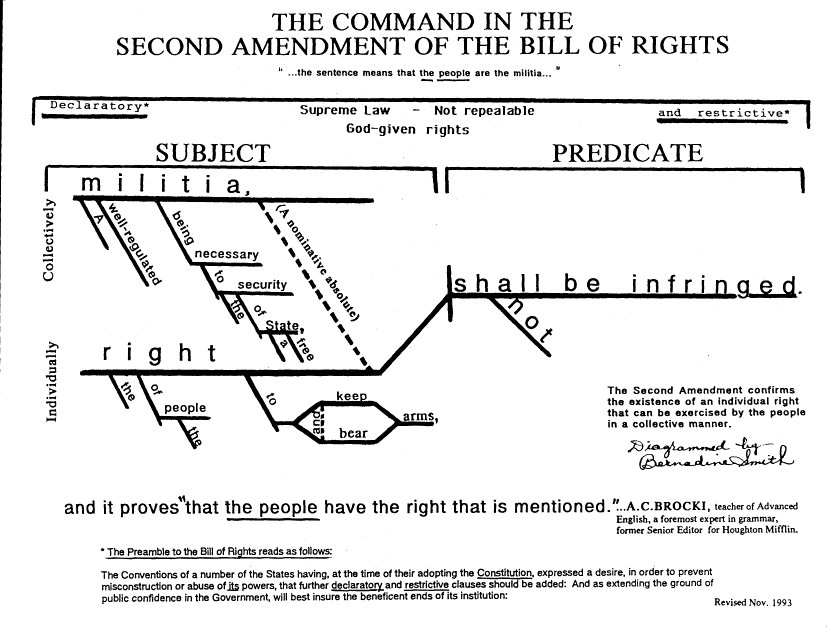
The right to keep and bear arms is not dependent on service or enrollment in the Militia. Consider the attached grammatical diagram.
Individual States have not only a right, but also a *duty* to maintain well-regulated Militia.
Indeed, as you suggest, armed groups that call themselves Militia are not true, Constitutional Militia. They are simply private, paramilitary groups, with no legal standing. See http://www.newswithviews.com/Vieira/edwin61.htm
"Bundy should be tried . . . ." is an opinion, one with which I disagree.
I am not aware of Bundy forming anything like a Militia. He got into this situation, and people showed up to provide assistance. I don't think was training them, or assigning ranks, or even recruiting them.
The right to keep and bear arms is not dependent on service or enrollment in the Militia. Consider the attached grammatical diagram.
Edwin Vieira, Jr. -- True Vs. False Militia & Why the Difference Matters, Part 1
Although at the present time I am one of very few people, if not the only person, vociferously advocating revitalization of the Militia of the several States along strict constitutional lines, I am confident that the Forces of Darkness fully anticipate that I shall not remain for much longer a lonely voice crying in the wilderness of the Internet and the market for rare books. Rather, as this country lurches ever-closer to crisis because of...
(3)
(0)
SPC Elijah J. Henry, MBA
SFC (Join to see), have you read Mack Tanner's excellent book: The Armed Citizen Solution to Crime in the Streets: So Many Criminals, so Few Bullets
He recommends a viable system -- he calls it an "informal defense alliance" -- that lacks only official sanction to comply with the historical and Constitutional standards of the Constitutional Militia. The informal defense alliance basically consists of an armed and proactive neighborhood watch group (applicable and adaptable to public transit systems, apartment buildings and complexes, office buildings, etc.)
He suggests that an organization of this kind would be well prepared for larger-scale societal breakdowns, such as natural disasters, wars, and socioeconomic collapse.
He recommends a viable system -- he calls it an "informal defense alliance" -- that lacks only official sanction to comply with the historical and Constitutional standards of the Constitutional Militia. The informal defense alliance basically consists of an armed and proactive neighborhood watch group (applicable and adaptable to public transit systems, apartment buildings and complexes, office buildings, etc.)
He suggests that an organization of this kind would be well prepared for larger-scale societal breakdowns, such as natural disasters, wars, and socioeconomic collapse.
(0)
(0)
0
-1
1
To Cornett and SSG at Campbell: I think if you actually do some research you can find that individual states have the right to maintain a "well-regulated" (Key words) militia. Not any individual who is POed. Bundy is a POed individual and not part of any government. As a matter of fact, Alexander Hamilton wrote in Federalist Paper number 29 "If a well-regulated militia be the most natural defence of a free country, it ought certainly to be under the regulation and at the disposal of that body which is constituted the guardian of the national security...confiding the regulation of the militia to the direction of the national authority...[but] reserving to the states...the authority of training the militia." Bo you really want anyone with excess cash forming their own militia? The mafia? The Bloods and Crips? Bill Gates? Nancy Pelozi? Bundy should be tried for insurrection and tax evasion. Bundy does not have ANY right to form a militia...unless he is elected Governor.
(0)
(1)
SPC (Join to see)
The Militia is We The People bringing our own arms from home. Individuals who come together to defend our liberties and freedom from foreign invasion, enslavement, oppression and tyranny.
Please read SSG Seidels comments where he correctly sites Article 1 Section 8 of the United States Constitution.
Please read SSG Seidels comments where he correctly sites Article 1 Section 8 of the United States Constitution.
(0)
(0)
1
-1
2

Well regulated militia, a well armed, unregulated populace, meh, same thing...
(1)
(2)
SPC Elijah J. Henry, MBA
SFC Michael Hasbun, that would be up to Congress or the States or the local unit. Probably there would be musters going on pretty much all the time, given how many people would be in the Militia of each State.
(0)
(0)
SPC (Join to see)
3% of the population of the 13 colonies actively fought against the British in the Revolutionary War. 10% of the population of the colonies actively supported the 3% who were actively engaged in fighting against the crown. Those numbers did grow but by wars end more of the colonies population fought for the crown than fought against it.
(0)
(0)
SSG Gerhard S.

It is important to NOT confuse the "militia" (the whole of the armed people) with the "well regulated militia" (the body activated by the request of the Central government, and approved by the State's governors for the common defense) The militia (unregulated) is in place to protect the States, and the People from a tyrannically controlled "regulated" militia.
The following article describes the differences, and the intent of the Framers when writing the Second Amendment. The link has the article, as well as the footnotes for your inspection. I hope this helps to clarify things.
by Daniel J. Schultz
The Second Amendment to the United States Constitution states: "A well regulated Militia, being necessary to the security of a free State, the right of the people to keep and bear Arms, shall not be infringed." The reference to a "well regulated" militia, probably conjures up a connotation at odds with the meaning intended by the Framers. In today's English, the term "well regulated" probably implies heavy and intense government regulation. However, that conclusion is erroneous.
The words "well regulated" had a far different meaning at the time the Second Amendment was drafted. In the context of the Constitution's provisions for Congressional power over certain aspects of the militia, and in the context of the Framers' definition of "militia," government regulation was not the intended meaning. Rather, the term meant only what it says, that the necessary militia be well regulated, but not by the national government.
To determine the meaning of the Constitution, one must start with the words of the Constitution itself. If the meaning is plain, that meaning controls. To ascertain the meaning of the term "well regulated" as it was used in the Second Amendment, it is necessary to begin with the purpose of the Second Amendment itself. The overriding purpose of the Framers in guaranteeing the right of the people to keep and bear arms was as a check on the standing army, which the Constitution gave the Congress the power to "raise and support."
As Noah Webster put it in a pamphlet urging ratification of the Constitution, "Before a standing army can rule, the people must be disarmed; as they are in almost every kingdom in Europe." George Mason remarked to his Virginia delegates regarding the colonies' recent experience with Britain, in which the Monarch's goal had been "to disarm the people; that [that] . . . was the best and most effectual way to enslave them." A widely reprinted article by Tench Coxe, an ally and correspondent of James Madison, described the Second Amendment's overriding goal as a check upon the national government's standing army: As civil rulers, not having their duty to the people duly before them, may attempt to tyrannize, and as the military forces which must be occasionally raised to defend our country, might pervert their power to the injury of their fellow citizens, the people are confirmed by the next article in their right to keep and bear their private arms.
Thus, the well regulated militia necessary to the security of a free state was a militia that might someday fight against a standing army raised and supported by a tyrannical national government. Obviously, for that reason, the Framers did not say "A Militia well regulated by the Congress, being necessary to the security of a free State" -- because a militia so regulated might not be separate enough from, or free enough from, the national government, in the sense of both physical and operational control, to preserve the "security of a free State."
It is also helpful to contemplate the overriding purpose and object of the Bill of Rights in general. To secure ratification of the Constitution, the Federalists, urging passage of the Constitution by the States had committed themselves to the addition of the Bill of Rights, to serve as "further guards for private rights." In that regard, the first ten amendments to the Constitution were designed to be a series of "shall nots," telling the new national government again, in no uncertain terms, where it could not tread.
It would be incongruous to suppose or suggest the Bill of Rights, including the Second Amendment, which were proscriptions on the powers of the national government, simultaneously acted as a grant of power to the national government. Similarly, as to the term "well regulated," it would make no sense to suggest this referred to a grant of "regulation" power to the government (national or state), when the entire purpose of the Bill of Rights was to both declare individual rights and tell the national government where the scope of its enumerated powers ended.
In keeping with the intent and purpose of the Bill of Rights both of declaring individual rights and proscribing the powers of the national government, the use and meaning of the term "Militia" in the Second Amendment, which needs to be "well regulated," helps explain what "well regulated" meant. When the Constitution was ratified, the Framers unanimously believed that the "militia" included all of the people capable of bearing arms.
George Mason, one of the Virginians who refused to sign the Constitution because it lacked a Bill of Rights, said: "Who are the Militia? They consist now of the whole people." Likewise, the Federal Farmer, one of the most important Anti-Federalist opponents of the Constitution, referred to a "militia, when properly formed, [as] in fact the people themselves." The list goes on and on.
By contrast, nowhere is to be found a contemporaneous definition of the militia, by any of the Framers, as anything other than the "whole body of the people." Indeed, as one commentator said, the notion that the Framers intended the Second Amendment to protect the "collective" right of the states to maintain militias rather than the rights of individuals to keep and bear arms, "remains one of the most closely guarded secrets of the eighteenth century, for no known writing surviving from the period between 1787 and 1791 states such a thesis."
Furthermore, returning to the text of the Second Amendment itself, the right to keep and bear arms is expressly retained by "the people," not the states. Recently the U.S. Supreme Court confirmed this view, finding that the right to keep and bear arms was an individual right held by the "people," -- a "term of art employed in select parts of the Constitution," specifically the Preamble and the First, Second, Fourth, Ninth and Tenth Amendments. Thus, the term "well regulated" ought to be considered in the context of the noun it modifies, the people themselves, the militia(s).
The above analysis leads us finally to the term "well regulated." What did these two words mean at the time of ratification? Were they commonly used to refer to a governmental bureaucracy as we know it today, with countless rules and regulations and inspectors, or something quite different? We begin this analysis by examining how the term "regulate" was used elsewhere in the Constitution. In every other instance where the term "regulate" is used, or regulations are referred to, the Constitution specifies who is to do the regulating and what is being "regulated." However, in the Second Amendment, the Framers chose only to use the term "well regulated" to describe a militia and chose not to define who or what would regulate it.
It is also important to note that the Framers' chose to use the indefinite article "a" to refer to the militia, rather than the definite article "the." This choice suggests that the Framers were not referring to any particular well regulated militia but, instead, only to the concept that well regulated militias, made up of citizens bearing arms, were necessary to secure a free State. Thus, the Framers chose not to explicitly define who, or what, would regulate the militias, nor what such regulation would consist of, nor how the regulation was to be accomplished.
This comparison of the Framers' use of the term "well regulated" in the Second Amendment, and the words "regulate" and "regulation" elsewhere in the Constitution, clarifies the meaning of that term in reference to its object, namely, the Militia. There is no doubt the Framers understood that the term "militia" had multiple meanings. First, the Framers understood all of the people to be part of the unorganized militia. The unorganized militia members, "the people," had the right to keep and bear arms. They could, individually, or in concert, "well regulate" themselves; that is, they could train to shoot accurately and to learn the basics of military tactics.
This interpretation is in keeping with English usage of the time, which included within the meaning of the verb "regulate" the concept of self- regulation or self-control (as it does still to this day). The concept that the people retained the right to self-regulate their local militia groups (or regulate themselves as individual militia members) is entirely consistent with the Framers' use of the indefinite article "a" in the phrase "A well regulated Militia."
This concept of the people's self-regulation, that is, non-governmental regulation, is also in keeping with the limited grant of power to Congress "for calling forth" the militia for only certain, limited purposes, to "provide for" the militia only certain limited control and equipment, and the limited grant of power to the President regarding the militia, who only serves as Commander in Chief of that portion of the militia called into the actual service of the nation. The "well regula[tion]" of the militia set forth in the Second Amendment was apart from that control over the militia exercised by Congress and the President, which extended only to that part of the militia called into actual service of the Union. Thus, "well regula[tion]" referred to something else. Since the fundamental purpose of the militia was to serve as a check upon a standing army, it would seem the words "well regulated" referred to the necessity that the armed citizens making up the militia(s) have the level of equipment and training necessary to be an effective and formidable check upon the national government's standing army.
This view is confirmed by Alexander Hamilton's observation, in The Federalist, No. 29, regarding the people's militias ability to be a match for a standing army: " . . . but if circumstances should at any time oblige the government to form an army of any magnitude, that army can never be formidable to the liberties of the people, while there is a large body of citizens, little if at all inferior to them in discipline and use of arms, who stand ready to defend their rights . . . ."
It is an absolute truism that law-abiding, armed citizens pose no threat to other law-abiding citizens. The Framers' writings show they also believed this. As we have seen, the Framers understood that "well regulated" militias, that is, armed citizens, ready to form militias that would be well trained, self-regulated and disciplined, would pose no threat to their fellow citizens, but would, indeed, help to "insure domestic Tranquility" and "provide for the common defence."
http://www.lectlaw.com/files/gun01.htm
The following article describes the differences, and the intent of the Framers when writing the Second Amendment. The link has the article, as well as the footnotes for your inspection. I hope this helps to clarify things.
by Daniel J. Schultz
The Second Amendment to the United States Constitution states: "A well regulated Militia, being necessary to the security of a free State, the right of the people to keep and bear Arms, shall not be infringed." The reference to a "well regulated" militia, probably conjures up a connotation at odds with the meaning intended by the Framers. In today's English, the term "well regulated" probably implies heavy and intense government regulation. However, that conclusion is erroneous.
The words "well regulated" had a far different meaning at the time the Second Amendment was drafted. In the context of the Constitution's provisions for Congressional power over certain aspects of the militia, and in the context of the Framers' definition of "militia," government regulation was not the intended meaning. Rather, the term meant only what it says, that the necessary militia be well regulated, but not by the national government.
To determine the meaning of the Constitution, one must start with the words of the Constitution itself. If the meaning is plain, that meaning controls. To ascertain the meaning of the term "well regulated" as it was used in the Second Amendment, it is necessary to begin with the purpose of the Second Amendment itself. The overriding purpose of the Framers in guaranteeing the right of the people to keep and bear arms was as a check on the standing army, which the Constitution gave the Congress the power to "raise and support."
As Noah Webster put it in a pamphlet urging ratification of the Constitution, "Before a standing army can rule, the people must be disarmed; as they are in almost every kingdom in Europe." George Mason remarked to his Virginia delegates regarding the colonies' recent experience with Britain, in which the Monarch's goal had been "to disarm the people; that [that] . . . was the best and most effectual way to enslave them." A widely reprinted article by Tench Coxe, an ally and correspondent of James Madison, described the Second Amendment's overriding goal as a check upon the national government's standing army: As civil rulers, not having their duty to the people duly before them, may attempt to tyrannize, and as the military forces which must be occasionally raised to defend our country, might pervert their power to the injury of their fellow citizens, the people are confirmed by the next article in their right to keep and bear their private arms.
Thus, the well regulated militia necessary to the security of a free state was a militia that might someday fight against a standing army raised and supported by a tyrannical national government. Obviously, for that reason, the Framers did not say "A Militia well regulated by the Congress, being necessary to the security of a free State" -- because a militia so regulated might not be separate enough from, or free enough from, the national government, in the sense of both physical and operational control, to preserve the "security of a free State."
It is also helpful to contemplate the overriding purpose and object of the Bill of Rights in general. To secure ratification of the Constitution, the Federalists, urging passage of the Constitution by the States had committed themselves to the addition of the Bill of Rights, to serve as "further guards for private rights." In that regard, the first ten amendments to the Constitution were designed to be a series of "shall nots," telling the new national government again, in no uncertain terms, where it could not tread.
It would be incongruous to suppose or suggest the Bill of Rights, including the Second Amendment, which were proscriptions on the powers of the national government, simultaneously acted as a grant of power to the national government. Similarly, as to the term "well regulated," it would make no sense to suggest this referred to a grant of "regulation" power to the government (national or state), when the entire purpose of the Bill of Rights was to both declare individual rights and tell the national government where the scope of its enumerated powers ended.
In keeping with the intent and purpose of the Bill of Rights both of declaring individual rights and proscribing the powers of the national government, the use and meaning of the term "Militia" in the Second Amendment, which needs to be "well regulated," helps explain what "well regulated" meant. When the Constitution was ratified, the Framers unanimously believed that the "militia" included all of the people capable of bearing arms.
George Mason, one of the Virginians who refused to sign the Constitution because it lacked a Bill of Rights, said: "Who are the Militia? They consist now of the whole people." Likewise, the Federal Farmer, one of the most important Anti-Federalist opponents of the Constitution, referred to a "militia, when properly formed, [as] in fact the people themselves." The list goes on and on.
By contrast, nowhere is to be found a contemporaneous definition of the militia, by any of the Framers, as anything other than the "whole body of the people." Indeed, as one commentator said, the notion that the Framers intended the Second Amendment to protect the "collective" right of the states to maintain militias rather than the rights of individuals to keep and bear arms, "remains one of the most closely guarded secrets of the eighteenth century, for no known writing surviving from the period between 1787 and 1791 states such a thesis."
Furthermore, returning to the text of the Second Amendment itself, the right to keep and bear arms is expressly retained by "the people," not the states. Recently the U.S. Supreme Court confirmed this view, finding that the right to keep and bear arms was an individual right held by the "people," -- a "term of art employed in select parts of the Constitution," specifically the Preamble and the First, Second, Fourth, Ninth and Tenth Amendments. Thus, the term "well regulated" ought to be considered in the context of the noun it modifies, the people themselves, the militia(s).
The above analysis leads us finally to the term "well regulated." What did these two words mean at the time of ratification? Were they commonly used to refer to a governmental bureaucracy as we know it today, with countless rules and regulations and inspectors, or something quite different? We begin this analysis by examining how the term "regulate" was used elsewhere in the Constitution. In every other instance where the term "regulate" is used, or regulations are referred to, the Constitution specifies who is to do the regulating and what is being "regulated." However, in the Second Amendment, the Framers chose only to use the term "well regulated" to describe a militia and chose not to define who or what would regulate it.
It is also important to note that the Framers' chose to use the indefinite article "a" to refer to the militia, rather than the definite article "the." This choice suggests that the Framers were not referring to any particular well regulated militia but, instead, only to the concept that well regulated militias, made up of citizens bearing arms, were necessary to secure a free State. Thus, the Framers chose not to explicitly define who, or what, would regulate the militias, nor what such regulation would consist of, nor how the regulation was to be accomplished.
This comparison of the Framers' use of the term "well regulated" in the Second Amendment, and the words "regulate" and "regulation" elsewhere in the Constitution, clarifies the meaning of that term in reference to its object, namely, the Militia. There is no doubt the Framers understood that the term "militia" had multiple meanings. First, the Framers understood all of the people to be part of the unorganized militia. The unorganized militia members, "the people," had the right to keep and bear arms. They could, individually, or in concert, "well regulate" themselves; that is, they could train to shoot accurately and to learn the basics of military tactics.
This interpretation is in keeping with English usage of the time, which included within the meaning of the verb "regulate" the concept of self- regulation or self-control (as it does still to this day). The concept that the people retained the right to self-regulate their local militia groups (or regulate themselves as individual militia members) is entirely consistent with the Framers' use of the indefinite article "a" in the phrase "A well regulated Militia."
This concept of the people's self-regulation, that is, non-governmental regulation, is also in keeping with the limited grant of power to Congress "for calling forth" the militia for only certain, limited purposes, to "provide for" the militia only certain limited control and equipment, and the limited grant of power to the President regarding the militia, who only serves as Commander in Chief of that portion of the militia called into the actual service of the nation. The "well regula[tion]" of the militia set forth in the Second Amendment was apart from that control over the militia exercised by Congress and the President, which extended only to that part of the militia called into actual service of the Union. Thus, "well regula[tion]" referred to something else. Since the fundamental purpose of the militia was to serve as a check upon a standing army, it would seem the words "well regulated" referred to the necessity that the armed citizens making up the militia(s) have the level of equipment and training necessary to be an effective and formidable check upon the national government's standing army.
This view is confirmed by Alexander Hamilton's observation, in The Federalist, No. 29, regarding the people's militias ability to be a match for a standing army: " . . . but if circumstances should at any time oblige the government to form an army of any magnitude, that army can never be formidable to the liberties of the people, while there is a large body of citizens, little if at all inferior to them in discipline and use of arms, who stand ready to defend their rights . . . ."
It is an absolute truism that law-abiding, armed citizens pose no threat to other law-abiding citizens. The Framers' writings show they also believed this. As we have seen, the Framers understood that "well regulated" militias, that is, armed citizens, ready to form militias that would be well trained, self-regulated and disciplined, would pose no threat to their fellow citizens, but would, indeed, help to "insure domestic Tranquility" and "provide for the common defence."
http://www.lectlaw.com/files/gun01.htm
The Second Amendment: The Framers' Intentions
The 'Well Regulated' Militia of the SecondAmendment: An Examination of the Framers' Intentions - from the 'Lectric LawLibrary's stacks
(0)
(0)
Read This Next


 Continue with Facebook
 Continue with Google