
Posted on Jun 30, 2025

Einstein publishes his groundbreaking theory of relativity | June 30, 1905 | HISTORY

1.56K
14
1
10
10
0
On June 30, 1905, Albert Einstein publishes “Zur Elektrodynamik bewegter Körper (On the Electrodynamics of Moving Bodies),” a paper that sets out his theory of special relativity, in the German physics journal Annalen der Physik. Einstein’s groundbreaking work shatters the foundations of physics.
After attending the Federal Polytechnic School in Zurich, Switzerland, Einstein worked at the Swiss patent office in Bern from 1902 to 1909. He was employed as a "third- class technical expert," examining inventions for their patentability, most likely among them a gravel sorting machine and a weather indicator. In a letter to his friend Michele Besso, Einstein regarded the patent office as “that secular cloister where I hatched my most beautiful ideas.”
The most profound of these ideas emerged in five theoretical papers written in quick succession in 1905 that would revolutionize 20th- century scientific thought. Historians would later refer to this period as Einstein’s annus mirabilis, or “miracle year.” His first paper described the particle theory of light, which would later earn him the 1921 Nobel Prize in Physics. His second created a new method for determining molecular sizes, and his third examined Brownian motion, offering a mathematical explanation for the movement of particles suspended in a fluid.
After attending the Federal Polytechnic School in Zurich, Switzerland, Einstein worked at the Swiss patent office in Bern from 1902 to 1909. He was employed as a "third- class technical expert," examining inventions for their patentability, most likely among them a gravel sorting machine and a weather indicator. In a letter to his friend Michele Besso, Einstein regarded the patent office as “that secular cloister where I hatched my most beautiful ideas.”
The most profound of these ideas emerged in five theoretical papers written in quick succession in 1905 that would revolutionize 20th- century scientific thought. Historians would later refer to this period as Einstein’s annus mirabilis, or “miracle year.” His first paper described the particle theory of light, which would later earn him the 1921 Nobel Prize in Physics. His second created a new method for determining molecular sizes, and his third examined Brownian motion, offering a mathematical explanation for the movement of particles suspended in a fluid.
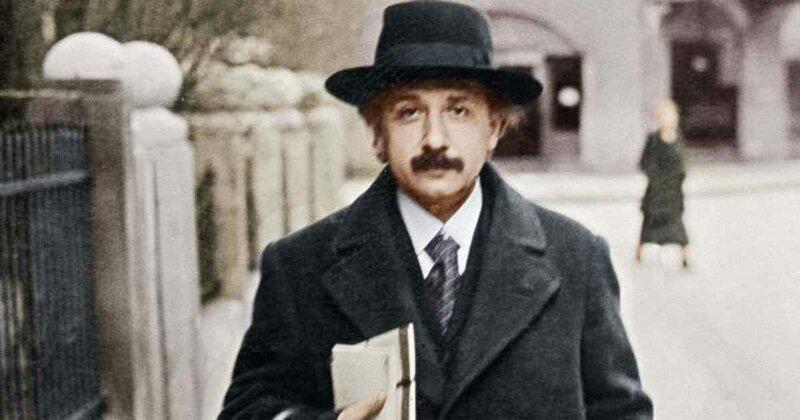
Einstein publishes his groundbreaking theory of relativity | June 30, 1905 | HISTORY
Posted from history.com World History
 Physics
 Bern
Bern
Posted 7 mo ago

Read This Next


 Continue with Facebook
 Continue with Google