
Posted on Oct 9, 2024

APOD: 2024 October 9 – M106: A Spiral Galaxy with a Strange Center

1.49K
11
2
11
11
0
Good morning, Rallypoint, and welcome to the October 9th edition of Astronomy Picture of the Day (APOD). We visit the 106th entry in Charles Messier's 'not a comet' catalogue, lying some 23.5 million light years away in the constellation Canes Venatici (Hunting Dogs). Messier 106 (M106) was discovered by the French astronomer Pierre Méchain in July of 1781. Méchain mentioned the discovery in a letter to Johann Bernoulli dated May 6, 1783. It was added to the Messier catalog in 1947, along with M105 and M107.
What is the 'strange center' of M106? For openers, scientists believe it is a black hole. The presence of ionized gas jets have been observed running the length of the galaxy (~60,000 light years). What also makes M106 interesting is the class of emissions (both radio wave and X-ray) that can be detected, earning this object the moniker 'Seyfert galaxy.' A Seyfert galaxy is believed to be a low-luminosity version of the same phenomenon observed in quasars.
This image of M106 comes to us from the Kuwaiti desert. There's something to be said for looking at the stars under dark skies.
What is the 'strange center' of M106? For openers, scientists believe it is a black hole. The presence of ionized gas jets have been observed running the length of the galaxy (~60,000 light years). What also makes M106 interesting is the class of emissions (both radio wave and X-ray) that can be detected, earning this object the moniker 'Seyfert galaxy.' A Seyfert galaxy is believed to be a low-luminosity version of the same phenomenon observed in quasars.
This image of M106 comes to us from the Kuwaiti desert. There's something to be said for looking at the stars under dark skies.
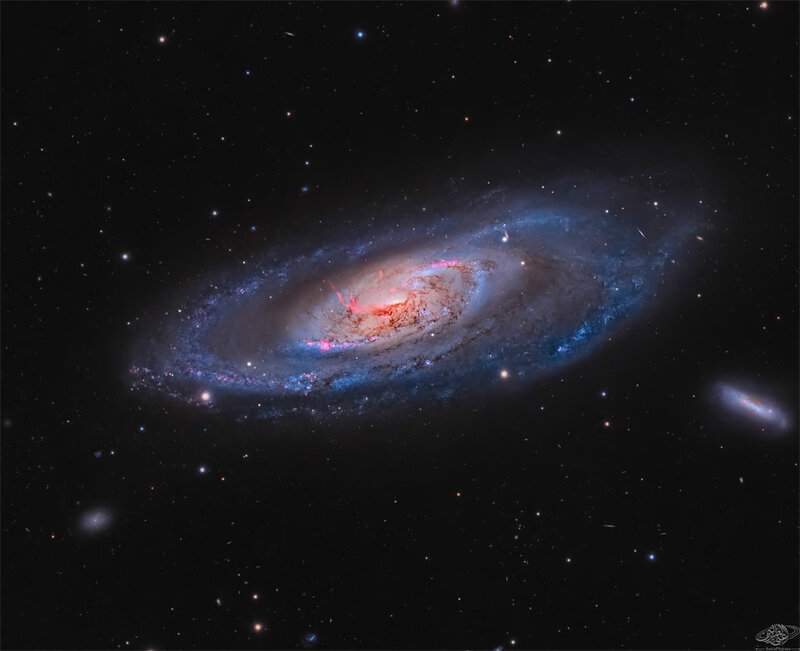
APOD: 2024 October 9 – M106: A Spiral Galaxy with a Strange Center
Posted from apod.nasa.gov NASA
NASA Space
Space Science
 Photography
 Astronomy
Posted 1 y ago
Responses: 2
0
0
0

0
0
0

Read This Next


 Continue with Facebook
 Continue with Google