

12
12
0
https://warfarehistorynetwork.com/article/firestorm-at-hollandia/?utm_source=Full+WHN+List&utm_campaign=725cdcd486-EMAIL_CAMPAIGN_2025_06_12_12_15_COPY_01&utm_medium=email&utm_term=0_-d714d9c [login to see] 7
Simultaneously, a landing was to be made at Humboldt Bay on the eastern side of the Cyclops Mountains outcropping. The 41st Infantry Division, National Guard troops commanded by Maj. Gen. Horace H. Fuller, would land at White Beaches 1 through 4. Thought to be more heavily defended, the strongest force would land on White Beaches 1 and 2 on a narrow strip of land about 21/2miles south of Hollandia town. Each beach was only about 700 yards long and 100 yards deep with a mangrove swamp directly behind. Another landing area, White Beach 3, was no better, situated on the tip of a finger of a peninsula separating large Humboldt Bay from small, hidden Jautefa Bay. On the northwestern shore of Jautefa Bay sat the small native village of Pim, which had a jetty and the start of a road leading to the eastern side of Lake Sentai. While most of the attackers would come ashore at White Beaches 1 and 2, a battalion of soldiers in LVT amphibious tractors and DUKW amphibious trucks would land at White Beach 3, rumble across the finger-like peninsula, splash into Jautefa Bay, and make a final landing near Pim at White Beach 4.
Throughout the month of March and into mid-April, MacArthur kept up the illusion that his next objective was Wewak, launching several aerial bombing runs and even a few naval bombardments. At the same time, Lt. Gen. George C. Kenney’s Fifth Air Force struck at the Hollandia airfields, wiping out almost all of the 350 defending Japanese planes. On April 20, the three invasion convoys, headed for Aitape, Tanahmerah Bay, and Humboldt Bay, rendezvoused near Manus Island. On the 21st, the ships bearing the invasion force for Aitape, code named Persecution Task Force, broke off and headed southeast toward their landing beaches. The rest of the ships, containing the invaders for Hollandia, code named Reckless Task Force, continued on. At 1:30 am on April 22, D-day, the remaining convoys split. The Central Attack Group carrying the 41st Division headed toward Humboldt Bay, while the Western Attack Group, with the 24th Division, went toward Tanahmerah Bay.
Simultaneously, a landing was to be made at Humboldt Bay on the eastern side of the Cyclops Mountains outcropping. The 41st Infantry Division, National Guard troops commanded by Maj. Gen. Horace H. Fuller, would land at White Beaches 1 through 4. Thought to be more heavily defended, the strongest force would land on White Beaches 1 and 2 on a narrow strip of land about 21/2miles south of Hollandia town. Each beach was only about 700 yards long and 100 yards deep with a mangrove swamp directly behind. Another landing area, White Beach 3, was no better, situated on the tip of a finger of a peninsula separating large Humboldt Bay from small, hidden Jautefa Bay. On the northwestern shore of Jautefa Bay sat the small native village of Pim, which had a jetty and the start of a road leading to the eastern side of Lake Sentai. While most of the attackers would come ashore at White Beaches 1 and 2, a battalion of soldiers in LVT amphibious tractors and DUKW amphibious trucks would land at White Beach 3, rumble across the finger-like peninsula, splash into Jautefa Bay, and make a final landing near Pim at White Beach 4.
Throughout the month of March and into mid-April, MacArthur kept up the illusion that his next objective was Wewak, launching several aerial bombing runs and even a few naval bombardments. At the same time, Lt. Gen. George C. Kenney’s Fifth Air Force struck at the Hollandia airfields, wiping out almost all of the 350 defending Japanese planes. On April 20, the three invasion convoys, headed for Aitape, Tanahmerah Bay, and Humboldt Bay, rendezvoused near Manus Island. On the 21st, the ships bearing the invasion force for Aitape, code named Persecution Task Force, broke off and headed southeast toward their landing beaches. The rest of the ships, containing the invaders for Hollandia, code named Reckless Task Force, continued on. At 1:30 am on April 22, D-day, the remaining convoys split. The Central Attack Group carrying the 41st Division headed toward Humboldt Bay, while the Western Attack Group, with the 24th Division, went toward Tanahmerah Bay.
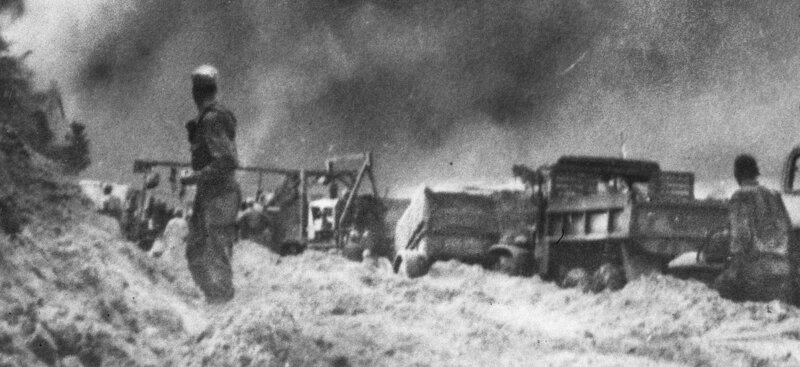
Firestorm at Hollandia
Posted from warfarehistorynetwork.com WWII World War Two
 World History
 Japan
Japan Military History
Posted 7 mo ago
Responses: 2

3
3
0

1
1
0

Funny how MacArthur used the 41st as the spearhead in quite a few operations as he hated the division for some reason. The Jungleers made quite a name for themselves despite MacArthur's dislike of them.
(1)
(0)
MSG (Join to see)
The Rainbow Division was his idea. Pull together a Division element of already trained National Guard troops cutting the time to produce a new division. Odd that he'd hate it.
Oklahoma's 700th Support Battlion has its roots in the 120th Quartermaster Company and 120th Maintenance Company that were pulled into the 42nd for WWI and the 42nd was reactivated for WWII at Camp Gruber, OK.
Oklahoma's 700th Support Battlion has its roots in the 120th Quartermaster Company and 120th Maintenance Company that were pulled into the 42nd for WWI and the 42nd was reactivated for WWII at Camp Gruber, OK.
(0)
(0)
Read This Next


 Continue with Facebook
 Continue with Google