
Posted on Jan 19, 2021

Pentagon Accelerates Efforts to Root Out Far-Right Extremism in the Ranks

8.46K
54
31
8
8
0
Our Defense Department does not have a political bias, and they are aware of basic moral principles. One does not take up arms to vote or protest rulings of Federal Courts on election law. If one thinks an official is sending you to attack the White House, Capital, or Supreme Court you don't go with your feelings about it, you ask yourself "Do I understand what I think I am hearing? Is this a lawful order?

Pentagon Accelerates Efforts to Root Out Far-Right Extremism in the Ranks
Posted from nytimes.com Constitution
 Chain of Command
 Justice
 Fascism
 Morals
Posted 5 y ago
Responses: 11
12
12
0

PO1 (Join to see)
Lunacy - that reminds me, in this time of stress, perhaps I can find some old MASH reruns.
(0)
(0)
8
8
0

As is typical of the US military, they start dealing with a problem only after it has become highly visible. This is the same way they started dealing with sexual harassment and assault and race. It's not about getting rid of the problem, it's about being seen as managing the problem until the scrutiny goes away.
(8)
(0)
3
2
1

One maybe far right in their politics if they voted for Trump. However, a white Supremist, like the Democratic Party, is left wing due to one party rule and identity politics. Not to mention eugenics.
The Old York Times wants low information voters to believe in a lie. Kind of like how SSgt Addison has fallen for the slight of hand.
Most white Supremist are not right wing. But do not let the truth get in the way of a lie to make a common enemy. In this case, all white males in the guard are suspect. Because a majority of white males voted for Trump.
This is true racism at it's core. Just as Hitler made the common enemy Jews. The Democrats make the common enemy the Saxon. One group was docile. The other come from a long line of war like peoples. Which I believe, is the desired intention. Division and bloodshed.
The Old York Times wants low information voters to believe in a lie. Kind of like how SSgt Addison has fallen for the slight of hand.
Most white Supremist are not right wing. But do not let the truth get in the way of a lie to make a common enemy. In this case, all white males in the guard are suspect. Because a majority of white males voted for Trump.
This is true racism at it's core. Just as Hitler made the common enemy Jews. The Democrats make the common enemy the Saxon. One group was docile. The other come from a long line of war like peoples. Which I believe, is the desired intention. Division and bloodshed.
(3)
(1)
MSG Stan Hutchison
Cpl Mark A. Morris - I see you have bought into that fable. Ok, fine. You have a nice day.
(1)
(0)
SSG Robert Webster
SGT Edward Wilcox - Using Wikipedia to define National Socialist, really? I wouldn't be surprised if you tried that tired trick with Fascism as well. ROFLMAO! Please continue drinking that Kool-Aid, at least it is not laced with potassium cyanide.
But then again your actions and comments illustrate how you are a useful innocent or useful idiot in practice.
In his 1947 book, Planned Chaos, Austrian-American economist Ludwig von Mises writes that the term useful innocents was used by Communists for liberals, whom von Mises describes as "confused and misguided sympathizers".
The phrase useful idiot was supposedly coined by Lenin, but there is no evidence of that, however, some would like to attribute it to Stalin.
What I think, it is an American term to describe the same thing as what the Italian meant it to be when they used the term useful innocent.
And then from academia sources of support -
"That being said, to all the true believers; God bless you, and keep marching!
To you who are unsure, or are marching because its exciting and the cool thing to do; don’t be an idiot! Don’t be a tool that can be used and then thrown aside when its usefulness ends.
The best way to prevent that is to arm yourself with knowledge before you gird your loins for protest. Conduct thorough research about the cause behind the marches and the people leading them. That will mean getting outside your echo chamber — that personal space filled only with material that reflects, or echoes, your beliefs."
So Mr. Wilcox please continue to show how innocent and idiotic you can be.
But then again your actions and comments illustrate how you are a useful innocent or useful idiot in practice.
In his 1947 book, Planned Chaos, Austrian-American economist Ludwig von Mises writes that the term useful innocents was used by Communists for liberals, whom von Mises describes as "confused and misguided sympathizers".
The phrase useful idiot was supposedly coined by Lenin, but there is no evidence of that, however, some would like to attribute it to Stalin.
What I think, it is an American term to describe the same thing as what the Italian meant it to be when they used the term useful innocent.
And then from academia sources of support -
"That being said, to all the true believers; God bless you, and keep marching!
To you who are unsure, or are marching because its exciting and the cool thing to do; don’t be an idiot! Don’t be a tool that can be used and then thrown aside when its usefulness ends.
The best way to prevent that is to arm yourself with knowledge before you gird your loins for protest. Conduct thorough research about the cause behind the marches and the people leading them. That will mean getting outside your echo chamber — that personal space filled only with material that reflects, or echoes, your beliefs."
So Mr. Wilcox please continue to show how innocent and idiotic you can be.
(1)
(0)
SSG Robert Webster
Capt Gregory Prickett - Really?
Nazi ideology could not accept an autonomous establishment whose legitimacy did not spring from the government. It desired the subordination of the church to the state. Although the broader membership of the Nazi Party after 1933 came to include many Catholics and Protestants, aggressive anti-Church radicals like Joseph Goebbels, Martin Bormann, and Heinrich Himmler saw the Kirchenkampf campaign against the Churches as a priority concern, and anti-church and anticlerical sentiments were strong among grassroots party activists.
Even though Hitler professed that his movement was Christian, it is well documented that they were no such thing.
But then again you are either a professed ashiest or agnostic aren't you? Either way, you act exactly the same as they did in this regard, therefor you are no different than them. There are several excellent works available on this very subject. Here is one such work - The Nazi Persecution of the Churches, 1933-1945 By John S. Conway; Regent College Publishing.
Christianity remained the dominant religion in Germany through the Nazi period, and its influence over Germans displeased the Nazi hierarchy. Evans wrote that Hitler believed that in the long run Nazism and religion would not be able to coexist, and stressed repeatedly that it was a secular ideology, founded on modern science. According to Evans: "Science, he declared, would easily destroy the last remaining vestiges of superstition." Germany could not tolerate the intervention of foreign influences such as the Pope, and "Priests, he said, were 'black bugs,' abortions in black cassocks.'"
Richard J. Evans; The Third Reich at War; Penguin Press; New York 2009
A number of historians maintain that the Nazis had a general covert plan, which some argue existed before the Nazis' rose to power, to destroy Christianity within the Reich. To what extent a plan to subordinate the churches and limit their role in the country's life existed before the Nazi rise to power, and exactly who among the Nazi leadership supported such a move remains contested." However, a minority of historians maintain, against consensus, that no such plan existed.
Bonney, Richard, Confronting the Nazi war on Christianity: the Kulturkampf newsletters, 1936-1939
Steigmann-Gall, Richard (2003)' The Holy Reich: Nazi Conceptions of Christianity, 1919-1945. Cambridge: Cambridge University Press.
Snyder, Louis L. (1981) Hitler's Third Reich: A Documentary History. New York: Nelson-Hall.
Dutton, Donald G. (2007). The Psychology of Genocide, Massacres, and Extreme Violence. Westport, CT: Greenwood Publishing Group.
Heschel, Susannah (2008). The Aryan Jesus. Princeton NJ: Princeton University Press.
Confino, Alon (2014). A World Without Jews: The Nazi Imagination from Persecution to Genocide. New York: Yale University Press.
Confino, Alon (2011). Foundational Pasts: The Holocaust as Historical Understanding. Cambridge: Cambridge University Press.
Nazi ideology could not accept an autonomous establishment whose legitimacy did not spring from the government. It desired the subordination of the church to the state. Although the broader membership of the Nazi Party after 1933 came to include many Catholics and Protestants, aggressive anti-Church radicals like Joseph Goebbels, Martin Bormann, and Heinrich Himmler saw the Kirchenkampf campaign against the Churches as a priority concern, and anti-church and anticlerical sentiments were strong among grassroots party activists.
Even though Hitler professed that his movement was Christian, it is well documented that they were no such thing.
But then again you are either a professed ashiest or agnostic aren't you? Either way, you act exactly the same as they did in this regard, therefor you are no different than them. There are several excellent works available on this very subject. Here is one such work - The Nazi Persecution of the Churches, 1933-1945 By John S. Conway; Regent College Publishing.
Christianity remained the dominant religion in Germany through the Nazi period, and its influence over Germans displeased the Nazi hierarchy. Evans wrote that Hitler believed that in the long run Nazism and religion would not be able to coexist, and stressed repeatedly that it was a secular ideology, founded on modern science. According to Evans: "Science, he declared, would easily destroy the last remaining vestiges of superstition." Germany could not tolerate the intervention of foreign influences such as the Pope, and "Priests, he said, were 'black bugs,' abortions in black cassocks.'"
Richard J. Evans; The Third Reich at War; Penguin Press; New York 2009
A number of historians maintain that the Nazis had a general covert plan, which some argue existed before the Nazis' rose to power, to destroy Christianity within the Reich. To what extent a plan to subordinate the churches and limit their role in the country's life existed before the Nazi rise to power, and exactly who among the Nazi leadership supported such a move remains contested." However, a minority of historians maintain, against consensus, that no such plan existed.
Bonney, Richard, Confronting the Nazi war on Christianity: the Kulturkampf newsletters, 1936-1939
Steigmann-Gall, Richard (2003)' The Holy Reich: Nazi Conceptions of Christianity, 1919-1945. Cambridge: Cambridge University Press.
Snyder, Louis L. (1981) Hitler's Third Reich: A Documentary History. New York: Nelson-Hall.
Dutton, Donald G. (2007). The Psychology of Genocide, Massacres, and Extreme Violence. Westport, CT: Greenwood Publishing Group.
Heschel, Susannah (2008). The Aryan Jesus. Princeton NJ: Princeton University Press.
Confino, Alon (2014). A World Without Jews: The Nazi Imagination from Persecution to Genocide. New York: Yale University Press.
Confino, Alon (2011). Foundational Pasts: The Holocaust as Historical Understanding. Cambridge: Cambridge University Press.
(1)
(0)
SGT Edward Wilcox
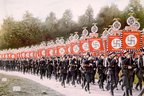
SSG Robert Webster here, is this better? https://www.britannica.com/event/Nazism
Nazism | Definition, Leaders, Ideology, & History
Nazism, totalitarian movement led by Adolf Hitler as head of the Nazi Party in Germany, characterized by intense nationalism, mass appeal, dictatorial rule, and a vision of annihilation of all enemies of the Aryan Volk as the one and only goal of Nazi policy.
(0)
(0)
Read This Next


 Continue with Facebook
 Continue with Google