
Posted on Jan 20, 2025

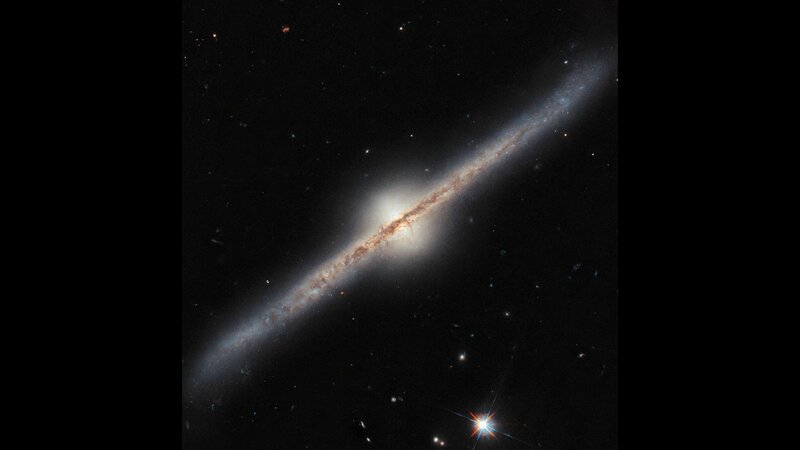
Space photo of the week: The tilted spiral galaxy that took Hubble 23 years to capture

2.12K
15
2
11
11
0
Like most full-color images of space objects, it's a composite of images taken in different wavelengths of light. What sets this image apart, however, is that the data used to create it was collected during observation sessions in 2000 and 2023 — 23 years apart. That's one advantage of having a space telescope in orbit for so long: Hubble was launched from the space shuttle Discovery on April 24, 1990, and its long service has enabled it to capture a huge amount of data about every corner of the cosmos.
But besides the prolonged methods used to create it, it's also an unusual image on its face. Spiral galaxies — which account for about 60% of all galaxies in the universe, according to the European Space Agency — are, by chance, typically seen face-on when viewed from the solar system. That’s why spiral galaxies are typically associated with vivid spiral arms, which can only be seen from a face-on vantage. However, UGC 10043 is viewed edge-on, with its rings seemingly flattened into a line. This unique angle gives astronomers the chance to see how spiral galaxies are structured in 3D.
But besides the prolonged methods used to create it, it's also an unusual image on its face. Spiral galaxies — which account for about 60% of all galaxies in the universe, according to the European Space Agency — are, by chance, typically seen face-on when viewed from the solar system. That’s why spiral galaxies are typically associated with vivid spiral arms, which can only be seen from a face-on vantage. However, UGC 10043 is viewed edge-on, with its rings seemingly flattened into a line. This unique angle gives astronomers the chance to see how spiral galaxies are structured in 3D.
Space photo of the week: The tilted spiral galaxy that took Hubble 23 years to capture
Posted from livescience.com Photography
 Space
Space Astronomy
 Physics
 Science
Posted 11 mo ago


Read This Next


 Continue with Facebook
 Continue with Google