

3
3
0
Always like to post cool things from NASA. Hope many of you agree. Enjoy.
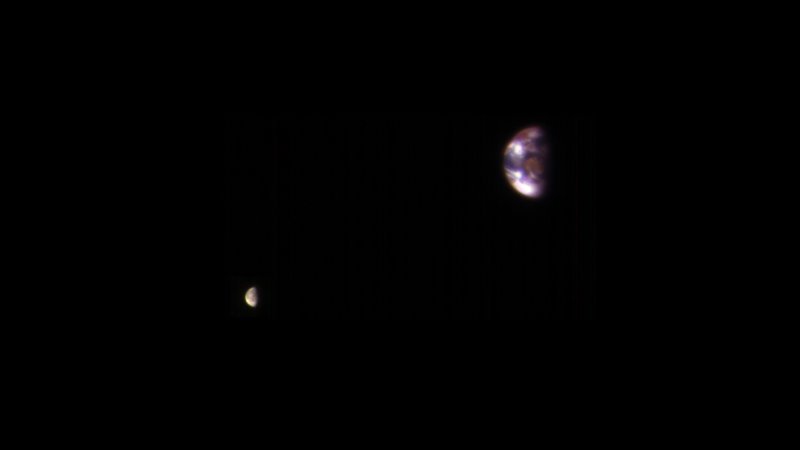
Your Home Planet, as Seen From Mars
Posted from nasa.gov NASA
NASA Space
Space Science
 Earth
Earth
Posted 9 y ago
Responses: 2

1
1
0

Maj William W. 'Bill' Price awesome read and share, I love astronomy. Thanks for posting!
http://www.jpl.nasa.gov/spaceimages/details.php?id=PIA21260
The image combines two separate exposures taken on Nov. 20, 2016, by the High Resolution Imaging Science Experiment (HiRISE) camera on NASA's Mars Reconnaissance Orbiter. The images were taken to calibrate HiRISE data, since the reflectance of the moon's Earth-facing side is well known. For presentation, the exposures were processed separately to optimize detail visible on both Earth and the moon. The moon is much darker than Earth and would barely be visible if shown at the same brightness scale as Earth.
http://www.jpl.nasa.gov/spaceimages/details.php?id=PIA21260
The image combines two separate exposures taken on Nov. 20, 2016, by the High Resolution Imaging Science Experiment (HiRISE) camera on NASA's Mars Reconnaissance Orbiter. The images were taken to calibrate HiRISE data, since the reflectance of the moon's Earth-facing side is well known. For presentation, the exposures were processed separately to optimize detail visible on both Earth and the moon. The moon is much darker than Earth and would barely be visible if shown at the same brightness scale as Earth.
Earth and Its Moon, as Seen From Mars
This composite image of Earth and its moon, as seen from Mars, combines the best Earth image with the best moon image from four sets of images acquired on Nov. 20, 2016, by NASA's Mars Reconnaissance Orbiter. Mars was about 127 million miles from Earth.
(1)
(0)
0
0
0

Read This Next


 Continue with Facebook
 Continue with Google