

Law Enforcement

Law Enforcement

7
7
0
I asked a question earlier about getting a LEOSA card. Have you had any experience having to present it to law enforcement, and how did that play out? Did they know what it was? Were they confused by it? Did they know enough to ask for your qualification?
 Law Enforcement
 Law
Law Gun Control
Edited 3 d ago
Posted 3 d ago
Responses: 4

There is no mandatory requirement for law enforcement agencies to be trained on, or even given familiarity with, the Law Enforcement Officers Safety Act (LEOSA).
Due to that, there have been a number of individuals, properly credentialed under LEOSA and complying with the applicable restrictions, who were arrested and charged with violations of local/state gun laws because the police officers and the prosecutor didn't understand the law and/or thought that the state's law for concealed carry permits took precedence.
Most of those arrests/prosecutions occurred in the first few years following the passage of LEOSA in 2004. Since then, most have occured because individuals (such as Department of Correction employees) didn't "fit the mold" of a "retired law enforcement officer".
In other words, LEOSA won't keep you from being arrested, but will serve as an affirmative defense if prosecuted (the same as a "stand your ground" law wouldn't prevent you from being arrested, but would serve as an affirmative defense if prosecuted).
In all cases where the individual was properly carrying a concealed firearm under LEOSA, the arrest and/or charge was eventually overturned. As recently as 2022, the state of New Jersey would not fully honor LEOSA and imposed its own permit restrictions and/or interpretations of the impact of LEOSA on the state. The most egregious example was in 2018 where a prison guard received a five-year sentence in New Jersey for a gun conviction. The conviction was overturned, but the individual had already served three of the five years sentence (New Jersey v. Dana Johnson*)
What does all this mean, specifically in regards to your question. Recognition of LEOSA appears to be hit or miss. While most LEOs have a passing familiarity with it, many do not understand it fully so you should expect the officer to have some confusion, even on what they should do under the law (e.g., the differences under 18 U.S.C. between currently serving law enforcement personnel those that are separated/retired).
The NRA Law Enforcement Division* and the Fraternal Order of Police* recommend that you fully read through and adhere to all the requirements of LEOSA and, even though it isn't required under LEOSA, obtain a state issued carry permit if possible.
--------------------------------------------
* State of New Jersey v. Dana R. Johnson - https://cases.justia.com/new-jersey/appellate-division-unpublished/2022-a-5622-18.pdf
* NRA Law Enforcement Division - https://le.nra.org/understanding-leosa/
* Fraternal Order of Police - Information on the Law Enforcement Officers' Safety Act (LEOSA) - https://fop.net/government-and-media-affairs/legislative-resources/hr218-leosa/
Reference:
* LEOSA - Army - https://leosaarmy.com/
* DoDI 5525.12, "Implementation of the Law Enforcement Officers Safety Act" - https://www.esd.whs.mil/Portals/54/Documents/DD/issuances/dodi/552512p.pdf
* 18 U.S. Code, Chapter 44, Section 926C - Carrying of concealed firearms by qualified retired law enforcement officers - https://www.law.cornell.edu/uscode/text/18/926C
Due to that, there have been a number of individuals, properly credentialed under LEOSA and complying with the applicable restrictions, who were arrested and charged with violations of local/state gun laws because the police officers and the prosecutor didn't understand the law and/or thought that the state's law for concealed carry permits took precedence.
Most of those arrests/prosecutions occurred in the first few years following the passage of LEOSA in 2004. Since then, most have occured because individuals (such as Department of Correction employees) didn't "fit the mold" of a "retired law enforcement officer".
In other words, LEOSA won't keep you from being arrested, but will serve as an affirmative defense if prosecuted (the same as a "stand your ground" law wouldn't prevent you from being arrested, but would serve as an affirmative defense if prosecuted).
In all cases where the individual was properly carrying a concealed firearm under LEOSA, the arrest and/or charge was eventually overturned. As recently as 2022, the state of New Jersey would not fully honor LEOSA and imposed its own permit restrictions and/or interpretations of the impact of LEOSA on the state. The most egregious example was in 2018 where a prison guard received a five-year sentence in New Jersey for a gun conviction. The conviction was overturned, but the individual had already served three of the five years sentence (New Jersey v. Dana Johnson*)
What does all this mean, specifically in regards to your question. Recognition of LEOSA appears to be hit or miss. While most LEOs have a passing familiarity with it, many do not understand it fully so you should expect the officer to have some confusion, even on what they should do under the law (e.g., the differences under 18 U.S.C. between currently serving law enforcement personnel those that are separated/retired).
The NRA Law Enforcement Division* and the Fraternal Order of Police* recommend that you fully read through and adhere to all the requirements of LEOSA and, even though it isn't required under LEOSA, obtain a state issued carry permit if possible.
--------------------------------------------
* State of New Jersey v. Dana R. Johnson - https://cases.justia.com/new-jersey/appellate-division-unpublished/2022-a-5622-18.pdf
* NRA Law Enforcement Division - https://le.nra.org/understanding-leosa/
* Fraternal Order of Police - Information on the Law Enforcement Officers' Safety Act (LEOSA) - https://fop.net/government-and-media-affairs/legislative-resources/hr218-leosa/
Reference:
* LEOSA - Army - https://leosaarmy.com/
* DoDI 5525.12, "Implementation of the Law Enforcement Officers Safety Act" - https://www.esd.whs.mil/Portals/54/Documents/DD/issuances/dodi/552512p.pdf
* 18 U.S. Code, Chapter 44, Section 926C - Carrying of concealed firearms by qualified retired law enforcement officers - https://www.law.cornell.edu/uscode/text/18/926C
(4)
(0)

PO3 Phyllis Maynard
COL Randall Cudworth I put all of this information in a file. I will ask the local law enforcement about application, in North Carolina.
(1)
(0)
COL Randall Cudworth

PO3 Phyllis Maynard - You don't apply for a LEOSA card from the local law enforcement agency unless that was the agency you are employed at or separated from.
LEOSA* allows for qualified current or separated law enforcement officers to basically have a nationwide concealed carry permit as long as they meet all the eligibility criteria, regardless of state and local laws.
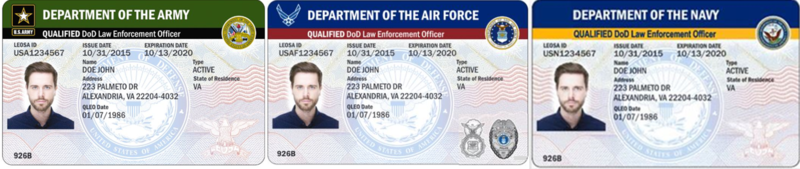
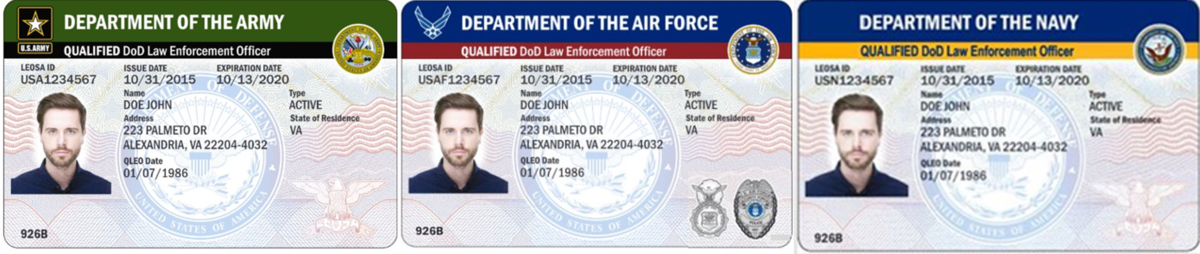
DoD has made it easier for individuals that meet the criteria of LEOSA to obtain credentials by standardizing the card (the only difference is the military department name on the card) and having one entity process them for all active or separated military (Defense Consulting Services, LLC). For example, active service members or veterans from the Army apply through the 'LEOSA - Army' website*; Navy individuals apply through the 'LEOSA - Navy' website*; etc.
-----------------------------------------
* HR 218/Law Enforcement Officers Safety Act (as amended by the 2013 NDAA) - https://le.nra.org/understanding-leosa/leosa/
* LEOSA - Army - https://leosaarmy.com/
* LEOSA - Navy - https://leosanavy.com/
LEOSA* allows for qualified current or separated law enforcement officers to basically have a nationwide concealed carry permit as long as they meet all the eligibility criteria, regardless of state and local laws.
DoD has made it easier for individuals that meet the criteria of LEOSA to obtain credentials by standardizing the card (the only difference is the military department name on the card) and having one entity process them for all active or separated military (Defense Consulting Services, LLC). For example, active service members or veterans from the Army apply through the 'LEOSA - Army' website*; Navy individuals apply through the 'LEOSA - Navy' website*; etc.
-----------------------------------------
* HR 218/Law Enforcement Officers Safety Act (as amended by the 2013 NDAA) - https://le.nra.org/understanding-leosa/leosa/
* LEOSA - Army - https://leosaarmy.com/
* LEOSA - Navy - https://leosanavy.com/
Law Enforcement, Military, Security
Detail of the Law Enforcement Officers Safety Act
(2)
(0)
PO3 Phyllis Maynard
COL Randall Cudworth thank you. I have retired and former military friends on the police force and sheriff's department.
(1)
(0)
CW3 Richard "Lee" Doty
Yeah, this confirmed what I thought might be the case. The one reference you you cited, to me, is the most troubling. The judge really screwed up on that one, and as a result, that guy spent three years in prison. Thanks for the write-up.
(1)
(0)
4
4
0

I imagine law enforcement wouldn't be confused by it since it concerns law enforcement. I haven't had to show anything other than my driver's license and I was very young when I did. Wish I could be more helpful.
(4)
(0)
0
0
0

Pennsylvania Issues An LEOSA Permit To Former And Retired Police And Corrections Officers.
I Have Maintained What Is Called Act 235 Certification , Special Police Officer Certification.
I Also Have Concealed Carry Permits Issued From Multiple States That I Travel To On A Regular Basis So I Can Legally Carry In Any Of The States That Recognize Other States Permits.
I Have Maintained What Is Called Act 235 Certification , Special Police Officer Certification.
I Also Have Concealed Carry Permits Issued From Multiple States That I Travel To On A Regular Basis So I Can Legally Carry In Any Of The States That Recognize Other States Permits.
(0)
(0)
Read This Next


 Continue with Facebook
 Continue with Google