

Medals

Medals


11
11
0
THE "Colonel's" MEDAL OF HONOR SERIES (Covering the period from 1861 to 1862 in alphabetic order)
Civil War
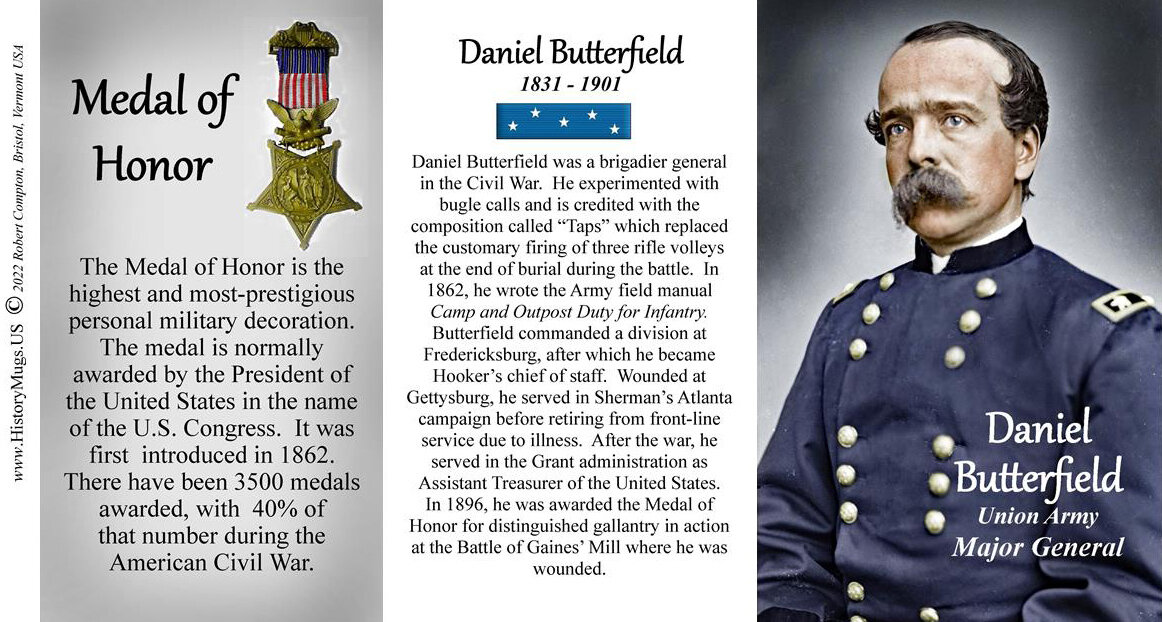
Brigadier General (Highest Rank: Major General) Daniel Adams Butterfield, U.S. Army, U.S. Volunteers, Year of Action: 1862, Location of Action: Gaines' Mill, Virginia.
Rank and organization: Brigadier General, U.S. Volunteers. Place and date: At Gaines Mill, Va., June 27, 1862. Entered service at: Washington, D.C. Born: October 31, 1831, Utica, N.Y. Date of issue: September 26, 1892.
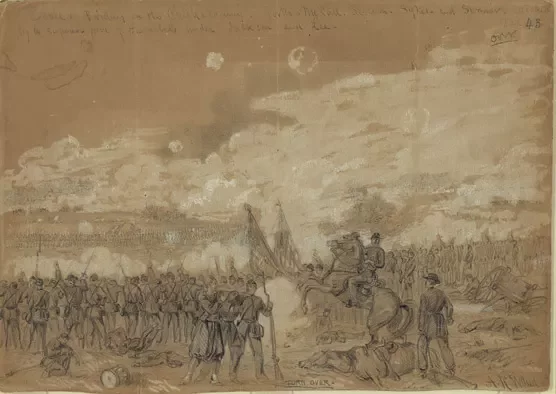
When his brigade lost more than six hundred men in the Battle of Gaines Mill, then-Brig. Gen. Butterfield took up the colors of the 83rd Pennsylvania Volunteers. Under heavy enemy fire, he encouraged the depleted ranks to regroup and continue the battle. Thirty years later, he awarded the Medal of Honor on September 26, 1892 “for distinguished gallantry in action at Gaines Mills, Virginia on June 27, 1862”
Medal of Honor Citation:
The President of the United States of America, in the name of Congress, takes pleasure in presenting the Medal of Honor to Brigadier General Daniel Adams Butterfield, United States Army, for extraordinary heroism on 27 June 1862, while serving with U.S. Volunteers, in action at Gaines Mill, Virginia. Brigadier General Butterfield seized the colors of the 83d Pennsylvania Volunteers at a critical moment and, under a galling fire of the enemy, encouraged the depleted ranks to renewed exertion.
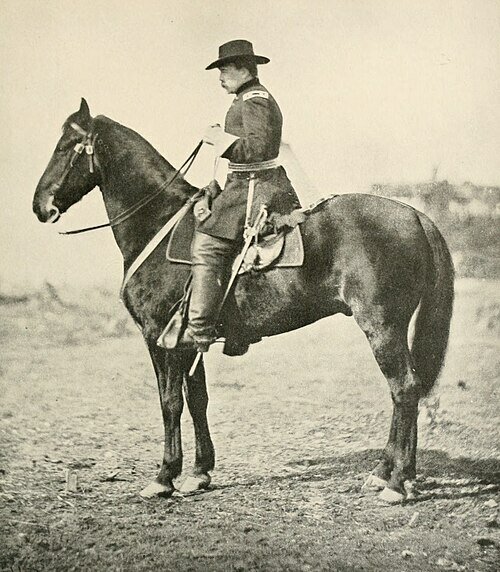
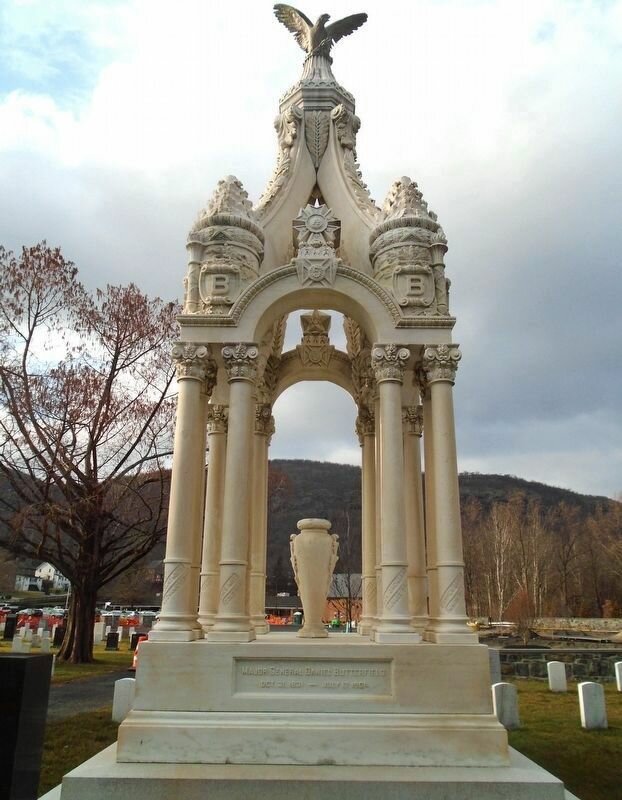
Daniel Adams Butterfield (October 31, 1831 – July 17, 1901) was a New York businessman, a Union general in the U.S. Civil War, and Assistant Treasurer of the United States.
After working for American Express, co-founded by his father, Butterfield served in the Civil War, where he was soon promoted brigadier general, and wounded at Gaines' Mill. While recuperating, he either wrote a bugle call for burials, called Taps. He commanded a division at Fredericksburg, and then became General Joseph Hooker's chief of staff for the Army of the Potomac, sharing both the credit for improved morale and responsibility for the licentious behavior that Hooker tolerated in camp. He also became embroiled in Hooker’s political feuds with Generals Ambrose Burnside and George Gordon Meade. When Meade took over the Army from Hooker, he attempted to replace Butterfield, but his chosen candidates preferred to stay in their current assignments, so Butterfield stayed on as chief of staff, to Meade's dissatisfaction.
Wounded at Gettysburg, Meade sent Butterfield away to recuperate. He then served in William T. Sherman’s Atlanta campaign, before retiring from front-line service through illness. He later received the Medal of Honor.
In Ulysses S. Grant's presidential administration, he was Assistant Treasurer of the United States, abusing that position to manipulate the price of gold, and being forced to resign. He then resumed his business career.
Butterfield’s extensive war archives are displayed at Cold Spring, New York.
Butterfield was born on October 31, 1831, in Utica, New York. He attended Union Academy and then graduated in 1849, from Union College in Schenectady, New York, where he became a member of the Sigma Phi Society. That same year, his father, John Warren Butterfield, founded the express company of Butterfield, Wasson, and Co., which later became the American Express Company. After graduating, Daniel studied law but as he was too young to sit the New York bar exam, he toured the country instead. Upon his return to Utica, he joined the Utica Citizen’s Corps as a private. He was employed in various businesses in New York and the South, including the American Express Company, which had been co-founded by his father, an owner of the Overland Mail Company, stage-coaches, steamships and telegraph lines.
Union General Daniel Butterfield went to New York City as superintendent of the eastern division of his father's company. There, he joined the Seventy-First regiment of New York militia as a captain. Shortly after the fall of Fort Sumter, Butterfield joined the Clay Guards of Washington, D.C., as a first sergeant, but subsequently transferred to the 12th New York Volunteer Infantry as a colonel.[2]
He was commissioned brigadier and major general of the Volunteers and commanded a division of the V Corps. He fought at the First Battle of Bull Run on 21 July 1861. He wrote the 1862 Army field manual, Camp and Outpost Duty for Infantry.
Butterfield joined Maj. Gen. George B. McClellan's Army of the Potomac for the Peninsula Campaign in the V Corps, commanded by Maj. Gen. Fitz John Porter. In the Seven Days Battles, at Gaines' Mill on June 27, 1862, he was wounded but demonstrated the bravery that was eventually recognized in 1892, with the Medal of Honor.
Butterfield continued in brigade command at the Second Battle of Bull Run and the Battle of Antietam, became division commander and then V Corps commander for the Battle of Fredericksburg. His corps was one of those assaulting through the city before facing an assault from Marye's Heights. After the debacles of Fredericksburg and the Mud March, Maj. Gen. Joseph Hooker replaced Ambrose Burnside as Army of the Potomac commander and Butterfield became Hooker's chief of staff in January 1863. Butterfield was promoted to major general of volunteers in March 1863, with a date of rank of November 29, 1862.
Hooker and Butterfield developed a close personal and political relationship. To the disgust of many army generals, their headquarters were frequented by women and liquor, being described as a combination of a "bar and brothel".[citation needed] Political infighting became rampant in the high command and Butterfield was widely disliked by most of his colleagues.[citation needed] However, in the spring of 1863, the two officers managed to turn around the poor morale of the army and greatly improved food, shelter and medical support. During this period Butterfield introduced another custom that remains in the Army today: the use of distinctive hat or shoulder patches to denote the unit to which a soldier belongs, in this case the corps. He was inspired by the division patches used earlier by Maj. Gen. Philip Kearny, but extended those to the full army; Butterfield designed most of the patches himself.
Hooker was replaced after the Battle of Chancellorsville by Maj. Gen. George G. Meade, just before the Battle of Gettysburg. Meade distrusted Butterfield, but retained him as chief of staff. Butterfield was wounded at Gettysburg on July 3, 1863, and left active duty to convalesce. Meade removed him as chief of staff on July 14, 1863. On July 1, 1863, Butterfield was appointed as colonel of the 5th United States Infantry.
After Gettysburg, Butterfield actively undermined Meade in cooperation with Maj. Gen. Daniel Sickles, another crony of Hooker's. Although the battle was a great Union victory, Sickles and Butterfield testified to the Joint Committee on the Conduct of the War that Meade vacillated and planned as early as July 1, to retreat from Gettysburg, thus damaging his reputation. Butterfield's chief evidence for this assertion was the Pipe Creek Circular that Meade had his staff prepare before it became apparent there would be a battle at Gettysburg.
Butterfield returned to duty that fall as chief of staff once again for Hooker, now commanding two corps in the Army of the Cumberland at Chattanooga, Tennessee. When these two depleted corps (the XI and XII Corps) were combined to form the XX Corps, Butterfield was given the 3rd Division, which he led through the first half of Sherman's Atlanta campaign. Illness prevented his continuing with Sherman, resulting in Butterfield's assuming light duties at Vicksburg, Mississippi, followed by recruiting and the command of harbor forces in New York.
While the Union Army recuperated at Harrison's Landing, Virginia, from its grueling withdrawal during the Seven Days Battles, Butterfield experimented with bugle calls and is credited with the composition of Taps. He wrote Taps to replace the customary firing of three rifle volleys at the end of burials during battle. Taps also replaced Tattoo, the French bugle call to signal lights out. Butterfield's bugler, Private Oliver W. Norton of the 83rd Pennsylvania Volunteers, was the first to sound the new call. Within months, Taps was played by buglers in both the Union and Confederate armies.
This account has been disputed by some who think Butterfield made an arrangement of another bugle call known as the Scott Tattoo rather than compose an original work. However, both Butterfield and Norton wrote letters saying that Butterfield composed the tune and sounded it out for Norton to transcribe on paper. Field commanders were known to play bugle calls when needed as that is how they gave orders in the field.
It is customary for those in uniform to render a hand salute, and those in civilian clothes to place the right hand over the heart and stand at attention while Taps is sounded.
Civil War
Brigadier General (Highest Rank: Major General) Daniel Adams Butterfield, U.S. Army, U.S. Volunteers, Year of Action: 1862, Location of Action: Gaines' Mill, Virginia.
Rank and organization: Brigadier General, U.S. Volunteers. Place and date: At Gaines Mill, Va., June 27, 1862. Entered service at: Washington, D.C. Born: October 31, 1831, Utica, N.Y. Date of issue: September 26, 1892.
When his brigade lost more than six hundred men in the Battle of Gaines Mill, then-Brig. Gen. Butterfield took up the colors of the 83rd Pennsylvania Volunteers. Under heavy enemy fire, he encouraged the depleted ranks to regroup and continue the battle. Thirty years later, he awarded the Medal of Honor on September 26, 1892 “for distinguished gallantry in action at Gaines Mills, Virginia on June 27, 1862”
Medal of Honor Citation:
The President of the United States of America, in the name of Congress, takes pleasure in presenting the Medal of Honor to Brigadier General Daniel Adams Butterfield, United States Army, for extraordinary heroism on 27 June 1862, while serving with U.S. Volunteers, in action at Gaines Mill, Virginia. Brigadier General Butterfield seized the colors of the 83d Pennsylvania Volunteers at a critical moment and, under a galling fire of the enemy, encouraged the depleted ranks to renewed exertion.
Daniel Adams Butterfield (October 31, 1831 – July 17, 1901) was a New York businessman, a Union general in the U.S. Civil War, and Assistant Treasurer of the United States.
After working for American Express, co-founded by his father, Butterfield served in the Civil War, where he was soon promoted brigadier general, and wounded at Gaines' Mill. While recuperating, he either wrote a bugle call for burials, called Taps. He commanded a division at Fredericksburg, and then became General Joseph Hooker's chief of staff for the Army of the Potomac, sharing both the credit for improved morale and responsibility for the licentious behavior that Hooker tolerated in camp. He also became embroiled in Hooker’s political feuds with Generals Ambrose Burnside and George Gordon Meade. When Meade took over the Army from Hooker, he attempted to replace Butterfield, but his chosen candidates preferred to stay in their current assignments, so Butterfield stayed on as chief of staff, to Meade's dissatisfaction.
Wounded at Gettysburg, Meade sent Butterfield away to recuperate. He then served in William T. Sherman’s Atlanta campaign, before retiring from front-line service through illness. He later received the Medal of Honor.
In Ulysses S. Grant's presidential administration, he was Assistant Treasurer of the United States, abusing that position to manipulate the price of gold, and being forced to resign. He then resumed his business career.
Butterfield’s extensive war archives are displayed at Cold Spring, New York.
Butterfield was born on October 31, 1831, in Utica, New York. He attended Union Academy and then graduated in 1849, from Union College in Schenectady, New York, where he became a member of the Sigma Phi Society. That same year, his father, John Warren Butterfield, founded the express company of Butterfield, Wasson, and Co., which later became the American Express Company. After graduating, Daniel studied law but as he was too young to sit the New York bar exam, he toured the country instead. Upon his return to Utica, he joined the Utica Citizen’s Corps as a private. He was employed in various businesses in New York and the South, including the American Express Company, which had been co-founded by his father, an owner of the Overland Mail Company, stage-coaches, steamships and telegraph lines.
Union General Daniel Butterfield went to New York City as superintendent of the eastern division of his father's company. There, he joined the Seventy-First regiment of New York militia as a captain. Shortly after the fall of Fort Sumter, Butterfield joined the Clay Guards of Washington, D.C., as a first sergeant, but subsequently transferred to the 12th New York Volunteer Infantry as a colonel.[2]
He was commissioned brigadier and major general of the Volunteers and commanded a division of the V Corps. He fought at the First Battle of Bull Run on 21 July 1861. He wrote the 1862 Army field manual, Camp and Outpost Duty for Infantry.
Butterfield joined Maj. Gen. George B. McClellan's Army of the Potomac for the Peninsula Campaign in the V Corps, commanded by Maj. Gen. Fitz John Porter. In the Seven Days Battles, at Gaines' Mill on June 27, 1862, he was wounded but demonstrated the bravery that was eventually recognized in 1892, with the Medal of Honor.
Butterfield continued in brigade command at the Second Battle of Bull Run and the Battle of Antietam, became division commander and then V Corps commander for the Battle of Fredericksburg. His corps was one of those assaulting through the city before facing an assault from Marye's Heights. After the debacles of Fredericksburg and the Mud March, Maj. Gen. Joseph Hooker replaced Ambrose Burnside as Army of the Potomac commander and Butterfield became Hooker's chief of staff in January 1863. Butterfield was promoted to major general of volunteers in March 1863, with a date of rank of November 29, 1862.
Hooker and Butterfield developed a close personal and political relationship. To the disgust of many army generals, their headquarters were frequented by women and liquor, being described as a combination of a "bar and brothel".[citation needed] Political infighting became rampant in the high command and Butterfield was widely disliked by most of his colleagues.[citation needed] However, in the spring of 1863, the two officers managed to turn around the poor morale of the army and greatly improved food, shelter and medical support. During this period Butterfield introduced another custom that remains in the Army today: the use of distinctive hat or shoulder patches to denote the unit to which a soldier belongs, in this case the corps. He was inspired by the division patches used earlier by Maj. Gen. Philip Kearny, but extended those to the full army; Butterfield designed most of the patches himself.
Hooker was replaced after the Battle of Chancellorsville by Maj. Gen. George G. Meade, just before the Battle of Gettysburg. Meade distrusted Butterfield, but retained him as chief of staff. Butterfield was wounded at Gettysburg on July 3, 1863, and left active duty to convalesce. Meade removed him as chief of staff on July 14, 1863. On July 1, 1863, Butterfield was appointed as colonel of the 5th United States Infantry.
After Gettysburg, Butterfield actively undermined Meade in cooperation with Maj. Gen. Daniel Sickles, another crony of Hooker's. Although the battle was a great Union victory, Sickles and Butterfield testified to the Joint Committee on the Conduct of the War that Meade vacillated and planned as early as July 1, to retreat from Gettysburg, thus damaging his reputation. Butterfield's chief evidence for this assertion was the Pipe Creek Circular that Meade had his staff prepare before it became apparent there would be a battle at Gettysburg.
Butterfield returned to duty that fall as chief of staff once again for Hooker, now commanding two corps in the Army of the Cumberland at Chattanooga, Tennessee. When these two depleted corps (the XI and XII Corps) were combined to form the XX Corps, Butterfield was given the 3rd Division, which he led through the first half of Sherman's Atlanta campaign. Illness prevented his continuing with Sherman, resulting in Butterfield's assuming light duties at Vicksburg, Mississippi, followed by recruiting and the command of harbor forces in New York.
While the Union Army recuperated at Harrison's Landing, Virginia, from its grueling withdrawal during the Seven Days Battles, Butterfield experimented with bugle calls and is credited with the composition of Taps. He wrote Taps to replace the customary firing of three rifle volleys at the end of burials during battle. Taps also replaced Tattoo, the French bugle call to signal lights out. Butterfield's bugler, Private Oliver W. Norton of the 83rd Pennsylvania Volunteers, was the first to sound the new call. Within months, Taps was played by buglers in both the Union and Confederate armies.
This account has been disputed by some who think Butterfield made an arrangement of another bugle call known as the Scott Tattoo rather than compose an original work. However, both Butterfield and Norton wrote letters saying that Butterfield composed the tune and sounded it out for Norton to transcribe on paper. Field commanders were known to play bugle calls when needed as that is how they gave orders in the field.
It is customary for those in uniform to render a hand salute, and those in civilian clothes to place the right hand over the heart and stand at attention while Taps is sounded.
 Medal of Honor
 Medals
 Civil War
 Military History
 Heroes
Edited 2 d ago
Posted 3 d ago


Read This Next


 Continue with Facebook
 Continue with Google