

Palestine

Palestine
Posted on Nov 2, 2025

Balfour Declaration letter written | November 2, 1917 | HISTORY

528
4
3
2
2
0
The start of the modern history of the Middle East...
On November 2, 1917, Foreign Secretary Arthur James Balfour writes an important letter to Britain’s most illustrious Jewish citizen, Baron Lionel Walter Rothschild, expressing the British government’s support for a Jewish homeland in Palestine. The letter would eventually become known as the Balfour Declaration.
Britain’s support for the Zionist movement came from its concerns regarding the direction of the First World War. Aside from a genuine belief in the righteousness of Zionism, held by Lloyd George among others, Britain’s leaders hoped that a statement supporting Zionism would help gain Jewish support for the Allies.
On November 2, Balfour sent his letter to Lord Rothschild, a prominent Zionist and a friend of Chaim Weizmann, stating that: “His Majesty’s Government view with favor the establishment in Palestine of a national home for the Jewish people.”
The influence of the Balfour Declaration on the course of post-war events was immediate: According to the “mandate” system created by the Versailles Treaty of 1919, Britain was entrusted with the administration of Palestine, with the understanding that it would work on behalf of both its Jewish and Arab inhabitants.
On November 2, 1917, Foreign Secretary Arthur James Balfour writes an important letter to Britain’s most illustrious Jewish citizen, Baron Lionel Walter Rothschild, expressing the British government’s support for a Jewish homeland in Palestine. The letter would eventually become known as the Balfour Declaration.
Britain’s support for the Zionist movement came from its concerns regarding the direction of the First World War. Aside from a genuine belief in the righteousness of Zionism, held by Lloyd George among others, Britain’s leaders hoped that a statement supporting Zionism would help gain Jewish support for the Allies.
On November 2, Balfour sent his letter to Lord Rothschild, a prominent Zionist and a friend of Chaim Weizmann, stating that: “His Majesty’s Government view with favor the establishment in Palestine of a national home for the Jewish people.”
The influence of the Balfour Declaration on the course of post-war events was immediate: According to the “mandate” system created by the Versailles Treaty of 1919, Britain was entrusted with the administration of Palestine, with the understanding that it would work on behalf of both its Jewish and Arab inhabitants.

Balfour Declaration letter written | November 2, 1917 | HISTORY
Posted from history.com Middle East
 World Affairs
 Palestine
 Israel
Posted 1 mo ago
Responses: 2
1
1
0

The problems that remain in the region started during WWI, with the Sykes-Picot Agreement secret treaty of 1916.
It preceded the 1917 Balfour Declaration the purpose of which was to renege on the treaty agreement regarding Palestine, to claim half the land that had been promised as an independent nation of Palestine to the secular Jewish Zionist movement for exclusive settelement of Jews, only.
Christian Zionist had pushed Jews to create a Jewish Zionist movement as an extension of Christian Zionism, though had not succeeded in convincing religious Jews. They eventually succeeded in convincing secular Jews, who organized the movement under the leadership of Herzel.
Clearly, the regional issues remain as an unsatisfactory resolution from WWI dissolution of the Ottoman Empire, The Treaty of Versailles and Paris Peace Conference which did not effectively resolve the chaos that had lead to WWI, and still remained regardless of the war's end.
https://manchesterhistorian.com/2016/the-partitioning-of-the-middle-east-after-wwi/
It preceded the 1917 Balfour Declaration the purpose of which was to renege on the treaty agreement regarding Palestine, to claim half the land that had been promised as an independent nation of Palestine to the secular Jewish Zionist movement for exclusive settelement of Jews, only.
Christian Zionist had pushed Jews to create a Jewish Zionist movement as an extension of Christian Zionism, though had not succeeded in convincing religious Jews. They eventually succeeded in convincing secular Jews, who organized the movement under the leadership of Herzel.
Clearly, the regional issues remain as an unsatisfactory resolution from WWI dissolution of the Ottoman Empire, The Treaty of Versailles and Paris Peace Conference which did not effectively resolve the chaos that had lead to WWI, and still remained regardless of the war's end.
https://manchesterhistorian.com/2016/the-partitioning-of-the-middle-east-after-wwi/
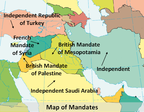
The Partitioning Of The Middle East
If you want to understand part of why the Middle East is such a volatile region today, a good place to start finding answers is the partitioning of the region
(1)
(0)
1
1
0

Read This Next


 Continue with Facebook
 Continue with Google