

Science

Science
Posted on Nov 22, 2023

Chaotic region shines bright with 500,00 stars in new JWST image

1.48K
37
7
17
17
0
A new image from NASA’s almost two-year-old James Webb Space Telescope features new details of a portion of our galaxy’s dense center for the first time. The image includes some parts of the star-forming hotspot that astronomers are still trying to fully understand. The region is named Sagittarius C and is about 300 light-years away from Sagittarius A*, or the supermassive black hole at the center of our galaxy.
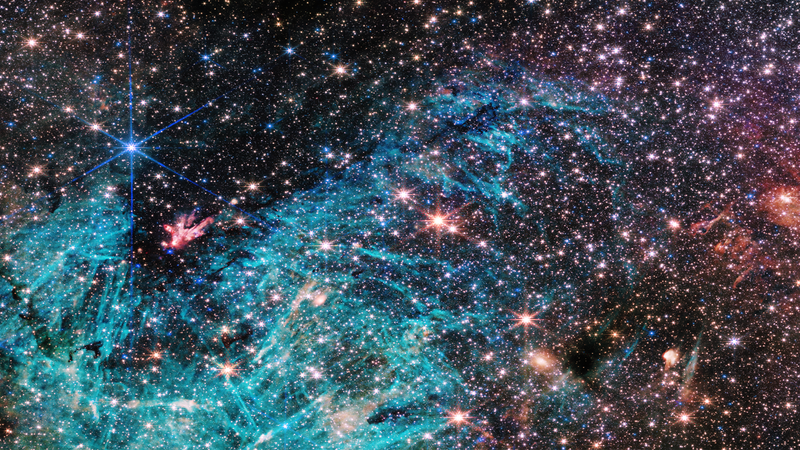
Chaotic region shines bright with 500,00 stars in new JWST image
Posted from popsci.com Science
 Photography
 Astronomy
 Space
Space Physics
Edited >1 y ago
Posted >1 y ago
Responses: 6
6
6
0

God is a very personable God, there has to be other living beings out there in the heavens, which are massive.
Someday, we will know it all.
Someday, we will know it all.
(6)
(0)
5
5
0

I suspect that half those that form into suns will slowly migrate outwards into the spiral arms as the other half slowly falls into the central blackhole.
There is a theory that calculates that approximately 1/3 of the star-material will form smaller blackholes that will either evaporate, orbit the central blackhole or migrate outwards/fall inwards.
As to IF the star-material and how much collects in with the smaller black holes (the ones that fall inward) or is thrown outwards is still in dispute. Part of this theory indicates that Oumuamua (1I/2017-U1), the first interstellar object detected passing through the Solar System is possibly some of this star-material. It's being formed in the 'weird conditions' of the blackhole's environ may account for its unusual properties of shape and (possibly a 'foamed structure' is one conjecture) density.
There is a theory that calculates that approximately 1/3 of the star-material will form smaller blackholes that will either evaporate, orbit the central blackhole or migrate outwards/fall inwards.
As to IF the star-material and how much collects in with the smaller black holes (the ones that fall inward) or is thrown outwards is still in dispute. Part of this theory indicates that Oumuamua (1I/2017-U1), the first interstellar object detected passing through the Solar System is possibly some of this star-material. It's being formed in the 'weird conditions' of the blackhole's environ may account for its unusual properties of shape and (possibly a 'foamed structure' is one conjecture) density.
(5)
(0)
5
5
0

Read This Next


 Continue with Facebook
 Continue with Google