
Your Response was posted! Click here to see it.
Posted on Sep 27, 2015

Have you read this important DCoE Blog: Sleep Issues Bedevil Soldiers’ Health?

6.34K
27
15
4
4
0
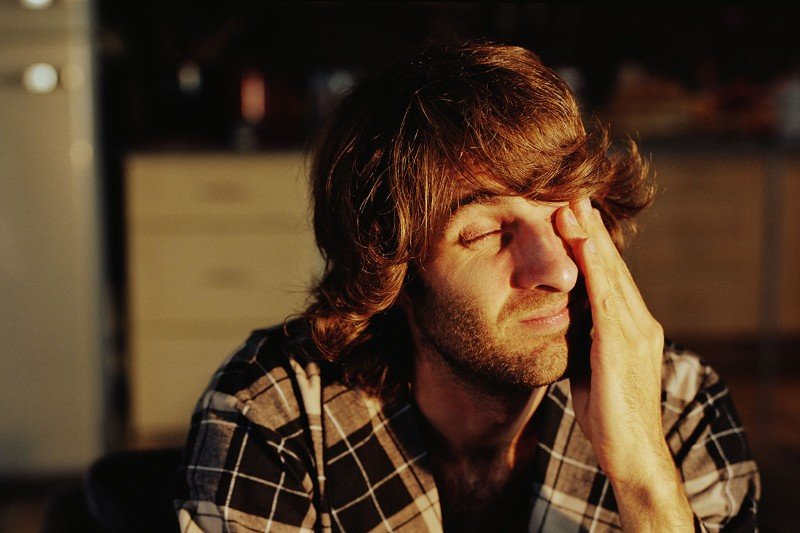
Have you read this important DCoE Blog: Sleep Issues Bedevil Soldiers’ Health?
Here is some very good information for soldiers and veterans that you may want to take a look at. This is provided by Kim Bolen RN CCM ACM Actions4Vets as part of Kids4Horses&Dogs4Vets a non-proftit organization under Virtual World Solutions d/b/a Sponsor a Vet Life (SALV).
http://content.govdelivery.com/accounts/USMHSDCOE/bulletins/11bed08?reqfrom=share
Lack of sleep is a serious issue for many service members, as shown by the findings of a study on military sleep sponsored by the Defense Centers of Excellence for Psychological Health and Traumatic Brain Injury (DCoE). In particular, sleep issues are the "No. 1 military disorder" among soldiers who return from deployment after sustaining traumatic brain injuries, according to Lt. Col. Kate Van Arman, medical director of the Traumatic Brain Injury Clinic on Fort Drum, New York. This article by David Vergun from the Fort Leonard Wood "Guidon" recounts Van Arman's presentation at the DCoE 2015 Summit on Psychological Health and Traumatic Brain Injury.
Here is some very good information for soldiers and veterans that you may want to take a look at. This is provided by Kim Bolen RN CCM ACM Actions4Vets as part of Kids4Horses&Dogs4Vets a non-proftit organization under Virtual World Solutions d/b/a Sponsor a Vet Life (SALV).
http://content.govdelivery.com/accounts/USMHSDCOE/bulletins/11bed08?reqfrom=share
Lack of sleep is a serious issue for many service members, as shown by the findings of a study on military sleep sponsored by the Defense Centers of Excellence for Psychological Health and Traumatic Brain Injury (DCoE). In particular, sleep issues are the "No. 1 military disorder" among soldiers who return from deployment after sustaining traumatic brain injuries, according to Lt. Col. Kate Van Arman, medical director of the Traumatic Brain Injury Clinic on Fort Drum, New York. This article by David Vergun from the Fort Leonard Wood "Guidon" recounts Van Arman's presentation at the DCoE 2015 Summit on Psychological Health and Traumatic Brain Injury.
 Sleeping
 Health
 PTSD
PTSD TBI
TBI
Edited 10 y ago
Posted 10 y ago
Responses: 10
Suspended Profile
Sleep disorders are a presumptive condition to Gulf War service. Further, anyone with TBI, PTSD, chronic pain, depression, and a whole host of other physical ailments end up with compromised sleep. This includes Sleep Apnea caused by weight gain, and by narcotic treatments for pain...
Maj Kim Patterson
This is a pretty succinct laundry list of contributing issues.
(0)
(0)
Suspended Profile
Maj Kim Patterson thanks. I worked as a DAV service officer for 4 years, so I'm very well trained...
Jennifer Lee (Doerflinger) Hill
I haven't been able to enter REM sleep since 1974. Even my recurring "dreams" happen when I'm fully awake.
(0)
(0)
3
3
0

COL Mikel J. Burroughs Many studies have shown that sleep issues affect health. It is a symptom and if possible and you fall into this category it's important to find out the underlying cause. Some possible underlying health issues such as, diabetes, heart failure, musculoskeletal disorders, kidney disease, breathing problems... Many people are on medications thy may not realize also impact sleep such as heart medication, high blood pressure medication, inflammation/asthma medications, medications that contain alcohol, medications that contain caffeine, ......
(3)
(0)
3
3
0

This doesn't end when one gets out. I have been out for 43 years and still have circadian rhythm and sleep issues. 5 hours is my norm, and I come alive between 10PM and 5AM.
Don't know how much this has to do with the military, but it became an issue for me in Viet Nam and has not improved much since.
Don't know how much this has to do with the military, but it became an issue for me in Viet Nam and has not improved much since.
(3)
(0)
2
2
0

Sleep issues plague many of us... for many different reasons. I'm not sure what can be done but sleeping pills are not the answer
(2)
(0)
1
1
0

1
1
0

I have suffered from chronic insomnia and a by product, workaholic tendencies to fill the time. I have been taking webinars from DCoE towards maintaining my BSN,RN licensure and they are extremely informative, clearly stated and cover a range of issues. I also get the Deployment Health Bulletin and this is one of the articles in it:
"How Pharmacists Can Combat the Military’s Top Health Problem
Pharmacy Times, 19 September 2015
“What is the No. 1 disorder seen among deployed soldiers? While many may guess that it’s post-traumatic stress disorder (PTSD), sleep problems are actually the most common health issue in the military, according to Lt. Col. Kate E. Van Arman. Among 300,000 military members who suffer a traumatic brain injury (TBI), 97% reported some form of a sleep problem, most commonly insomnia. In addition, 34% said they had sleep apnea, and half of them said they experienced fragmented sleep, according to Lt. Col. Van Arman, who recently gave a presentation on sleep disorders among military patients with mild TBI.”. It is most likely the same study
With the constant need to be at the ready, I don't see how anyone gets good refreshing sleep and add in the time changes from theater to home and other places of deployment and shift work and days of constant bombing and gunfire, frankly, I am surprised most vets can sleep at all without self medicating or physician provided sleeping medicine. With the exception of those who are currently working 18 hour days, 7 days a week, as someone put it: Bill Murry's "Goundhog Day" captures life where they are and exhaustion and heat overtake them only to get up and repeat the same scenario day in and day out, barely having the strength to choke down a bowl of fruit loops.
I actually experienced falling asleep without medication this week for the first time in I can't count how many decades. Sleeping is amazing, especially the part where one drifts off in a safe environment. I never knew what "falling asleep" felt like. I was either awake or heavily drugged and still awake. The moments when you know you can't fight the Sandman anymore and give in are incredible!
"How Pharmacists Can Combat the Military’s Top Health Problem
Pharmacy Times, 19 September 2015
“What is the No. 1 disorder seen among deployed soldiers? While many may guess that it’s post-traumatic stress disorder (PTSD), sleep problems are actually the most common health issue in the military, according to Lt. Col. Kate E. Van Arman. Among 300,000 military members who suffer a traumatic brain injury (TBI), 97% reported some form of a sleep problem, most commonly insomnia. In addition, 34% said they had sleep apnea, and half of them said they experienced fragmented sleep, according to Lt. Col. Van Arman, who recently gave a presentation on sleep disorders among military patients with mild TBI.”. It is most likely the same study
With the constant need to be at the ready, I don't see how anyone gets good refreshing sleep and add in the time changes from theater to home and other places of deployment and shift work and days of constant bombing and gunfire, frankly, I am surprised most vets can sleep at all without self medicating or physician provided sleeping medicine. With the exception of those who are currently working 18 hour days, 7 days a week, as someone put it: Bill Murry's "Goundhog Day" captures life where they are and exhaustion and heat overtake them only to get up and repeat the same scenario day in and day out, barely having the strength to choke down a bowl of fruit loops.
I actually experienced falling asleep without medication this week for the first time in I can't count how many decades. Sleeping is amazing, especially the part where one drifts off in a safe environment. I never knew what "falling asleep" felt like. I was either awake or heavily drugged and still awake. The moments when you know you can't fight the Sandman anymore and give in are incredible!
(1)
(0)
1
1
0

COL Mikel J. Burroughs
Nothing new here! Military members suffer from sleep deprivation? Who knew? LOL!
Seriously though, as a person who suffers from Obstructive Sleep Apnea that's compounded by other issues: I work nights so I sleep during the day. But on my days off I sleep at night so my sleep patterns are in a constant state of flux. I know what I can do to make it better but it's just not feasible. My job isn't going to change my hours just to better suit my personal needs.
Nothing new here! Military members suffer from sleep deprivation? Who knew? LOL!
Seriously though, as a person who suffers from Obstructive Sleep Apnea that's compounded by other issues: I work nights so I sleep during the day. But on my days off I sleep at night so my sleep patterns are in a constant state of flux. I know what I can do to make it better but it's just not feasible. My job isn't going to change my hours just to better suit my personal needs.
(1)
(0)
1
1
0

I average around 4 hours each night" sleep at 3 am up at 7-8 am. I can't sleep like I used to I wish I could but after awhile I can't keep laying in bed thus the 4 hours any longer and I hurt bad.
(1)
(0)
1
1
0

Learn to live with it WITHOUT pills. I doubt that I have had a dozen nights of good sleep over the last decade. When I was AD and for a while after, I could sleep on a bed of nails any time, any place. I function well, but do wish the old habit would return. My Doc told me that some people just don't need as much sleep as others.
(1)
(0)
1
1
0

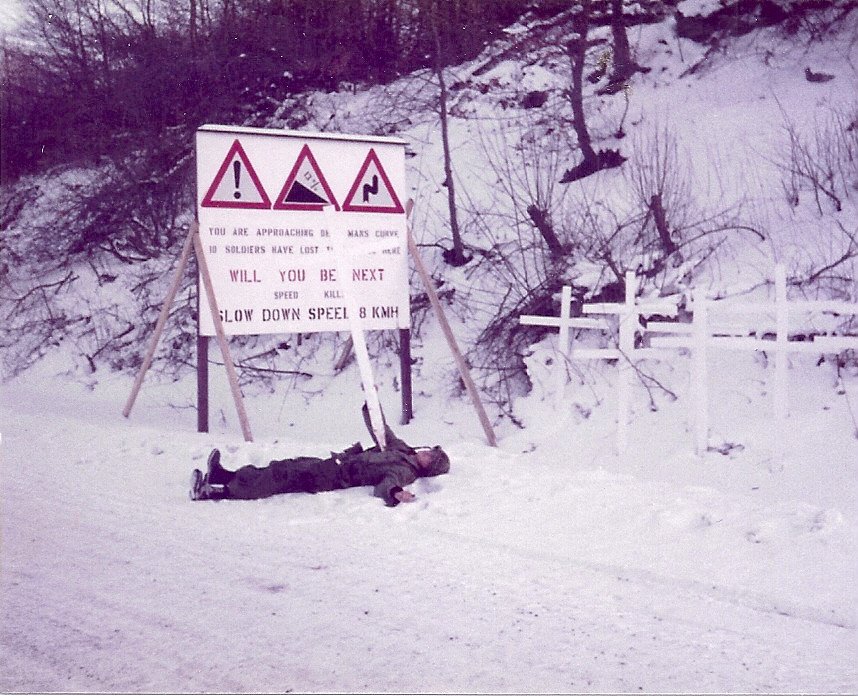
I think you could probably trace sleep issues affecting soldier performance back to ancient warfare COL Mikel J. Burroughs. Long forced marches under full load with combat sometimes at both ends occurred in Alexander the Great's time.
Certainly as we have become more reliant on first unsophisticated vehicles and more recently sophisticated technology sleep issues have become more problematic.
I used to require two jeep drivers during multi-day operations. Driving under black-out drive for extended periods wears one down. I did my best to monitor my driver and switch out drivers before we had any problems.
Having a driver fall asleep at the wheel has killed or injured a lot of personnel in uniform.
I have uploaded a picture from Dead Man's Curve at Wildflecken in 1983.
Amphetamines have been used to keep military personnel awake for operations - sometimes other medications were required to calm them down afterwards.
Extended sleep problems can certainly affect the health of the one with the problems as well as those who rely on them. Hopefully people close to people who exhibit signs of sleep problems will help them recognize the issue and help them as they seek help.
Certainly as we have become more reliant on first unsophisticated vehicles and more recently sophisticated technology sleep issues have become more problematic.
I used to require two jeep drivers during multi-day operations. Driving under black-out drive for extended periods wears one down. I did my best to monitor my driver and switch out drivers before we had any problems.
Having a driver fall asleep at the wheel has killed or injured a lot of personnel in uniform.
I have uploaded a picture from Dead Man's Curve at Wildflecken in 1983.
Amphetamines have been used to keep military personnel awake for operations - sometimes other medications were required to calm them down afterwards.
Extended sleep problems can certainly affect the health of the one with the problems as well as those who rely on them. Hopefully people close to people who exhibit signs of sleep problems will help them recognize the issue and help them as they seek help.
(1)
(0)
SSG Jesus Sijalbo
It take good leadership insight to do what you did COL. "Rotate"! The little things we all could do to make things bearable.
(2)
(0)
Read This Next


 Continue with Facebook
 Continue with Google