
Posted on Feb 16, 2015

What's your unit insignia or crest look like and what does it mean?

19.9K
134
74
5
5
0

I am regimental affliated with 321st Field Artillery Regiment. Will doing research for the 321st Regt Room at Fort Sill I was give this pin worn during WW II.
Distinctive unit insignia Description A Gold color metal and enamel device 1 1/8 inches (2.86 cm) in height overall consisting of a shield blazoned: Gules, two lion’s paws issuing out of the dexter and sinister base points chevron-ways Or. Attached below and to the sides of the shield a Gold scroll inscribed “NOLI ME TANGERE” in Red letters. Symbolism The shield is scarlet for Artillery. The lion’s paws are significant of Field Artillery, which may be likened to a mountain lion whose paw has great strength and power in felling and crushing a victim. Background The distinctive unit insignia was originally approved for the 452d Field Artillery Regiment on 1 February 1927. It was redesignated for the 321st Field Artillery Regiment on 21 November 1930. It was redesignated for the 321st Field Artillery Battalion on 15 April 1942. It was redesignated for the 321st Glider Field Artillery Battalion on 14 October 1942. It was redesignated for the 518th Airborne Field Artillery Battalion on 26 September 1951. The insignia was redesignated for the 321st Airborne Field Artillery Battalion on 31 July 1956. On 25 February 1958, it was redesignated for the 321st Artillery Regiment. The insignia was redesignated for the 321st Field Artillery Regiment effective 1 September 1971. Coat of arms Blazon Shield Gules, two lion’s paws issuing out of the dexter and sinister base points chevron-ways Or. Crest On a wreath Or and Gules, a cannon barrel palewise Sable winged Argent behind a lion sejant affronté with two heads addorsed of the first armed and langued Azure grasping in each forepaw a round of the third and surmounted by an escutcheon per pale Gules and of the fifth an annulet Argent, on a chief of the like three fleurs-de-lis Azure. Motto NOLI ME TANGERE (Don’t Tread On Me). Symbolism Shield The shield is scarlet for Artillery. The lion’s paws are significant of Field Artillery, which may be likened to a mountain lion whose paw has great strength and power in felling and crushing a victim. Crest The lion with one head facing forward and the other backward, brandishing a round in both directions, refers to the organization’s claim to have been the unit of the 101st Airborne Division to fire the first and the last rounds on German soil. The winged cannon stands for the former designation of the organization as a Glider Field Artillery Battalion and its assignment during World War II to the 101st Airborne Division. The red and blue escutcheon is from the arms of Bastogne; the annulet represents the enemy encirclement of that objective and refers to the unit’s distinguished action in its defense during World War II. The three fleurs-de-lis stand for the organization’s first war service, i.e., participation in three campaigns in France during World War I. Background The coat of arms was originally approved for the 452d Field Artillery Regiment on 1 February 1927. It was redesignated for the 321st Field Artillery Regiment on 14 November 1930. It was redesignated for the 321st Field Artillery Battalion on 14 April 1942. It was redesignated for the 321st Glider Field Artillery Battalion on 14 October 1942. It was redesignated for the 518th Airborne Field Artillery Battalion and amended to delete the Organized Reserves crest on 26 September 1951. The insignia was redesignated for the 321st Airborne Field Artillery Battalion on 31 July 1956. On 25 February 1958, it was redesignated for the 321st Artillery Regiment. It was amended to add a crest on 22 April 1966. The insignia was redesignated for the 321st Field Artillery Regiment effective 1 September 1971.
Distinctive unit insignia Description A Gold color metal and enamel device 1 1/8 inches (2.86 cm) in height overall consisting of a shield blazoned: Gules, two lion’s paws issuing out of the dexter and sinister base points chevron-ways Or. Attached below and to the sides of the shield a Gold scroll inscribed “NOLI ME TANGERE” in Red letters. Symbolism The shield is scarlet for Artillery. The lion’s paws are significant of Field Artillery, which may be likened to a mountain lion whose paw has great strength and power in felling and crushing a victim. Background The distinctive unit insignia was originally approved for the 452d Field Artillery Regiment on 1 February 1927. It was redesignated for the 321st Field Artillery Regiment on 21 November 1930. It was redesignated for the 321st Field Artillery Battalion on 15 April 1942. It was redesignated for the 321st Glider Field Artillery Battalion on 14 October 1942. It was redesignated for the 518th Airborne Field Artillery Battalion on 26 September 1951. The insignia was redesignated for the 321st Airborne Field Artillery Battalion on 31 July 1956. On 25 February 1958, it was redesignated for the 321st Artillery Regiment. The insignia was redesignated for the 321st Field Artillery Regiment effective 1 September 1971. Coat of arms Blazon Shield Gules, two lion’s paws issuing out of the dexter and sinister base points chevron-ways Or. Crest On a wreath Or and Gules, a cannon barrel palewise Sable winged Argent behind a lion sejant affronté with two heads addorsed of the first armed and langued Azure grasping in each forepaw a round of the third and surmounted by an escutcheon per pale Gules and of the fifth an annulet Argent, on a chief of the like three fleurs-de-lis Azure. Motto NOLI ME TANGERE (Don’t Tread On Me). Symbolism Shield The shield is scarlet for Artillery. The lion’s paws are significant of Field Artillery, which may be likened to a mountain lion whose paw has great strength and power in felling and crushing a victim. Crest The lion with one head facing forward and the other backward, brandishing a round in both directions, refers to the organization’s claim to have been the unit of the 101st Airborne Division to fire the first and the last rounds on German soil. The winged cannon stands for the former designation of the organization as a Glider Field Artillery Battalion and its assignment during World War II to the 101st Airborne Division. The red and blue escutcheon is from the arms of Bastogne; the annulet represents the enemy encirclement of that objective and refers to the unit’s distinguished action in its defense during World War II. The three fleurs-de-lis stand for the organization’s first war service, i.e., participation in three campaigns in France during World War I. Background The coat of arms was originally approved for the 452d Field Artillery Regiment on 1 February 1927. It was redesignated for the 321st Field Artillery Regiment on 14 November 1930. It was redesignated for the 321st Field Artillery Battalion on 14 April 1942. It was redesignated for the 321st Glider Field Artillery Battalion on 14 October 1942. It was redesignated for the 518th Airborne Field Artillery Battalion and amended to delete the Organized Reserves crest on 26 September 1951. The insignia was redesignated for the 321st Airborne Field Artillery Battalion on 31 July 1956. On 25 February 1958, it was redesignated for the 321st Artillery Regiment. It was amended to add a crest on 22 April 1966. The insignia was redesignated for the 321st Field Artillery Regiment effective 1 September 1971.
Edited 11 y ago
Posted 11 y ago
Responses: 33

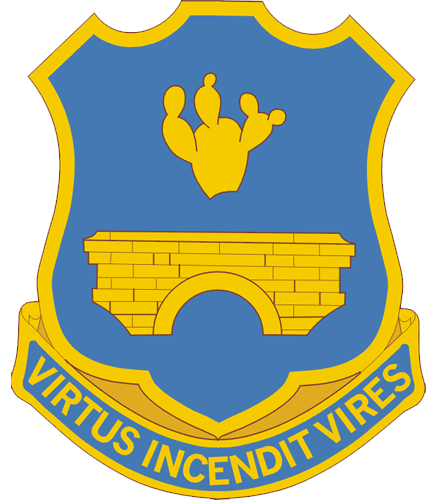
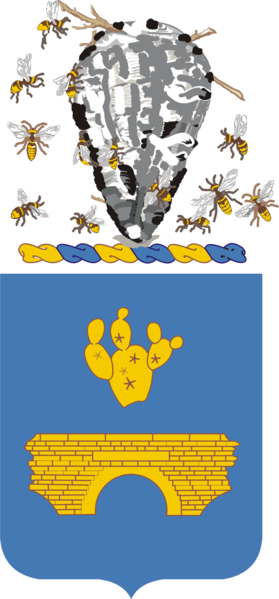
The 120th Infantry Regiment's distinctive unit insignia, approved on 28 June 1928, consists of a gold metal and enamel device 1 5/32 inches (2.94 cm) in height overall, consisting of a shield blazoned azure, in pale a prickly pear cactus and the entrance to the canal tunnel over the St. Quentin Canal. Attached below the shield is a blue scroll inscribed VIRTUS INCENDIT VIRES ("Virtue Kindles Strength") in gold.
The shield is blue for infantry. The cactus represents service on the Mexican border as the 3rd Infantry, North Carolina National Guard. The tunnel symbolizes the mouth of the tunnel in the Hindenburg Line at Bellicourt, France, captured by the 120th Infantry on 29 September 1918.
The shield is blue for infantry. The cactus represents service on the Mexican border as the 3rd Infantry, North Carolina National Guard. The tunnel symbolizes the mouth of the tunnel in the Hindenburg Line at Bellicourt, France, captured by the 120th Infantry on 29 September 1918.
(1)
(0)
1
1
0

1
1
0




1
1
0
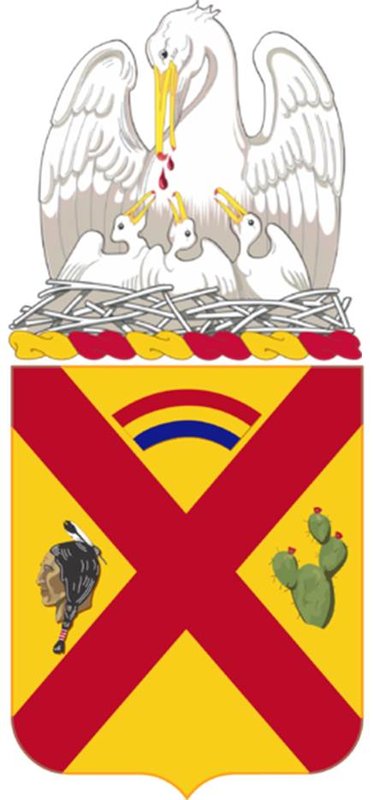
Crest: The regiments and separate battalions of the Georgia and Louisiana National -2-108th Squadron in Louisiana: A pelican in her piety affronte with three young in its nest on a wreath of the colors ], argent armed and vulned proper.
Shield: Consists of a Shield composed of a yellow a gules (for the Cavalry), red saltire (denoting Confederate Service), a three color (red, yellow, blue) rainbow at the honour point (for service with the 42nd Infantry Division during World War II), a prickly pear cactus at the charge (for Mexican border service), and an Indian's Head in profile with one feather in a top-knot (for Indian Wars).
Shield: Consists of a Shield composed of a yellow a gules (for the Cavalry), red saltire (denoting Confederate Service), a three color (red, yellow, blue) rainbow at the honour point (for service with the 42nd Infantry Division during World War II), a prickly pear cactus at the charge (for Mexican border service), and an Indian's Head in profile with one feather in a top-knot (for Indian Wars).
(1)
(0)
1
1
0

My unit insignia looks like a Punkin pach, And to all its stand for is ; To defend and protect
(1)
(0)
1
1
0
The best one I had was with 365 EN BN it was a dozer with wings that said Fast and Rugged. It was due to our construction mission.
(1)
(0)
0
0
0

Crest: https://www.pinterest.com/pin/ [login to see] 7334837/?lp=true
Meaning: https://www.houseofnames.com/mcintosh-family-crest
Meaning: https://www.houseofnames.com/mcintosh-family-crest
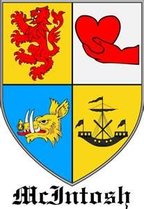
McIntosh Coat of Arms | Coat of arms, Scottish clans, Scotland castles
This Pin was discovered by Bruce McIntosh. Discover (and save!) your own Pins on Pinterest.
(0)
(0)
0
0
0

Phenomenal Historical Share
MAJ Patrick O’Brian Boling !
I am going to find My Certificates of Achievement! I have one from an Artillery Battalion when I was assigned to 2nd Armored Division (FWD) in Garlstedt FRG
1986-1987.
MAJ Patrick O’Brian Boling !
I am going to find My Certificates of Achievement! I have one from an Artillery Battalion when I was assigned to 2nd Armored Division (FWD) in Garlstedt FRG
1986-1987.
(0)
(0)
0
0
0

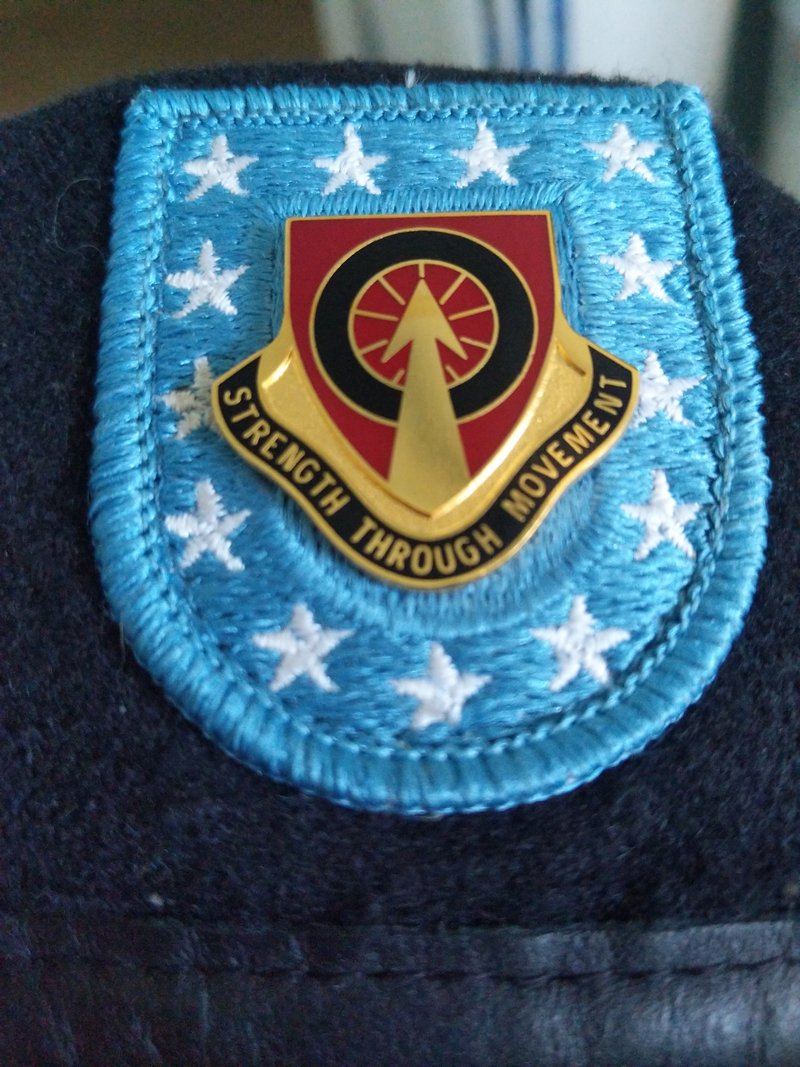
450th Movement Control Battalion - Brick red and gold are the colors of the Transportation Corps. The wheel alludes to the Transportation Corps and represents the battalion's mission. The broad Arrow represents movement, swiftness, and accuracy, and represents forward progress. The battalion's motto, "Strength Through Movement," is displayed across the bottom. It represents the battalion's mission in supporting the fight with transportation
(0)
(0)

Read This Next


 Continue with Facebook
 Continue with Google