
Posted on Aug 10, 2014

Who do you think is responsible for our failure in Iraq?

77.4K
635
407
18
17
1

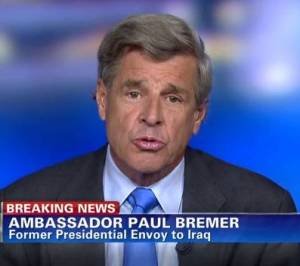
Strategically, who do you think the blame falls with? Is it Paul Bremer, GWB, or do you blame some of the senior leaders for screwing OIF up?
Not trying start a debate here, but it's obvious that this war was mishandled and strategically screwed up ... and if you need proof, just look at what ISIS is doing.
Thoughts?
Not trying start a debate here, but it's obvious that this war was mishandled and strategically screwed up ... and if you need proof, just look at what ISIS is doing.
Thoughts?
 Operation Iraqi Freedom (OIF)
 Operation New Dawn (OND)
 ISIS
ISIS Iraq
Iraq
Edited >1 y ago
Posted >1 y ago
Responses: 199
2
2
0

2
2
0
I feel it is our civilian leadership is to blame for the failure in Iraq. We learned after we left Nam, that the country was quickly over ran. If we had followed our lead after WWII, we discover that we left a strong (West) Germany. We left a weak Iraqi Government and we did nothing to really support them.
(2)
(0)
2
2
0

I love the line, "Not trying start a debate here." Blame seems a bit petty, and responsibility falls from the top down, the CiC to senior leaders. The factors though are so numerous that I'd run out of characters before listing them, not to mention addressing them all. Strategic policy, Foreign policy, and national readiness, are key issues on the governmental side. Military/Industrial preparation, clarity of mission, and Joint planning, were important issues on the military side. Organization of the Coalition Provisional Authority and integration of the coalition politically were significant factors. The structure of our economy,(the Finance, Insurance, Real Estate [F.I.R.E.] model) played an important role in hindering our ability to prepare in advance, coordinate industry, and work with our foreign partners.
(2)
(0)
2
2
0

The War was unconstitutional and pointless in the first place. I blame the American people (to include myself) that were bamboozled into supporting the psychopaths in D.C. in waging this war to begin with.
(2)
(0)
2
2
0
Is anyone surprised that any discussion of "Who is responsible for our failure in Iraq?" has wandered so far afield? This is politically charged stuff. No, make that ideologically charged.
Yes, there was some disagreement with the Iraqis over the Force Agreement, but that was just a political posture adopted to rationalize the withdrawal. The decision to withdraw was made long before President Obama was even elected.
The simple fact is that President Obama placed himself in a box. He had no choice to "end the war" without regard for the situation there. He made it a key campaign promise, castigated President Bush for even going there in the first place, pooh-poohed the idea of WMDs, and all the rest. To cast it in military terms, he put his political forces on line and charged without first determining the tactical situation.
Does all this mean that President Obama is to blame? Maybe.
Now, let's deal with the side issues that have been raised in this discussion thread...
There are those who argue that the error falls on the shoulders of those who committed us to the war in the first place. They seek to blame President Bush because Sadaam was already contained, he posed no threat. Really? Is it really that simple?
Let's look at the broader picture. Iraq threatened US vital interests in the region when Sadaam invaded Kuwait. He threatened to take control of oil supplies flowing from that part of the world which would have put him in the catbird's seat for determining socio-political outcomes all over the world. The coalition that drove him back to his own borders didn't stop because they had won a war. They stopped by virtue of an armistice, an agreement wherein Sadaam agreed to open his borders to inspectors to demonstrate that he did not have the capability to do it again.
Sadaam reneged on that agreement. He broke the armistice. The coalition was not only legally empowered to resume hostilities, it was obligated to do so. To fail to respond to Sadaam's actions, would be to encourage him and other tyrants to embark on other misadventures. The coalition would have, in effect, defanged the international community and the rule of international law.
Now, as to those who argue that there were no WMD's, let's put that one to rest for once and for all. The WMD's were found. The yellow cake was found. American service members are suffering the effects of being exposed to them. Can we now stop talking about that one?
So, we come back to President Obama's withdrawal. Was it premature? Well, to answer that we have to ask, did he have an option?
Of course, there was an option. It's an option that we should have exercised in Vietnam as well as Iraq. It's an option that we exercised in Korea, Germany, and Japan, and has been proven effective in each and every case. We could have left a Trigger Force. A complement of US and coalition forces just strong enough to defend themselves and justify a full deployment if attacked in the future. A warning to hostile forces that we would return if they failed to "behave".
There you have it. That's my opinion. Responses welcome...
Yes, there was some disagreement with the Iraqis over the Force Agreement, but that was just a political posture adopted to rationalize the withdrawal. The decision to withdraw was made long before President Obama was even elected.
The simple fact is that President Obama placed himself in a box. He had no choice to "end the war" without regard for the situation there. He made it a key campaign promise, castigated President Bush for even going there in the first place, pooh-poohed the idea of WMDs, and all the rest. To cast it in military terms, he put his political forces on line and charged without first determining the tactical situation.
Does all this mean that President Obama is to blame? Maybe.
Now, let's deal with the side issues that have been raised in this discussion thread...
There are those who argue that the error falls on the shoulders of those who committed us to the war in the first place. They seek to blame President Bush because Sadaam was already contained, he posed no threat. Really? Is it really that simple?
Let's look at the broader picture. Iraq threatened US vital interests in the region when Sadaam invaded Kuwait. He threatened to take control of oil supplies flowing from that part of the world which would have put him in the catbird's seat for determining socio-political outcomes all over the world. The coalition that drove him back to his own borders didn't stop because they had won a war. They stopped by virtue of an armistice, an agreement wherein Sadaam agreed to open his borders to inspectors to demonstrate that he did not have the capability to do it again.
Sadaam reneged on that agreement. He broke the armistice. The coalition was not only legally empowered to resume hostilities, it was obligated to do so. To fail to respond to Sadaam's actions, would be to encourage him and other tyrants to embark on other misadventures. The coalition would have, in effect, defanged the international community and the rule of international law.
Now, as to those who argue that there were no WMD's, let's put that one to rest for once and for all. The WMD's were found. The yellow cake was found. American service members are suffering the effects of being exposed to them. Can we now stop talking about that one?
So, we come back to President Obama's withdrawal. Was it premature? Well, to answer that we have to ask, did he have an option?
Of course, there was an option. It's an option that we should have exercised in Vietnam as well as Iraq. It's an option that we exercised in Korea, Germany, and Japan, and has been proven effective in each and every case. We could have left a Trigger Force. A complement of US and coalition forces just strong enough to defend themselves and justify a full deployment if attacked in the future. A warning to hostile forces that we would return if they failed to "behave".
There you have it. That's my opinion. Responses welcome...
(2)
(0)
2
2
0

GWB. As I learned in the Navy, you can delegate authority, you can't delegate responsibility. Did we learn anything from this? Not likely.
"Hubris is one of the great renewable resources" -P.J. O'Rourke
"Hubris is one of the great renewable resources" -P.J. O'Rourke
(2)
(0)
2
2
0

It definetly was not our Military, it was the POTUS and Congress and our own families and citizens, it almost got to be like NAM all over again
(2)
(0)
CPT (Join to see)
I agree -- it wasn't the military. I guess I was speaking more about those at the top -- more macro level, if that makes sense.
Thanks for the comment James!
Jon
Thanks for the comment James!
Jon
(1)
(0)
2
2
0

Le me the devils advocate here...we the voters allowed this to happen, we pushed for it as a nation in 2003, we fell for the hype, we ignored the obvious and we put out patriotism over our common sense. It sounds harsh but in retrospect it is clear...wars are not fought to be won these days, I hope we now see this and act accordingly in the future.
I ASK that when and if anyone comments, or please do not read into my words, create a statement I did not write and then insult me as if I meant what you wrote.
I am however up for an invigorating, civil debate.
Steady on,
Steven
I ASK that when and if anyone comments, or please do not read into my words, create a statement I did not write and then insult me as if I meant what you wrote.
I am however up for an invigorating, civil debate.
Steady on,
Steven
(2)
(0)
Maj Mike Sciales
I agree with you. We went in out of national anger. Political wars have no "win" for us. Our military did a fine job of defeating the military objectives. It was correct to hang the "Mission Accomplished" sign on that carrier. It was the US Department of State which had the football for "what to do the day after we knock down the Statue of Saddam." They weren't ready and the rest, is history.
(1)
(0)
COL Ted Mc
SGT Steven Eugene Kuhn MBA Sergeant; I think that it would be fair to say that [a] there is blame enough to go around so that anyone you want to name can have a sufficiency, [b] there is justification enough (provided that you scrunch your eyes up real tight and stick your fingers in your ears) to say that anyone you want to absolve of blame (regardless of facts) is without flaw, and [c] there is absolutely nothing to be gained by attempting to blame people for what happened if you don't actually look at the facts of what happened and try and learn how not to screw up again. (Something about "Lessons Learned" seems vaguely familiar.)
My impression/opinion is that Iraq was attacked on the basis of "Let's attack Iraq" rather than "Let's attack Iraq and accomplish __[fill in the blank]__ - and to do that successfully we will have to __[fill in a whole bunch of blanks {including timetables, kit lists, and tables of organization}]__.".
About the only people who don't come in for approbation are the vast majority of those who put their boots on the ground because they were told to and did what they were told to do, to the best of their ability, and in a civilized manner - which accounts for about 99.9999% of the military people deployed.
My impression/opinion is that Iraq was attacked on the basis of "Let's attack Iraq" rather than "Let's attack Iraq and accomplish __[fill in the blank]__ - and to do that successfully we will have to __[fill in a whole bunch of blanks {including timetables, kit lists, and tables of organization}]__.".
About the only people who don't come in for approbation are the vast majority of those who put their boots on the ground because they were told to and did what they were told to do, to the best of their ability, and in a civilized manner - which accounts for about 99.9999% of the military people deployed.
(1)
(0)
2
2
0

Multiple things are to blame for the failure in Iraq. We pulled out knowing the job wasn't done and that once we left, it was up to a government that had not cemented itself. The Iraqi gov. for not being prepared is also to blame. I wasn't a huge fan when we pulled out and were still getting attacked so I don't believe the blame just goes to one person or organization.
(2)
(0)
2
2
0
CPT Springer,
Did we close in and destroy the enemy in 2003? Did we accomplish the mission of removing Sadaam Hussein from power?
The failure in Iraqi Freedom as you stated in my opinion was purely political, Don Rumsfeld, and General Officers afraid to stand up to a bully! (I understand strategic operations are handled by senior officers) To afraid or to go against the current of the time except for one, General Shinseki. They scoffed at his attempt to give an accurate picture to congress. So what did Don Rumsfeld do, he said you can retire.
I also believe we must address the responsibility of the Iraqi army and how the have inherent responsibility to their people and country.
I would argue that every war has been mishandled since WWII, given the current political atmosphere at the time.
Did we close in and destroy the enemy in 2003? Did we accomplish the mission of removing Sadaam Hussein from power?
The failure in Iraqi Freedom as you stated in my opinion was purely political, Don Rumsfeld, and General Officers afraid to stand up to a bully! (I understand strategic operations are handled by senior officers) To afraid or to go against the current of the time except for one, General Shinseki. They scoffed at his attempt to give an accurate picture to congress. So what did Don Rumsfeld do, he said you can retire.
I also believe we must address the responsibility of the Iraqi army and how the have inherent responsibility to their people and country.
I would argue that every war has been mishandled since WWII, given the current political atmosphere at the time.
(2)
(0)
CPT Robert Skinner
CPT Jack Durish,
Total Victory, not piece meal victory like today. General MacArthur on the Missouri signing the peace treaty, and German Officers signing total surrender documents. No war is without fault but total victory is what was the end game for WWII. I can't wait to see your response as to why you think it was mishandled. I'm not being sarcastic, just want your opinion.
Total Victory, not piece meal victory like today. General MacArthur on the Missouri signing the peace treaty, and German Officers signing total surrender documents. No war is without fault but total victory is what was the end game for WWII. I can't wait to see your response as to why you think it was mishandled. I'm not being sarcastic, just want your opinion.
(0)
(0)
Read This Next


 Continue with Facebook
 Continue with Google