
Posted on Jul 21, 2015

Why Does Leadership Fail: 4 Horrible Bosses & 6 Healthy Habits?

23.1K
351
45
65
65
0

RP Members, Connection, and Friends here is another great article on Leadership that fell into the dark hole of RP back in Jul 2015, but it is a great article (all below) that is worth sharing.
Why Does Leadership Fail: 4 Horrible Bosses & 6 Healthy Habits SEE ENTIRE ARTICLE BELOW
By Dr Pete Stebbins
Psychologist & Executive Coach
"People don't leave companies - they leave leaders!" Greg Savage
Did you know that we spend 34% of our lives (approximately 228,708 hours!) at work? Given how much time we invest in our work it is important to be in a job we are happy with, and even more important to have a Champion Boss (or be a Champion Boss if you are a manager yourself!).
Horrible Bosses: Four Leadership Patterns to Avoid
We all know what it is like to have a Horrible Boss – either through firsthand experience or through friends and colleagues. Check out these four common types of horrible bosses:
The 'Laissez-Faire' Leader
Laissez-Faire is a French term which translated means: “let it be” or “let them do as they will”. With this definition in mind you can easily imagine the dysfunctional leadership characteristics of the Laissez-Faire leader. Their preference is to avoid responsibility and not interfere with anything either above or below them in the organisational structure. In management meetings they avoid sharing their opinions and go with the status quo. When interacting with their staff they do not provide feedback, do not follow-up on requests for help, do not communicate their views about important issues and remain vague and elusive.
The impact of this style of leadership on staff is quite destructive, with increased withdrawal behaviours among staff who show low discretionary effort and poor performance, eventually leading to complete disengagement and team dysfunction.
The 'Popular' Leader
The popular leader may not initially seem like a dysfunctional leadership style. Popular leaders are, by definition, focused on being ‘liked’ by their staff. As such, their leadership style has some upsides, namely high support and a very strong focus on positive interpersonal relationships.
However the downsides of a popular leader are low focus on core business, neglect of performance management, avoidance of tough conversations, and a team vs corporate or ‘us and them’ mentality. The impact on staff working with a popular leader is initially positive with high discretionary effort among staff to follow directions. However, the over focus on relationships and the lack of focus on core business invariably leads to poor team performance. Instead of addressing the issues, the popular leader engages in upwards bullying by blaming other teams and more senior leaders for issues rather than taking responsibility and accountability.
The 'Command and Control' Leader
Command and Control Leaders, as the name suggests, take the necessary management responsibility of organising and directing teams to unhealthy and extreme levels. The one redeeming characteristic of a Command and Control leader – high clarity – is completely overwhelmed by the negative characteristics of low perceived support, low engagement, poor communication, neglect of developmental feedback, and an over-emphasis on corrective feedback. The impact of this dysfunctional leadership style on the team is vast and includes a stigma about reporting personal problems, low discretionary effort, low innovation, increased withdrawal behaviours, fear, intimidation and conflict.
The 'Follow The Rules' Leader
What’s wrong with a leader following the rules, I hear you say? Nothing at all – unless of course it is taken to the extremes and becomes the only focus of leadership activity at the neglect of everything else. The ‘Follow The Rules’ leader is characterised by a strong focus on rules and procedures, low perceived support, a reactive people focus, high clarity, everything is black or white, and low engagement. When under pressure, they tighten adherence to the rule.
The impact of this dysfunctional leadership style on staff includes a reluctance to report problems, low discretionary effort, low innovation, increased withdrawal behaviours, harassment and conflict.
Champion Bosses: 6 Healthy Leadership Habits
While many of us may have had to work with one or more horrible bosses in our careers, we may have also worked with several Champion Bosses but in all the mayhem and confusion of work and life may not have realised it at the time.
A Champion Boss isn’t necessarily a boss who gives you everything you want but rather a boss who can bring out the best in you at work and make the workplace both engaging and profitable for the whole team. Champion Bosses are able to both (1) drive team performance and (2) effectively support staff by engaging in 6 Healthy Habits.
6 Healthy Habits for Champion Bosses
There are 6 Healthy Leadership Habits of Champion Bosses. 3 Habits help drive team performance and the other 3 Habits assist in effectively supporting staff.
Healthy Habits To Drive Team Performance
Healthy Habit No 1. Communicating Vision & Strategy
Champion Bosses have a great ability to regularly and clearly communicate to team members the short- and long-term vision and strategy of the organisation at both a global and team-specific level.
Healthy Habit No 2. Showing Credibility & Getting Results
Champion Bosses are able to effectively demonstrate their own competence and to perform their role and get the team to deliver credible results at both the team and organisational level.
Healthy Habit No 3. Providing Feedback & Development Opportunities
Champion Bosses are always on the look out for opportunities to give and receive both positive and constructive feedback as well as provide developmental opportunities to team members in a way that is fair and equitable to all.
Healthy Habits To Effectively Support Staff
Healthy Habit No. 4. Being Trustworthy
Champion Bosses are able to create an environment of honesty and trust by being an effective listener and never sharing in any negative gossiping. By being trustworthy, Champion Bosses help team members openly share their needs and concerns.
Healthy Habit No. 5. Providing Motivation & Encouragement
Champion Bosses have a great ability to motivate and encourage team members based on their individual needs and preferences. They are great at knowing what makes each individual ‘tick’ and can use friendly nicknames, jokes, small talk, and have goal driven conversations to make people feel encouraged and motivated at work.
Healthy Habit No 6. Supporting People’s Career & Personal Goals
Champion Bosses take the time to understand the career and personal goals of their team members and then provide feedback and support to help them when opportunities emerge.
Champion Bosses: What healthy habits does your boss have?
If we take a good hard look at our leaders (and ourselves) it is easy to find fault but not always as easy to see the Healthy Habits our Bosses may already have. It is just too easy to cut down the tall poppy when they try to change for the better, or crush the seeds of hope when only a few redeeming features may be evident.
One of my all time favourite sayings is about seeing the glass half full rather than half empty. I always try to encourage people to focus on the positive characteristics of their bosses. So take some time now to reflect and ask yourself the following questions:
How many different bosses have I had over the years and how would I rate each boss in terms of the 6 Healthy Habits to Drive Performance and Support Staff?
Focus on my current boss: (1) What habits are they already a Champion in? When was the last time I gave them some positive feedback about this? (2) What areas do they need to improve on and how could I support and encourage their Healthy Habits?
Focus on myself as a Boss (whether you are currently a Boss or may one day become a Boss): what are my strengths and development opportunities across each of the 6 Healthy Habits of a Champion Boss?
By taking the time to assess and support the 6 Healthy Habits of the Champion Bosses around you, as well as setting your own leadership growth goals, you will be on a path to greater success and happiness in your workplace!
Ride The Waves of Life!
Dr Pete
The Stress Surfer
Why Does Leadership Fail: 4 Horrible Bosses & 6 Healthy Habits SEE ENTIRE ARTICLE BELOW
By Dr Pete Stebbins
Psychologist & Executive Coach
"People don't leave companies - they leave leaders!" Greg Savage
Did you know that we spend 34% of our lives (approximately 228,708 hours!) at work? Given how much time we invest in our work it is important to be in a job we are happy with, and even more important to have a Champion Boss (or be a Champion Boss if you are a manager yourself!).
Horrible Bosses: Four Leadership Patterns to Avoid
We all know what it is like to have a Horrible Boss – either through firsthand experience or through friends and colleagues. Check out these four common types of horrible bosses:
The 'Laissez-Faire' Leader
Laissez-Faire is a French term which translated means: “let it be” or “let them do as they will”. With this definition in mind you can easily imagine the dysfunctional leadership characteristics of the Laissez-Faire leader. Their preference is to avoid responsibility and not interfere with anything either above or below them in the organisational structure. In management meetings they avoid sharing their opinions and go with the status quo. When interacting with their staff they do not provide feedback, do not follow-up on requests for help, do not communicate their views about important issues and remain vague and elusive.
The impact of this style of leadership on staff is quite destructive, with increased withdrawal behaviours among staff who show low discretionary effort and poor performance, eventually leading to complete disengagement and team dysfunction.
The 'Popular' Leader
The popular leader may not initially seem like a dysfunctional leadership style. Popular leaders are, by definition, focused on being ‘liked’ by their staff. As such, their leadership style has some upsides, namely high support and a very strong focus on positive interpersonal relationships.
However the downsides of a popular leader are low focus on core business, neglect of performance management, avoidance of tough conversations, and a team vs corporate or ‘us and them’ mentality. The impact on staff working with a popular leader is initially positive with high discretionary effort among staff to follow directions. However, the over focus on relationships and the lack of focus on core business invariably leads to poor team performance. Instead of addressing the issues, the popular leader engages in upwards bullying by blaming other teams and more senior leaders for issues rather than taking responsibility and accountability.
The 'Command and Control' Leader
Command and Control Leaders, as the name suggests, take the necessary management responsibility of organising and directing teams to unhealthy and extreme levels. The one redeeming characteristic of a Command and Control leader – high clarity – is completely overwhelmed by the negative characteristics of low perceived support, low engagement, poor communication, neglect of developmental feedback, and an over-emphasis on corrective feedback. The impact of this dysfunctional leadership style on the team is vast and includes a stigma about reporting personal problems, low discretionary effort, low innovation, increased withdrawal behaviours, fear, intimidation and conflict.
The 'Follow The Rules' Leader
What’s wrong with a leader following the rules, I hear you say? Nothing at all – unless of course it is taken to the extremes and becomes the only focus of leadership activity at the neglect of everything else. The ‘Follow The Rules’ leader is characterised by a strong focus on rules and procedures, low perceived support, a reactive people focus, high clarity, everything is black or white, and low engagement. When under pressure, they tighten adherence to the rule.
The impact of this dysfunctional leadership style on staff includes a reluctance to report problems, low discretionary effort, low innovation, increased withdrawal behaviours, harassment and conflict.
Champion Bosses: 6 Healthy Leadership Habits
While many of us may have had to work with one or more horrible bosses in our careers, we may have also worked with several Champion Bosses but in all the mayhem and confusion of work and life may not have realised it at the time.
A Champion Boss isn’t necessarily a boss who gives you everything you want but rather a boss who can bring out the best in you at work and make the workplace both engaging and profitable for the whole team. Champion Bosses are able to both (1) drive team performance and (2) effectively support staff by engaging in 6 Healthy Habits.
6 Healthy Habits for Champion Bosses
There are 6 Healthy Leadership Habits of Champion Bosses. 3 Habits help drive team performance and the other 3 Habits assist in effectively supporting staff.
Healthy Habits To Drive Team Performance
Healthy Habit No 1. Communicating Vision & Strategy
Champion Bosses have a great ability to regularly and clearly communicate to team members the short- and long-term vision and strategy of the organisation at both a global and team-specific level.
Healthy Habit No 2. Showing Credibility & Getting Results
Champion Bosses are able to effectively demonstrate their own competence and to perform their role and get the team to deliver credible results at both the team and organisational level.
Healthy Habit No 3. Providing Feedback & Development Opportunities
Champion Bosses are always on the look out for opportunities to give and receive both positive and constructive feedback as well as provide developmental opportunities to team members in a way that is fair and equitable to all.
Healthy Habits To Effectively Support Staff
Healthy Habit No. 4. Being Trustworthy
Champion Bosses are able to create an environment of honesty and trust by being an effective listener and never sharing in any negative gossiping. By being trustworthy, Champion Bosses help team members openly share their needs and concerns.
Healthy Habit No. 5. Providing Motivation & Encouragement
Champion Bosses have a great ability to motivate and encourage team members based on their individual needs and preferences. They are great at knowing what makes each individual ‘tick’ and can use friendly nicknames, jokes, small talk, and have goal driven conversations to make people feel encouraged and motivated at work.
Healthy Habit No 6. Supporting People’s Career & Personal Goals
Champion Bosses take the time to understand the career and personal goals of their team members and then provide feedback and support to help them when opportunities emerge.
Champion Bosses: What healthy habits does your boss have?
If we take a good hard look at our leaders (and ourselves) it is easy to find fault but not always as easy to see the Healthy Habits our Bosses may already have. It is just too easy to cut down the tall poppy when they try to change for the better, or crush the seeds of hope when only a few redeeming features may be evident.
One of my all time favourite sayings is about seeing the glass half full rather than half empty. I always try to encourage people to focus on the positive characteristics of their bosses. So take some time now to reflect and ask yourself the following questions:
How many different bosses have I had over the years and how would I rate each boss in terms of the 6 Healthy Habits to Drive Performance and Support Staff?
Focus on my current boss: (1) What habits are they already a Champion in? When was the last time I gave them some positive feedback about this? (2) What areas do they need to improve on and how could I support and encourage their Healthy Habits?
Focus on myself as a Boss (whether you are currently a Boss or may one day become a Boss): what are my strengths and development opportunities across each of the 6 Healthy Habits of a Champion Boss?
By taking the time to assess and support the 6 Healthy Habits of the Champion Bosses around you, as well as setting your own leadership growth goals, you will be on a path to greater success and happiness in your workplace!
Ride The Waves of Life!
Dr Pete
The Stress Surfer
 Leadership Development
 Education
 Leadership
 Vision
 Trust
Trust
Edited 7 y ago
Posted >1 y ago
Responses: 28
5
5
0

COL Mikel J. Burroughs
LTC Stephen F.
There is no finer example for Christian leadership than our Lord Jesus Christ. He declared, “I am the good shepherd. The good shepherd lays down his life for the sheep” (John 10:11). It is within this verse that we see the perfect description of a Christian leader, whether NCO or Officer. He is one who acts as a firm but fair shepherd to those “sheep” in his care. He is a brother who would put his life on the line for his fellow soldiers.
LTC Stephen F.
There is no finer example for Christian leadership than our Lord Jesus Christ. He declared, “I am the good shepherd. The good shepherd lays down his life for the sheep” (John 10:11). It is within this verse that we see the perfect description of a Christian leader, whether NCO or Officer. He is one who acts as a firm but fair shepherd to those “sheep” in his care. He is a brother who would put his life on the line for his fellow soldiers.
(5)
(0)
5
5
0

When informed are divshion officer after he came down on one of my sailors for some small infraction in front of the rest of his peers. Going way over board that in the future that if he has a problem he could bring it to me and I would take care of it. But if it was a BRAVO ZULO to give out please by all means go right ahead and go full steam ahead with that. It took awhile but I was taught by a old crusty GMGC that unless the thing that is done is going to hurt someone or something you remanded in private, and you as the CPO NOT THE DIVO OR DEPT HEAD OR ANYONE ELSE BUT YOURSELF SHOULD HANDLE IT and also give out the well dones before the others even see it !
(5)
(0)
5
5
0

All great points. Always from the front and willing to stand and work next to our college's.
(5)
(0)
4
4
0
This a great tidbit for the leaders heading into the new year. I appreciate your continued leadership after so many respectable years of service. I am trying to figure out a way to print this out so I can keep it as a reminder.
(4)
(0)
4
4
0

Have read a similar treatise on the subject by another motivational speaker/writer. All good points. My thoughts on this have been pretty much put out there in other posts. I would note that there are pieces of the six bad habits that are in 'good' bosses. The 'Champion" bosses have learned which pieces to use and when. Being a leader involves understanding the motivations of the individuals above and below you and using to your advantage to accomplish the objective. Also a guide to training. Once you're in the 'foxhole' there's only one motivation.
(4)
(0)
3
3
0

Very informative colonel. Over my careers in the military and DoD Contractor World, I have been exposed too and have seen I think all of these. The bad one I learned of things not to do and the good one taught me a lot. I tried to emulate the good things I had learned and not pick up the bad habits. As I became a team leader and a project manager, following the good examples worked much of the time. However I have to say there were times when use of the bad habits were need to get a task or job accomplished on time and target.
Thanks Sir !
Thanks Sir !
(3)
(0)
3
3
0

1
1
0

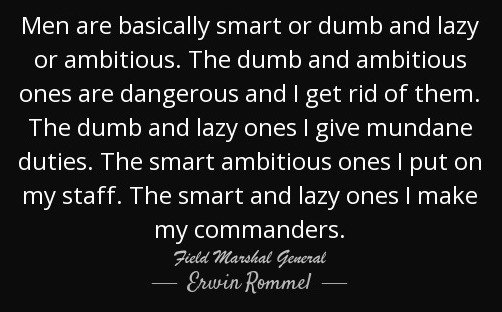
I don't know if it applies to all the services, but my experience taught me that, with some flexibility within the type, the army only wants command and control type leaders and has not tolerance for or desire to nurture other leadership styles. This is in direct opposition to what I consider the very best model on leadership by Field Marshal Erwin Rommel, see picture. To fully understand FM Rommel's model one has to read his book in which he explains why the smart and lazy ones make the best commanders.
(1)
(0)
Read This Next


 Continue with Facebook
 Continue with Google