

Posted on Jul 29, 2018

Sinking Standards And Indoctrination: A Veteran's View Of The College Experience

137K
837
280
257
257
0

When I graduated high school I immediately enlisted in the military. After months completing OSUT at Fort Knox, Kentucky, and a brief vacation home for HRAP, I was stationed at Fort Hood, Texas. Over the next few years, my education would come in the form of deployments, field training exercises, structured self-development courses, and professional development schools. I wanted something more though. I looked forward to a time where my career would be at such an optempo as to allow for me to complete my formal civilian education. That time never came. Instead, I found myself medically retired at the age of twenty-four. After a brief stint of wallowing in my own self-pity, I decided to get my life back on track and, ten years after graduating high school, I found myself front and center in a college classroom.
I had previously imagined how college would be. I was never a great student in high school; more often than not, I was a slacker who managed to skate by with good test scores. In my head, I thought that, at best, I would be roughly a B student if I put some real effort into my work. Due to the VA educational benefits that I had earned, I did not have to split my time between working some part time job to pay the bills and use my spare time to complete schoolwork. No, I could completely dedicate myself to my studies. I soon found that my vision of what college would be was nothing close to the reality of it.
I soon found that I was not expected to put in the kind of effort that I had set out to do. Surrounded by hordes of young kids, ranging in ages between 18 and 22 mostly, I was easily one of the oldest people in each classroom. Most of the students didn’t do the assigned readings, turned in homework late, and scored terribly on midterms and finals; did they know something I didn’t? Yes, they did. It would seem that the American education system had morphed from a place to broaden one’s formal education and promote critical thinking to a daycare of sorts where these teenagers and early-twenty-somethings could prolong their childhoods for a few more years while the teachers, in what can only be rationalized as an effort to keep their jobs “useful”, tossed passing grades on to transcripts. Eventually, without learning how to even properly format a paper, these students would graduate with Bachelor’s Degrees in their various disciplines. This is not at all an exaggeration, sadly.
Just recently, I completed a condensed three credit hour course during the summer 2018 semester. I didn’t have to study, I didn’t open up the books after the first week, and I spent most of the lecture time arguing with the professor. I ended up with a final grade of over 99%. How did this happen? Well, because the course was simple to begin with. I was always going to get a low ‘A’, but the reason that it was nearly a perfect grade was because the professor continually added extra points to exams and assignments in order to ensure that every student received a passing grade. If this sounds asinine to you, it should. The idiotic professor’s disgusting and intellectually dishonest practice allowed me to receive a 121% on an exam just so a few more undeserving idiots could pass. This is what the American education system has become.
Now, I have spoken before about a professor that I have become quite close to; in fact, if it were not for our professional, student-teacher relationship, I may go as far as to say we were friends. She has not yet been taken in by this system of inflating grades to ensure the survival of her position, but even she has voiced how the standards that students are being held to are abysmal at best. Reading comprehension is non-existent, the ability to write a coherent paper of over a page and a half is rare, and it would seem that grades are seen, by students, as not earned by virtue of hard-work and demonstrated understanding but rather they are bought and paid for via their tuition. This may be a symptom of the rampant entitlement that seems to be almost ubiquitous amongst this up and coming generation. Sadly, I belong to this generation.
At the very same time that students are being shuffled through their university education, many professors take the opportunity to vomit their vile personal beliefs from the lectern. In the army we always joked about fighting communists as if it were a thing of the distant past, but it would seem alive and well. I never imagined having to defend the American way of life in a classroom and yet, time after time, I find myself defending the constitution, capitalism, and the rule of law from whole groups who believe that the founding fathers had it all wrong. If the fact that students were getting unearned diplomas was not enough to anger me, listening to students and professors preach the many blessings of communism surely did the trick.
After two more semesters I will graduate with my BA in English; I am on track to graduate with honors. I will be throwing my application for admission to a short list of institutions and I have no doubt that I will be allowed to attend one of them. I can only hope that graduate school will not be tainted with the same practices as undergrad.
If attending college has taught me one thing so far, it is that traditional, four year degrees should not be sought by everyone. In fact, I have become a firm believer in the value of technical schools and trades. Were it possible to go into my field, teaching, without a liberal arts degree, I would. What has become apparent is that the often spoken lie that one cannot be a success without a college degree has been espoused so many times that we all seem to believe it and that is sad. I have an entire group of very close friends who have never attended college, some of them dropped out of high school, and they are all on their way to making far more money in their careers than I can ever hope to make as a college English professor. Perhaps we would be better off if students understood the value of some of these careers or at least understood the necessity of hard work.
I had previously imagined how college would be. I was never a great student in high school; more often than not, I was a slacker who managed to skate by with good test scores. In my head, I thought that, at best, I would be roughly a B student if I put some real effort into my work. Due to the VA educational benefits that I had earned, I did not have to split my time between working some part time job to pay the bills and use my spare time to complete schoolwork. No, I could completely dedicate myself to my studies. I soon found that my vision of what college would be was nothing close to the reality of it.
I soon found that I was not expected to put in the kind of effort that I had set out to do. Surrounded by hordes of young kids, ranging in ages between 18 and 22 mostly, I was easily one of the oldest people in each classroom. Most of the students didn’t do the assigned readings, turned in homework late, and scored terribly on midterms and finals; did they know something I didn’t? Yes, they did. It would seem that the American education system had morphed from a place to broaden one’s formal education and promote critical thinking to a daycare of sorts where these teenagers and early-twenty-somethings could prolong their childhoods for a few more years while the teachers, in what can only be rationalized as an effort to keep their jobs “useful”, tossed passing grades on to transcripts. Eventually, without learning how to even properly format a paper, these students would graduate with Bachelor’s Degrees in their various disciplines. This is not at all an exaggeration, sadly.
Just recently, I completed a condensed three credit hour course during the summer 2018 semester. I didn’t have to study, I didn’t open up the books after the first week, and I spent most of the lecture time arguing with the professor. I ended up with a final grade of over 99%. How did this happen? Well, because the course was simple to begin with. I was always going to get a low ‘A’, but the reason that it was nearly a perfect grade was because the professor continually added extra points to exams and assignments in order to ensure that every student received a passing grade. If this sounds asinine to you, it should. The idiotic professor’s disgusting and intellectually dishonest practice allowed me to receive a 121% on an exam just so a few more undeserving idiots could pass. This is what the American education system has become.
Now, I have spoken before about a professor that I have become quite close to; in fact, if it were not for our professional, student-teacher relationship, I may go as far as to say we were friends. She has not yet been taken in by this system of inflating grades to ensure the survival of her position, but even she has voiced how the standards that students are being held to are abysmal at best. Reading comprehension is non-existent, the ability to write a coherent paper of over a page and a half is rare, and it would seem that grades are seen, by students, as not earned by virtue of hard-work and demonstrated understanding but rather they are bought and paid for via their tuition. This may be a symptom of the rampant entitlement that seems to be almost ubiquitous amongst this up and coming generation. Sadly, I belong to this generation.
At the very same time that students are being shuffled through their university education, many professors take the opportunity to vomit their vile personal beliefs from the lectern. In the army we always joked about fighting communists as if it were a thing of the distant past, but it would seem alive and well. I never imagined having to defend the American way of life in a classroom and yet, time after time, I find myself defending the constitution, capitalism, and the rule of law from whole groups who believe that the founding fathers had it all wrong. If the fact that students were getting unearned diplomas was not enough to anger me, listening to students and professors preach the many blessings of communism surely did the trick.
After two more semesters I will graduate with my BA in English; I am on track to graduate with honors. I will be throwing my application for admission to a short list of institutions and I have no doubt that I will be allowed to attend one of them. I can only hope that graduate school will not be tainted with the same practices as undergrad.
If attending college has taught me one thing so far, it is that traditional, four year degrees should not be sought by everyone. In fact, I have become a firm believer in the value of technical schools and trades. Were it possible to go into my field, teaching, without a liberal arts degree, I would. What has become apparent is that the often spoken lie that one cannot be a success without a college degree has been espoused so many times that we all seem to believe it and that is sad. I have an entire group of very close friends who have never attended college, some of them dropped out of high school, and they are all on their way to making far more money in their careers than I can ever hope to make as a college English professor. Perhaps we would be better off if students understood the value of some of these careers or at least understood the necessity of hard work.
 Education
 Teacher
 Teaching
 Transition
 Writing
Posted >1 y ago
Responses: 114
1
1
0

YOu're a liberal arts major..to be honest, those graduate degrees ARE alot harder to come by for the most part because they DO require alot of critical thinking..and also..friends of mine who have MAT's, and MA's in history, economics, language, etc do say that alot of the programs were in fact VERY hard. and MS programs in the hard sciences are quite complex and challenging as well. I will say that the business side of things for the most part is more degree mill from my experience..then again, I went into alot of the classes with knowledge many of my peers--including those who held full time jobs..did not have.....I think being ex-military gives you an upper hand in many respects...
(1)
(0)
1
1
0
This is well written and totally correct. But having gotten two master's in health adminstration and informatics, I can tell you that the same practices occur there, only worse
(1)
(0)
SGT Joseph Gunderson
MAJ Rj M you couldn't just let me have my fantasy about graduate school, could you? lol
(0)
(0)
1
1
0

While a student at The Ohio State University, I was older and a member of the Army National Guard. As an older student, I was surprised to find the liberal slant in the classroom and had to choose my battles/classes wisely. The more liberal the professor, the more memorization and regurgitation and less debate on philosophy (play along to get along). I learned this after earning a few battle scars, defending conservative ideology and earning reduced grades, as a result. So, either I sacrificed GPA to argue against progressive socialism or bite my tongue and adapt. Fortunately, adapting is a skill actually required in the world, whereas most of the classes I attended were not.
Fast forward 20 years and a graduate degree, I am teaching graduate courses online for an MBA program. My course was Operations Management, which is standard problem solving for the military as well as a College Introduction class for new grad students. In both classes, I required two writing assignments (a personal bio and problem statement). I published a grading rubric ahead for each assignment and provided a week to write both documents and submit. The purpose of the assignments were to learn more about the students, identify a problem they would solve during the course of the class and determine their writing skills. Grading on each of these assignments was 50% grammar, structure and APA compliance and 50% fulfillment of the assignment.
What I found during this first week assignment was an inability by most students to write clearly and meet the standards. With a class size of 12 for each course, I routinely had 2-4 students receive the lowest grade allowed ('C') with few 'A' grades. At least one student dropped the course because of the emphasize on writing proper documents that were grammatically correct and intelligible, while others complained that they had a 4.0 GPA and deserved a better score. Most adapted.
Fortunately, once the 'entitled' students dropped, the course focused on learning. Students learned that communicating, in the proper form, using industry preferred language and focused on informing or persuading was just as important as solving problems. Most learned as much about writing and presenting ideas as they did about formal problem solving. Many maintained contact after the class for mentorship during the remainder of their coursework and even after graduating.
Unfortunately, in the 20 years since I taught these classes, colleges have become more liberal, more focused on setting the bar lower and more intent on trading classwork for money (tuition). College is a business, focused more on revenue generation and throughput (graduations) than quality. Colleges and Universities (private and public) have become so focused on money, that they have traded quality for quantity. Worse, our government has decided to enable this by guaranteeing student loans and the endless stream of cash required to continue the indoctrination of students. It is no wonder that we have surging student debt and unemployable students.
Fast forward 20 years and a graduate degree, I am teaching graduate courses online for an MBA program. My course was Operations Management, which is standard problem solving for the military as well as a College Introduction class for new grad students. In both classes, I required two writing assignments (a personal bio and problem statement). I published a grading rubric ahead for each assignment and provided a week to write both documents and submit. The purpose of the assignments were to learn more about the students, identify a problem they would solve during the course of the class and determine their writing skills. Grading on each of these assignments was 50% grammar, structure and APA compliance and 50% fulfillment of the assignment.
What I found during this first week assignment was an inability by most students to write clearly and meet the standards. With a class size of 12 for each course, I routinely had 2-4 students receive the lowest grade allowed ('C') with few 'A' grades. At least one student dropped the course because of the emphasize on writing proper documents that were grammatically correct and intelligible, while others complained that they had a 4.0 GPA and deserved a better score. Most adapted.
Fortunately, once the 'entitled' students dropped, the course focused on learning. Students learned that communicating, in the proper form, using industry preferred language and focused on informing or persuading was just as important as solving problems. Most learned as much about writing and presenting ideas as they did about formal problem solving. Many maintained contact after the class for mentorship during the remainder of their coursework and even after graduating.
Unfortunately, in the 20 years since I taught these classes, colleges have become more liberal, more focused on setting the bar lower and more intent on trading classwork for money (tuition). College is a business, focused more on revenue generation and throughput (graduations) than quality. Colleges and Universities (private and public) have become so focused on money, that they have traded quality for quantity. Worse, our government has decided to enable this by guaranteeing student loans and the endless stream of cash required to continue the indoctrination of students. It is no wonder that we have surging student debt and unemployable students.
(1)
(0)
1
1
0

This one finely written article. I miss the military. It was an excellent training camp for understanding the importance of being human. Thank you
(1)
(0)
MSgt James Lindsey
This is, was suppose to start off. My brain suffered a stroke 2012. It does not always see mistakes. You stay strong, train them the best you can. If it comes to having them online, make sure you got their 6 not the other way around.
(0)
(0)
1
1
0
Can’t argue with anything that you said. I went back to school about three years after I retired. IIRC I was 43 years old when I started. I couldn’t believe how easy things were. I never really understood how it was possible to score over 100% on some of the tests either. Never had much trouble arguing with the teachers after the first semester. They figured out that I was older than all but one of my instructors and that although I lacked the degrees, I had more general knowledge than any of them. I graduated high school in 1965 and they actually required you to learn things back then. I ended up graduating with honors and didn’t have to work that hard to do it. This was accomplished while being a single parent with two kids in high school and holding down a part time job. I actually found my Command NCO Academy more difficult, and that only lasted 3 months.
I do hope things improve before my grandson starts college. But, I fear it is only a pipe dream.
I do hope things improve before my grandson starts college. But, I fear it is only a pipe dream.
(1)
(0)
1
1
0
I too went to school after I retired. To many TDY's to get any education while in the service. I never found anything like what you are talking about. ALL grades were "hard" learned. (why I never got an A) LOL. I agree a Colledge education is not for everone. My son is a truck driver and can make $100,000 + if he wants to be away from home that much. All it takes is to pass a physical and test. No specified education , or language required. When I finally got my MBA I was to old and to qualified. BUT, I can take it to the grave with me and no one can take it away from me. Nuff said!!
(1)
(0)
1
1
0

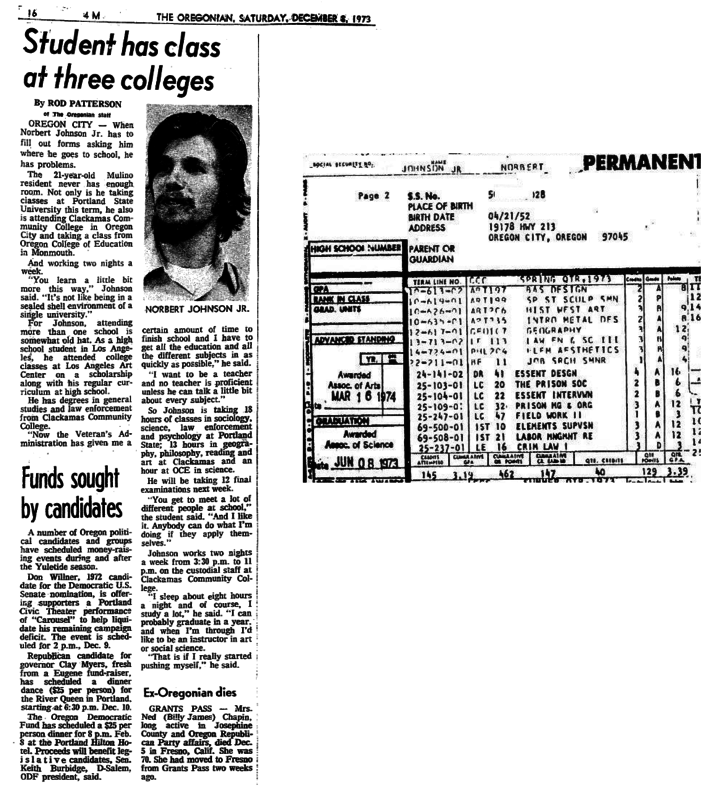
SGT Gunderson, I understand your plight and disillusionment so completely except that this disillusionment did not occur in the hear and now but within the past. I too was a bottom feeder in High School graduating number 83 out of 84 graduates. My only choice according to the School Counselor was to Join the Army because at least I could get a set of skills for my service. So after my first Medical Discharge I entered College... a place that I was told I could never enter due to GPA. I saw the College Admissions Counselor and brought in my DD214 as well as my Entry Tests Scores for the Army. She was not impressed that I graduated HS with a low GPA, but things changed when I presented my Test Scores on the Entry exam. With a 97 on my AFQT and the average score over 120, she made an exception (and it might be because I had VA funds for education as well (you never know the driving force for exceptions to the rule until you try... I think it was all for the money).
With my ACT/SAT exam requirement waived, and it only 6 days before the start of the term, I was accepted. Due to the fact that my time in service was cut short the first time, I only had 2 years of VA education benefits, and I had to maximize my efforts to succeed and graduate. I did graduate with 3 Associates Degrees in 2 years and maintain the Dean's Honor List throughout my College experience even with my only "D" grade in Criminal Law (fell asleep in the final exam). I did notice that with every change in focus of minority student recruitment, there existed patterns of changes in requirements to lessen the content and allow for those deemed disadvantaged to be able to pass the coursework. Then came the intro to Remedial courses.. then to Remedial Courses counting toward a Degree, and then the halving of the required coursework to the point of a Bachelor Degree being nothing more in content of knowledge than an Associates Degree (all in the name of diversity and inclusion).
While I saw the reduction of course requirements and lessening the rules on recruitment as a "Window Dressing" to support inclusion of less than qualified individuals, and the degree watered down changing requirements for acceptance to Graduate School occur, did I realize that this was a disservice to not only the qualified but the unqualified in College. For a time that created the stigma of the Graduate of a Lessor Degree thought process of the Minority and/or educationally disadvantaged Graduate. And at times it appeared it was a Degree of Participation and no longer Qualification (depending on the educational institution and field of study). How many times have you heard that mantra of I have a College Degree, then to ask what it was in.. ANSWER: General or Liberal Studies, or Student initiated Studies, or Gender Identity or Women and Minority Studies, etc. Then to ask the question... Did you find a job in that field and to be told 99% of the time "...NO I did not!" Well I have one of those General Studies Degrees and when I tried to use that, well my High School Diploma was worth more to the Employer.
Sometimes we make statements in this forum that others think is outlandish or just isn't exactly right on spot... so since I am Old and no longer have to prove anything.. I thought I would bring PROOF to the table in support of your contention that there COllege is not for everyone and also I emphasize with your disillusions about the educational process being watered down. Now remember this is NOT the fault of the Student, it is the fault of the increased amount of Grants and Loans which increase educational costs to the students for an inferior level of return on investment. The Newspaper clip and the partial transcript review will verify that a Working College Student can take over the minimum coursework required for a standard degree, in fact 2 times the coursework and still maintain Honors... and one time just to prove a point succeed in taking 40 credit hours of College in one Quarter while working part time (20 hr per week), and again maintaining honors (just remember not to fall asleep during finals).
SOmething else to ponder is that the Joint Services Transcript for your military training and experience can shorten your time in College tremendously. I had mine evaluated at Liberty University and was granted 100 Semester hours of College Credit for the JST Transcripted recommendations alone. I suggest everyone on this board have their JST Transcript reviewed by a college to see how much their Military training and experience equates toward a College degree. You might be very surprised as I was.
With my ACT/SAT exam requirement waived, and it only 6 days before the start of the term, I was accepted. Due to the fact that my time in service was cut short the first time, I only had 2 years of VA education benefits, and I had to maximize my efforts to succeed and graduate. I did graduate with 3 Associates Degrees in 2 years and maintain the Dean's Honor List throughout my College experience even with my only "D" grade in Criminal Law (fell asleep in the final exam). I did notice that with every change in focus of minority student recruitment, there existed patterns of changes in requirements to lessen the content and allow for those deemed disadvantaged to be able to pass the coursework. Then came the intro to Remedial courses.. then to Remedial Courses counting toward a Degree, and then the halving of the required coursework to the point of a Bachelor Degree being nothing more in content of knowledge than an Associates Degree (all in the name of diversity and inclusion).
While I saw the reduction of course requirements and lessening the rules on recruitment as a "Window Dressing" to support inclusion of less than qualified individuals, and the degree watered down changing requirements for acceptance to Graduate School occur, did I realize that this was a disservice to not only the qualified but the unqualified in College. For a time that created the stigma of the Graduate of a Lessor Degree thought process of the Minority and/or educationally disadvantaged Graduate. And at times it appeared it was a Degree of Participation and no longer Qualification (depending on the educational institution and field of study). How many times have you heard that mantra of I have a College Degree, then to ask what it was in.. ANSWER: General or Liberal Studies, or Student initiated Studies, or Gender Identity or Women and Minority Studies, etc. Then to ask the question... Did you find a job in that field and to be told 99% of the time "...NO I did not!" Well I have one of those General Studies Degrees and when I tried to use that, well my High School Diploma was worth more to the Employer.
Sometimes we make statements in this forum that others think is outlandish or just isn't exactly right on spot... so since I am Old and no longer have to prove anything.. I thought I would bring PROOF to the table in support of your contention that there COllege is not for everyone and also I emphasize with your disillusions about the educational process being watered down. Now remember this is NOT the fault of the Student, it is the fault of the increased amount of Grants and Loans which increase educational costs to the students for an inferior level of return on investment. The Newspaper clip and the partial transcript review will verify that a Working College Student can take over the minimum coursework required for a standard degree, in fact 2 times the coursework and still maintain Honors... and one time just to prove a point succeed in taking 40 credit hours of College in one Quarter while working part time (20 hr per week), and again maintaining honors (just remember not to fall asleep during finals).
SOmething else to ponder is that the Joint Services Transcript for your military training and experience can shorten your time in College tremendously. I had mine evaluated at Liberty University and was granted 100 Semester hours of College Credit for the JST Transcripted recommendations alone. I suggest everyone on this board have their JST Transcript reviewed by a college to see how much their Military training and experience equates toward a College degree. You might be very surprised as I was.
(1)
(0)
1
1
0

well said. First university educational standards vary widely across the country. Secondly when I entered my university in 1958 we were told half the freshman class would not make it and only about 20 - 30% would actually get their degree.You have matured and learned how to focus on a task and finish it. Most youngsters have not had that experience and you may not have done much better at 18. Having said all that there is a lot of evidence our education system has some major deficiencies. The advent of the massive student loan program has encouraged universities to take almost anyone who will pay and often take their money and leave them with no marketable skills. When government money gets stuffed into any system costs go up and the charlatans and scammers abound.
(1)
(0)
1
1
0

Reading through the responses it seems tome that a large majority of the people here have missed an important part of the problem. You can not expect a high standard at university, if the students coming to your from secondary education are deficient.
I am one of the few people, in my opinion, that does not put teachers on pedestals.
Is it commendable for one to choose to teach? Probably, really depends on the person in my opinion; if you suck at what you do, you can not be commended for doing it can you?
However, the problem is that we have neglected the basics in our initial entry training for an academic career. SO too many students going to university, or especially a junior college, are there to play catch up first.
It is this deficiency that causes the survey courses of general ed to be a cake walk the teacher has to make allowances for the deficiency of other students.
I started at the junior college level, and all of the classes i took were transfer level courses that also were applicable to the associate degree. I am not sure if this was the "official" policy or not, but I had one professor who said at the beginning of class, that what he did was graded everyone one the same standard, but at the end of the class if you took a non transferable class, he would bump your overall grade one grade, a D becomes an C and so fourth.
I am one of the few people, in my opinion, that does not put teachers on pedestals.
Is it commendable for one to choose to teach? Probably, really depends on the person in my opinion; if you suck at what you do, you can not be commended for doing it can you?
However, the problem is that we have neglected the basics in our initial entry training for an academic career. SO too many students going to university, or especially a junior college, are there to play catch up first.
It is this deficiency that causes the survey courses of general ed to be a cake walk the teacher has to make allowances for the deficiency of other students.
I started at the junior college level, and all of the classes i took were transfer level courses that also were applicable to the associate degree. I am not sure if this was the "official" policy or not, but I had one professor who said at the beginning of class, that what he did was graded everyone one the same standard, but at the end of the class if you took a non transferable class, he would bump your overall grade one grade, a D becomes an C and so fourth.
(1)
(0)
1
1
0

At first I found it difficult to further my education. Now I am in a grove and want to push my intellectual limits.
(1)
(0)
Read This Next


 Continue with Facebook
 Continue with Google