
Posted on Jan 22, 2025

APOD: 2025 January 22 – The North America Nebula

523
13
1
11
11
0
Good morning, Rallypoint, and welcome to this edition of Astronomy Picture of the Day (APOD) for January 22, 2025.
Did you know about the North America Nebula (aka NGC 7000)? First noted by William Herschel in 1798 as a “faint milky nebulosity scattered over this space, in some places pretty bright," a long-exposure photograph taken by Max Wolf in 1890 revealed its continental shape. The nebula is lies 1,500 light years away in the constellation Cygnus (the Swan), located near the bright star at the swan's tail (Deneb). Using an ultra-high contrast (UHC) filter, NGC 7000 can be seen via binoculars or telescope under dark skies.
Emission nebulae (such as the North American Nebula) are HII regions that shine because their hydrogen gas is ionized by the ultraviolet radiation from a hot star. Edwin Hubble proposed that Deneb may be responsible for lighting up the North America Nebula in 1922. Further research revealed that Deneb may not be hot enough (its spectra suggests a surface temperature of 14,800 degrees Fahrenheit). The spectrum for the North American Nebula indicates that it is being heated by a star hotter than 53,000 degrees Fahrenheit. European astronomers Fernando Comerón and Anna Pasquali found evidence of that star (Bajamar, 'behind' NGC 7000) in 2004.
Did you know about the North America Nebula (aka NGC 7000)? First noted by William Herschel in 1798 as a “faint milky nebulosity scattered over this space, in some places pretty bright," a long-exposure photograph taken by Max Wolf in 1890 revealed its continental shape. The nebula is lies 1,500 light years away in the constellation Cygnus (the Swan), located near the bright star at the swan's tail (Deneb). Using an ultra-high contrast (UHC) filter, NGC 7000 can be seen via binoculars or telescope under dark skies.
Emission nebulae (such as the North American Nebula) are HII regions that shine because their hydrogen gas is ionized by the ultraviolet radiation from a hot star. Edwin Hubble proposed that Deneb may be responsible for lighting up the North America Nebula in 1922. Further research revealed that Deneb may not be hot enough (its spectra suggests a surface temperature of 14,800 degrees Fahrenheit). The spectrum for the North American Nebula indicates that it is being heated by a star hotter than 53,000 degrees Fahrenheit. European astronomers Fernando Comerón and Anna Pasquali found evidence of that star (Bajamar, 'behind' NGC 7000) in 2004.
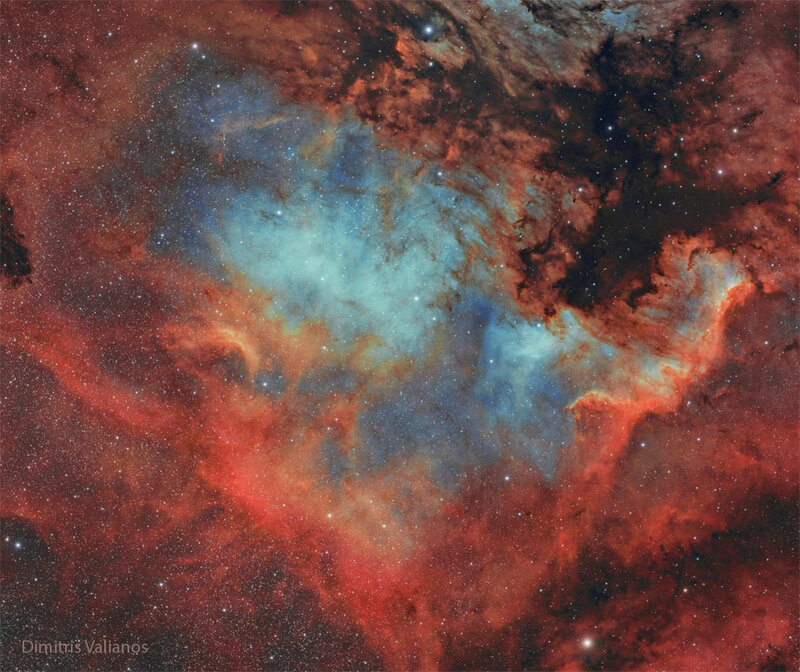
APOD: 2025 January 22 – The North America Nebula
Posted from apod.nasa.gov NASA
NASA Space
Space Science
 Photography
 Astronomy
Edited 1 y ago
Posted 1 y ago
Responses: 1

Read This Next


 Continue with Facebook
 Continue with Google