
Posted on Jan 29, 2025

APOD: 2025 January 29 – Dust Shells around WR 140 from Webb

655
21
3
12
12
0
Good morning, Rallypoint, and welcome to this edition of Astronomy Picture of the Day (APOD) for January 29, 2025.
If you elect to visit today's APOD, you are greeted with a 2023 image from the James Webb Space Telescope of a star system in the constellation Cygnus (The Swan). Mouse over the image on the APOD page, and a 2022 photo of the same star system is displayed. See how the rings (or shells) appear to move outward over time?
The source of the dust rings is the central feature of the star system: Wolf-Rayet 140. The analysis of light from a Wolf-Rayet (WR) star reveals prominent broad emission lines of ionised helium and highly ionized nitrogen or carbon...and very little (if any) hydrogen. In other words, the star has run out of its standard fuel (hydrogen) and is now fusing heavier elements (e.g. helium, etc) in its core.
The stars (WR 140 and its companions) are in orbit about each other. The period of that orbit (when they return to a 'starting' point) is about eight years, creating another dust ring. The light coming from these rings tells us they are rich in carbon. The rings were first observed in 1999, and these ground-based infrared observations only resolved one to two discrete shells. Webb changed that. I counted 13 rings across these images (Wikipedia says there are 17), representing over 100 years of dust production.
The fires of creation continue to unfold.
If you elect to visit today's APOD, you are greeted with a 2023 image from the James Webb Space Telescope of a star system in the constellation Cygnus (The Swan). Mouse over the image on the APOD page, and a 2022 photo of the same star system is displayed. See how the rings (or shells) appear to move outward over time?
The source of the dust rings is the central feature of the star system: Wolf-Rayet 140. The analysis of light from a Wolf-Rayet (WR) star reveals prominent broad emission lines of ionised helium and highly ionized nitrogen or carbon...and very little (if any) hydrogen. In other words, the star has run out of its standard fuel (hydrogen) and is now fusing heavier elements (e.g. helium, etc) in its core.
The stars (WR 140 and its companions) are in orbit about each other. The period of that orbit (when they return to a 'starting' point) is about eight years, creating another dust ring. The light coming from these rings tells us they are rich in carbon. The rings were first observed in 1999, and these ground-based infrared observations only resolved one to two discrete shells. Webb changed that. I counted 13 rings across these images (Wikipedia says there are 17), representing over 100 years of dust production.
The fires of creation continue to unfold.
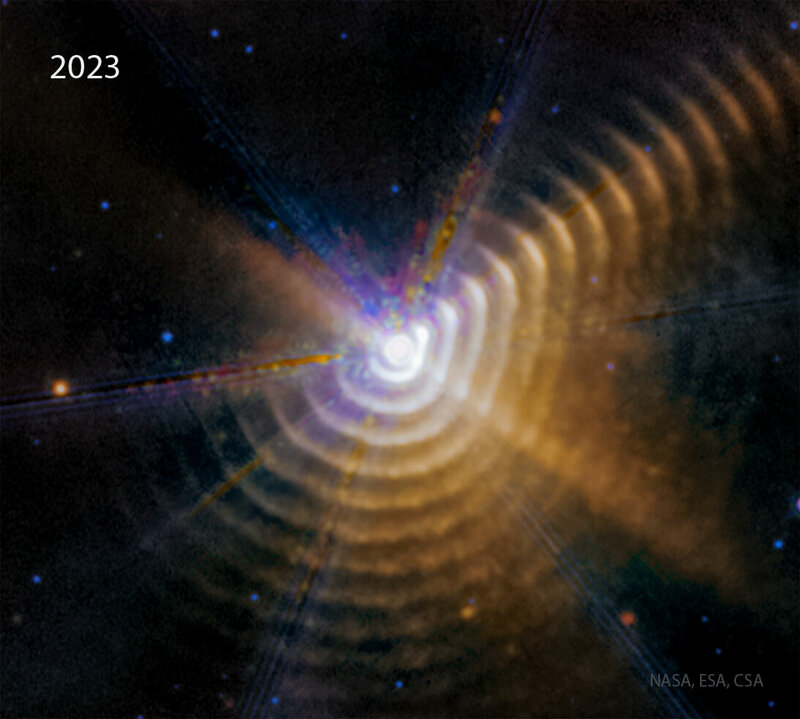
APOD: 2025 January 29 – Dust Shells around WR 140 from Webb
Posted from apod.nasa.gov NASA
NASA Space
Space Science
 Photography
 Astronomy
Edited 11 mo ago
Posted 11 mo ago
Responses: 3
4
4
0

3
3
0

This looks like it's been I'D. I know it hasn't but it's another amazing photo by someone much better at it than I.
(3)
(0)
2
2
0

Read This Next


 Continue with Facebook
 Continue with Google