
Posted on Mar 5, 2025

APOD: 2025 March 5 – Seven Sisters versus California

3.75K
16
2
10
10
0
Good morning, Rallypoint, and welcome to this Ash Wednesday edition of Astronomy Picture of the Day (APOD) for March 5, 2025.
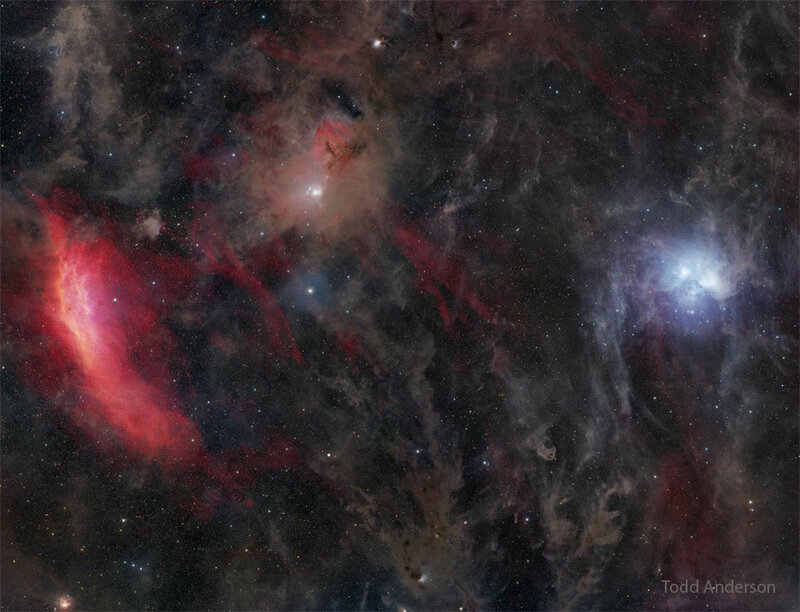
Our featured photo is actually a 12-panel mosaic of the Taurus Molecular Cloud. If you visit the APOD page and mouse over the image, things are labelled for you. The Pleiades (Messier 45) are on the right, and the California Nebula (NGC 1499) is on the left. Between the two is the star forming region IC 348, and in the lower quadrant (just right of center) is the Baby Eagle Nebula (aka the Vulture Nebula, it is heads-down in this orientation), Lynds' Bright Nebula (LBN) 777.
I was familiar with LDN (Lynds' Catalog of Dark Nebulae), but not LBN. So that sent me off hunting. Images from the Palomar Observatory outside of San Diego, California, are categorized based on the wavelength of light being observed (red/infrared or blue/ultraviolet) and were captured on either red or blue 'plates'. American astronomer Beverly Turner Lynds created a taxonomy of 'bright' reflection nebulae based on the relative brightness and color of objects as shown on the Palomar red or blue plates. LBN 777 has a brightness of 4 and a color of 3, meaning it was most visible on the Palomar red plate data set.
Our featured photo is actually a 12-panel mosaic of the Taurus Molecular Cloud. If you visit the APOD page and mouse over the image, things are labelled for you. The Pleiades (Messier 45) are on the right, and the California Nebula (NGC 1499) is on the left. Between the two is the star forming region IC 348, and in the lower quadrant (just right of center) is the Baby Eagle Nebula (aka the Vulture Nebula, it is heads-down in this orientation), Lynds' Bright Nebula (LBN) 777.
I was familiar with LDN (Lynds' Catalog of Dark Nebulae), but not LBN. So that sent me off hunting. Images from the Palomar Observatory outside of San Diego, California, are categorized based on the wavelength of light being observed (red/infrared or blue/ultraviolet) and were captured on either red or blue 'plates'. American astronomer Beverly Turner Lynds created a taxonomy of 'bright' reflection nebulae based on the relative brightness and color of objects as shown on the Palomar red or blue plates. LBN 777 has a brightness of 4 and a color of 3, meaning it was most visible on the Palomar red plate data set.
APOD: 2025 March 5 – Seven Sisters versus California
Posted from apod.nasa.gov NASA
NASA Space
Space Science
 Photography
 Astronomy
Edited 11 mo ago
Posted 11 mo ago
Responses: 2


Read This Next


 Continue with Facebook
 Continue with Google