

30
30
0
His Marine Patrol was deep into enemy territory in South Vietnam’s Quang Tin Province when they were ambushed by a large NVA force. “It was the first time I’d been shot at,” Barney said. “So, I hit the deck.” Seeing that his Company commander, Capt Paul Gormleyand, was severely injured in the opening volley, he braved enemy fire to get to Gormleyand, who died in Barney’s arms after he carried him back to their line. He recalled, “The way the Communists fight is they take the commander out first.”
Their radio operator had also been killed. “When I … looked around, I could see all these young Marines’ eyes looking at me, and they’re saying, ‘OK, lieutenant, what the hell are we going to do?’” He recalls, “I was scared, but officers have to learn how to control fear and not exhibit fear. When we got ambushed, and the Company commander was killed, I knew what we needed — teamwork. … At that point, I started doing what lieutenants do, and that’s giving direction.” He knew he had to retrieve the radio: “So, I ran out, took the radio off the dead operator, carried it back, and strapped it to myself. I got on the phone, called the battalion commander, and told him what happened and that I was assuming command.”
He assumed command of his Company and rallied the remaining Marines to formulate a counterattack as he called for intense artillery support. His battalion commander advised by radio that there was no way to extract his men from their current position and that they would have to fight their way to the nearby village or hold their position overnight. But he knew holding overnight would not be possible: “Casualties were mounting rapidly. Ammunition was getting low, and the ceiling was closing in on us. I didn’t think our chances were going to be very good if we stayed.”
He ordered several Marines to clear a landing zone for evacuation of the wounded and dead before it got too hot for anyone else to land. He then began coordinating curtains of suppression fire toward the enemy trench lines as two Huey gunships arrived overhead for air support. He picked up a rocket launcher and, fully exposed to enemy fire, sent three rockets blazing toward the enemy position so the Huey pilots would know where to lay down their fire.
As soon as the air attack commenced, it allowed for two helicopters to land and evacuate the wounded and dead.
Their radio operator had also been killed. “When I … looked around, I could see all these young Marines’ eyes looking at me, and they’re saying, ‘OK, lieutenant, what the hell are we going to do?’” He recalls, “I was scared, but officers have to learn how to control fear and not exhibit fear. When we got ambushed, and the Company commander was killed, I knew what we needed — teamwork. … At that point, I started doing what lieutenants do, and that’s giving direction.” He knew he had to retrieve the radio: “So, I ran out, took the radio off the dead operator, carried it back, and strapped it to myself. I got on the phone, called the battalion commander, and told him what happened and that I was assuming command.”
He assumed command of his Company and rallied the remaining Marines to formulate a counterattack as he called for intense artillery support. His battalion commander advised by radio that there was no way to extract his men from their current position and that they would have to fight their way to the nearby village or hold their position overnight. But he knew holding overnight would not be possible: “Casualties were mounting rapidly. Ammunition was getting low, and the ceiling was closing in on us. I didn’t think our chances were going to be very good if we stayed.”
He ordered several Marines to clear a landing zone for evacuation of the wounded and dead before it got too hot for anyone else to land. He then began coordinating curtains of suppression fire toward the enemy trench lines as two Huey gunships arrived overhead for air support. He picked up a rocket launcher and, fully exposed to enemy fire, sent three rockets blazing toward the enemy position so the Huey pilots would know where to lay down their fire.
As soon as the air attack commenced, it allowed for two helicopters to land and evacuate the wounded and dead.
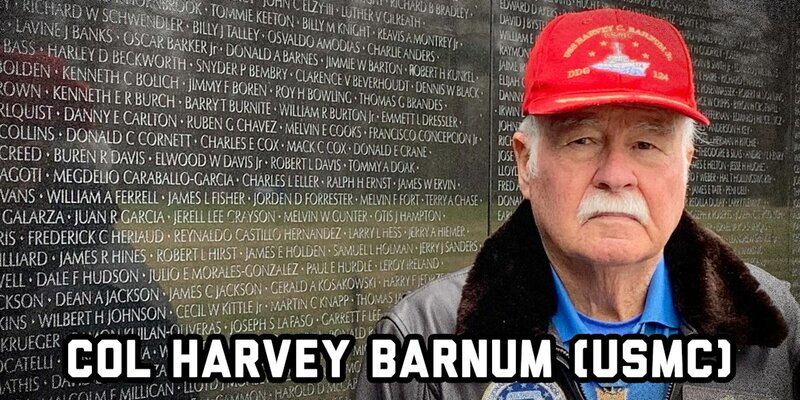
Profiles of Valor: Col Harvey Barnum (USMC)
Posted from patriotpost.us Vietnam War
 Medal of Honor
 Marines
 Heroes
 Courage
Edited 8 mo ago
Posted 8 mo ago
Responses: 7

13
13
0

Lt Col Charlie Brown OOHRAH Colonel (at the time Lt.) Barnum! Great share Colonel. "Uncommon Valor was a common Virtue"
(13)
(0)
11
11
0

8
8
0

Some men are born to greatness. Others have it thrust upon them. Then there are those who are leaders of Marines.
(8)
(0)
Read This Next


 Continue with Facebook
 Continue with Google