
Posted on Apr 22, 2025

This Battery Heals Itself After Being Cut in Half

2.06K
21
3
12
12
0
A new lithium-ion battery can not only withstand stretching and twisting, but can get stabbed with needles and cut in half with razor blades—and then heal itself to continue providing power to a device.
Wearable electronics, soft robots, and other devices could benefit from soft, stretchable lithium-ion batteries. However, most commercial lithium-ion batteries are hermetically sealed in rigid packages to keep out moisture that can degrade their performance, and to prevent toxic and flammable electrolytes from leaking out.
Previous research had investigated stretchable batteries that used hydrogels as their electrolytes. By using water as their solvent, these hydrogel batteries would prove nonflammable and less sensitive to moisture than commercial lithium-ion batteries. However, prior devices suffered from a number of limitations. Some only proved stable in relatively low voltages. Others depended on toxic, expensive flourine-loaded compounds.
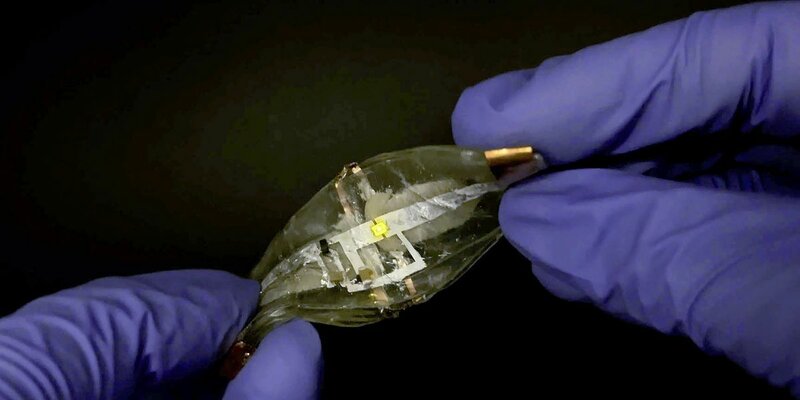
In the new study, researchers developed a new water-based hydrogel lithium-ion battery that does not contain fluorine. Previous stretchable batteries have proven sturdy, surviving twisting and even strikes from a hammer. The new battery displays another level of durability, not only enduring stretching, twisting, and folding, but continuously powering a yellow light even while being repeatedly punctured with needles. In addition, “the battery can be cut in half, put together, and self-heal to still maintain more than 90 percent of its capacity,” says Liwei Lin, a professor of mechanical engineering at the University of California, Berkeley.
Wearable electronics, soft robots, and other devices could benefit from soft, stretchable lithium-ion batteries. However, most commercial lithium-ion batteries are hermetically sealed in rigid packages to keep out moisture that can degrade their performance, and to prevent toxic and flammable electrolytes from leaking out.
Previous research had investigated stretchable batteries that used hydrogels as their electrolytes. By using water as their solvent, these hydrogel batteries would prove nonflammable and less sensitive to moisture than commercial lithium-ion batteries. However, prior devices suffered from a number of limitations. Some only proved stable in relatively low voltages. Others depended on toxic, expensive flourine-loaded compounds.
In the new study, researchers developed a new water-based hydrogel lithium-ion battery that does not contain fluorine. Previous stretchable batteries have proven sturdy, surviving twisting and even strikes from a hammer. The new battery displays another level of durability, not only enduring stretching, twisting, and folding, but continuously powering a yellow light even while being repeatedly punctured with needles. In addition, “the battery can be cut in half, put together, and self-heal to still maintain more than 90 percent of its capacity,” says Liwei Lin, a professor of mechanical engineering at the University of California, Berkeley.
This Battery Heals Itself After Being Cut in Half
Posted from spectrum.ieee.orgPosted in these groups:  Science
 Technology
 Energy
 Mechanical Engineering
 University of California – Berkeley
Science Technology Energy Mechanical Engineering University of California – Berkeley
Posted 10 mo ago


Read This Next


 Continue with Facebook
 Continue with Google