

Astronomy

Astronomy
Posted on Feb 9, 2025

APOD: 2025 February 9 – Milky Way over the Australian Pinnacles

1.92K
27
5
16
16
0
Good morning, Rallypoint, and welcome to the Super Bowl Sunday edition of Astronomy Picture of the Day (APOD) for February 9, 2025.
We travel to the 'Land Down Under' today for this throw-back from the APOD archives taken in Pinnacles National Park in Western Australia. This 29-exposure composite was captured in September 2015 and has made repeat APOD appearances since then.
The park contains thousands of weathered limestone pillars. Some of the tallest pinnacles reach heights over 10 feet above the yellow sand base. The different types of formations include ones which are much taller than they are wide and resemble columns—suggesting the name of Pinnacles—while others are only 3 feet or so in height and width resembling short tombstones. A cross-bedding structure is observed in many of the structures where the angle of deposited sand changed suddenly due to changes in prevailing winds during formation of the limestone beds.
Pinnacles with tops similar to mushrooms were created where a harder carbonate deposit has formed over a softer limestone layer below it. As a result, the lower layers weather and erode at a faster rate than the top layer leaving behind more material at the top of the pinnacle. Did you notice the light 'pyramid'? That is zodiacal light adding a nice touch to the overall visual product.
We travel to the 'Land Down Under' today for this throw-back from the APOD archives taken in Pinnacles National Park in Western Australia. This 29-exposure composite was captured in September 2015 and has made repeat APOD appearances since then.
The park contains thousands of weathered limestone pillars. Some of the tallest pinnacles reach heights over 10 feet above the yellow sand base. The different types of formations include ones which are much taller than they are wide and resemble columns—suggesting the name of Pinnacles—while others are only 3 feet or so in height and width resembling short tombstones. A cross-bedding structure is observed in many of the structures where the angle of deposited sand changed suddenly due to changes in prevailing winds during formation of the limestone beds.
Pinnacles with tops similar to mushrooms were created where a harder carbonate deposit has formed over a softer limestone layer below it. As a result, the lower layers weather and erode at a faster rate than the top layer leaving behind more material at the top of the pinnacle. Did you notice the light 'pyramid'? That is zodiacal light adding a nice touch to the overall visual product.
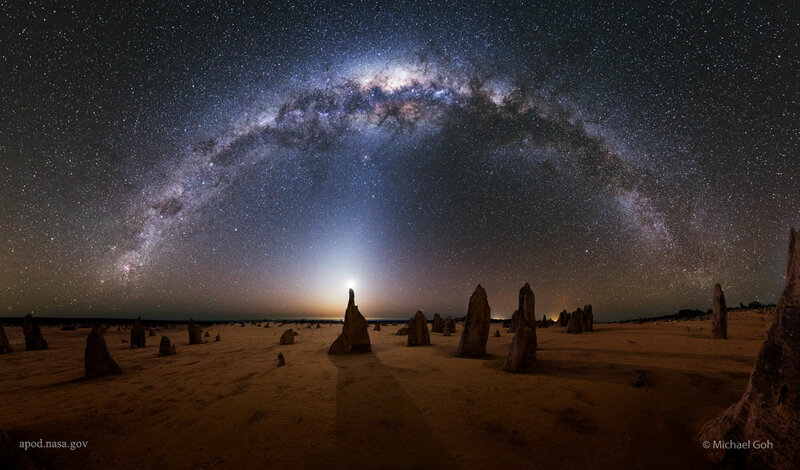
APOD: 2025 February 9 – Milky Way over the Australian Pinnacles
Posted from apod.nasa.gov NASA
NASA Space
Space Science
 Photography
 Astronomy
Edited 1 y ago
Posted 1 y ago
Responses: 4
6
6
0

A1C Medrick "Rick" DeVaney

More Than Just A Pillar ~ Those Are Monoliths And Their All Over The World ~
Pre Historic Structures ~ "We Are NOT Alone, And We've NEVER Been Alone"
http://www.webmag.fr/en/culture-en/the-riddle-of-the..
Pre Historic Structures ~ "We Are NOT Alone, And We've NEVER Been Alone"
http://www.webmag.fr/en/culture-en/the-riddle-of-the..
Monolites: Mysteries and Meanings of the Silent Giants
Uncover the enigma of the Monolith in a fascinating exploration of grandiose structures and their meaning. Immerse yourself in the history, architecture and mysteries surrounding these monumental monuments and their impact on our culture today.
(0)
(0)
2
2
0

This rendered me speechless when I first viewed it. Our world and our universe are amazing and beautiful!
(2)
(0)
1
1
0

Read This Next


 Continue with Facebook
 Continue with Google