

Astronomy

Astronomy
Posted on Jan 20, 2026

APOD: 2026 January 20 – Io in True Color

544
46
9
12
12
0
Good morning, Rallypoint, and welcome to the January 20, 2026 edition of Astronomy Picture of the Day (APOD).
An APOD regular since 2004, Io is the innermost and second-smallest of the four Galilean moons of Jupiter. It was visited by the Galileo spacecraft in 1999. Slightly larger than Earth's Moon, Io is the fourth-largest natural satellite in the Solar System, has the highest density and strongest surface gravity of any natural satellite, and the lowest amount of water by atomic ratio of any known astronomical object in the Solar System. And it is the most geologically active (over 400 volcanoes).
Researchers believe this activity is due to a gravitational tug-o-war between Jupiter and two other Galilean moons—Europa and Ganymede. Sulfur gives Io its yellow hue.
An APOD regular since 2004, Io is the innermost and second-smallest of the four Galilean moons of Jupiter. It was visited by the Galileo spacecraft in 1999. Slightly larger than Earth's Moon, Io is the fourth-largest natural satellite in the Solar System, has the highest density and strongest surface gravity of any natural satellite, and the lowest amount of water by atomic ratio of any known astronomical object in the Solar System. And it is the most geologically active (over 400 volcanoes).
Researchers believe this activity is due to a gravitational tug-o-war between Jupiter and two other Galilean moons—Europa and Ganymede. Sulfur gives Io its yellow hue.
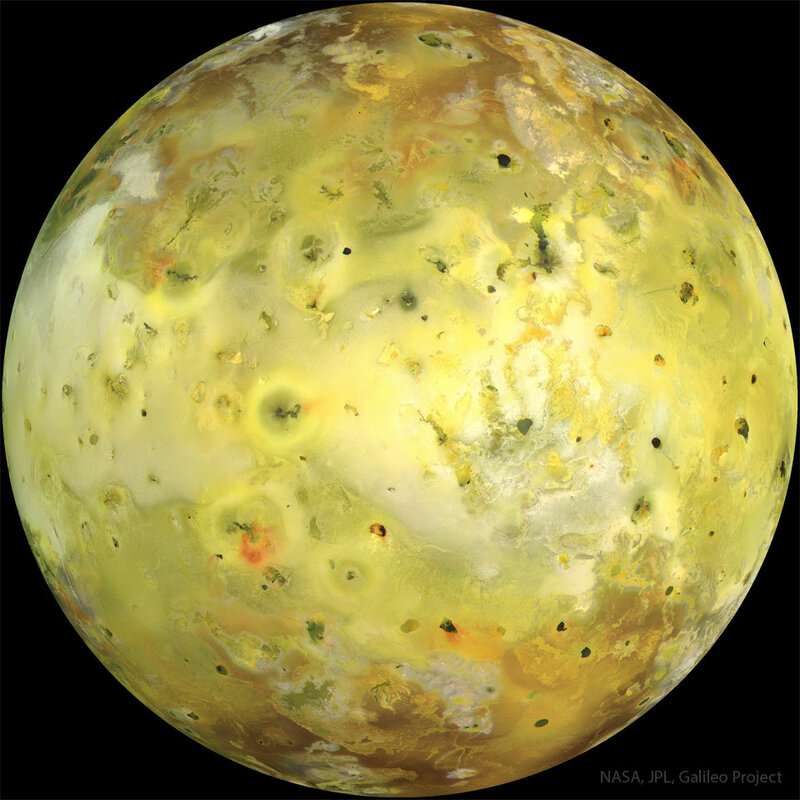
APOD: 2026 January 20 – Io in True Color
Posted from apod.nasa.gov Space
Space Science
 Photography
 Astronomy
Edited 24 d ago
Posted 24 d ago
Responses: 7
8
8
0

Almost a perfect orb based on its image taken by the Galileo spacecraft in 1999... It's sulfur content is very high as is the number of Volcanoes. It almost looks like a lemon meringue pie without the meringue! - Fascinating!
(8)
(0)
7
7
0

5
5
0

Read This Next


 Continue with Facebook
 Continue with Google