

Astronomy

Astronomy

9
9
0
Good morning, Rallypoint, and welcome to this edition of Astronomy Picture of the Day (APOD) for February 20, 2025.
We visited a similar structure in the Taurus Molecular Cloud yesterday, but this one is far larger (and much further away). Charles Messier discovered this object (M87) in 1781, and first categorized it as a nebula. Edwin Hubble first suggested the term 'external galaxies' versus 'extragalactic nebulae' as the term 'galaxy' was used as a synonym for our Milky Way. After 1954 (as technology improved), radio and x-ray sources were observed to overlap the location of the M87. As additional data was gathered, M87 began being classified as a separate galaxy.
How big is M87? Our Milky Way is estimated to contain billions of stars...M87 contains trillions of stars. The jets we saw in yesterday's APOD were 300-600 astronomical units (AU; 1 AU = distance between the Sun and Earth)...the jet we see in this image (off the center to the right) is estimated to be 5,000 light years in length. Scientists estimate that the center of the galaxy is over 6 billion times the size of our Sun.
We visited a similar structure in the Taurus Molecular Cloud yesterday, but this one is far larger (and much further away). Charles Messier discovered this object (M87) in 1781, and first categorized it as a nebula. Edwin Hubble first suggested the term 'external galaxies' versus 'extragalactic nebulae' as the term 'galaxy' was used as a synonym for our Milky Way. After 1954 (as technology improved), radio and x-ray sources were observed to overlap the location of the M87. As additional data was gathered, M87 began being classified as a separate galaxy.
How big is M87? Our Milky Way is estimated to contain billions of stars...M87 contains trillions of stars. The jets we saw in yesterday's APOD were 300-600 astronomical units (AU; 1 AU = distance between the Sun and Earth)...the jet we see in this image (off the center to the right) is estimated to be 5,000 light years in length. Scientists estimate that the center of the galaxy is over 6 billion times the size of our Sun.
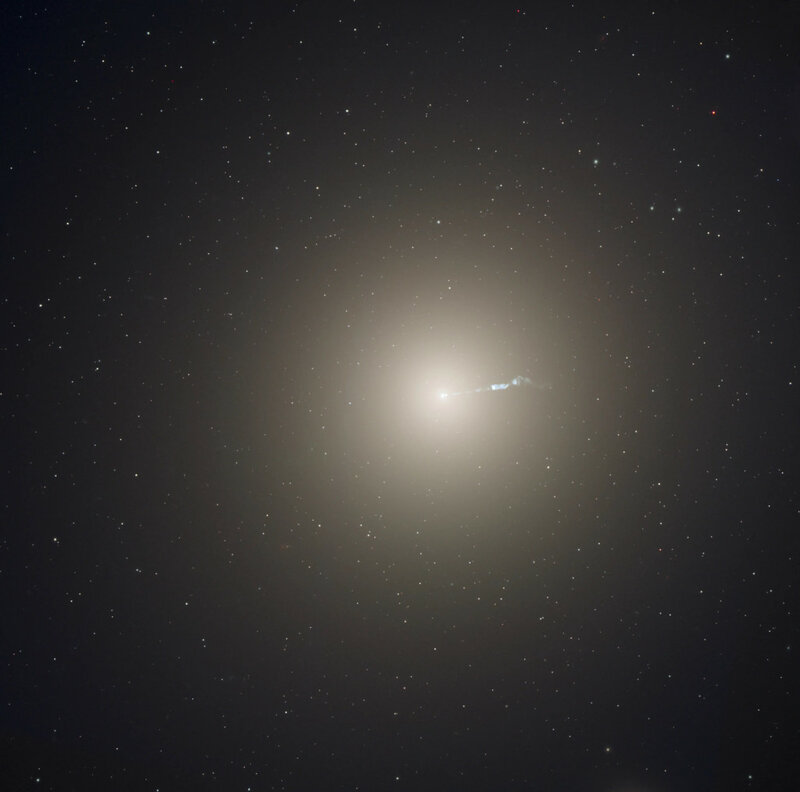
APOD: 2025 February 20 - Messier 87
Posted from apod.nasa.gov NASA
NASA Space
Space Science
 Photography
 Astronomy
Posted 1 y ago
Responses: 3

2
2
0

Maj William W. 'Bill' Price
Given the distance (53 million light years away), it is a challenge to discern individual stars.
(1)
(0)
1
1
0

A agree with COL (Join to see), it does looke solid objects! A rectangle with a sort of piramid on the end...
(1)
(0)
0
0
0

Okay, Fess-Up; Which One Of You Can ACTUALLY Comprehend Those Numbers?
~ I'm Still Trying To Calculate Where "Buzz Lightyear" Is.~
~ I'm Still Trying To Calculate Where "Buzz Lightyear" Is.~
(0)
(0)
Read This Next


 Continue with Facebook
 Continue with Google