

Special Forces

Special Forces


5
5
0
More from: " My time in Service:"
So what does a guy from Brazil, another guy from India, and a kid from Cleveland have in common. Well, not much. But if they are all in Armies...and then meet for hand to hand Combat training, just for fun- well, you get this story.
I boxed when I was little. I sucked. I could take a punch. And that was a good thing, because everyone else pounded on me. Later I wrestled. I sucked there too. But...nobody ever pinned me. And I learned how maneuver on the ground, which is where I found myself most fights. I took exactly six weeks of Karate training...to learn one specific counter for an attack a bully pulled on me every Friday at School. That is another story. I will tell it someday, but not today.
Today I want to talk about Special Forces and fighting styles. Not the Krav Maga stuff of those elite Operators. But how different folks fight in different situations.
So at one of my Units, they had a bunch of Grunts from different Armies to come over and train a little, but mostly just to familiarize those guys to American Infantry weapons and tactics. I was there as a note taker.
One of the guys I met was a Green Beret, and a Black Belt in Tae Kwan Do. He also did jujitsu, boxing and who knows what other marital arts. He was using me as a volunteer for some throws.
So when we broke for lunch a guy from the Indian Army, and a guy from Brazil came over to chat about some techniques. Over the next couple of days...they would meet up at the gym after Duty hours and talk about stuff they saw and did. I took notes. LOL
And the Indian guy, and the Brazilian Guy told the Green Beret that his techniques took up too much space and room. And that he didn't make decisions... or movements... quick enough.
Well, that led to some interesting stuff. The Brazilian guy understood right away. He said this:
"Yeah, I noticed that to when Playing football (soccer) against Americans. They don't have Fustal Courts, so they are slow and need more room."
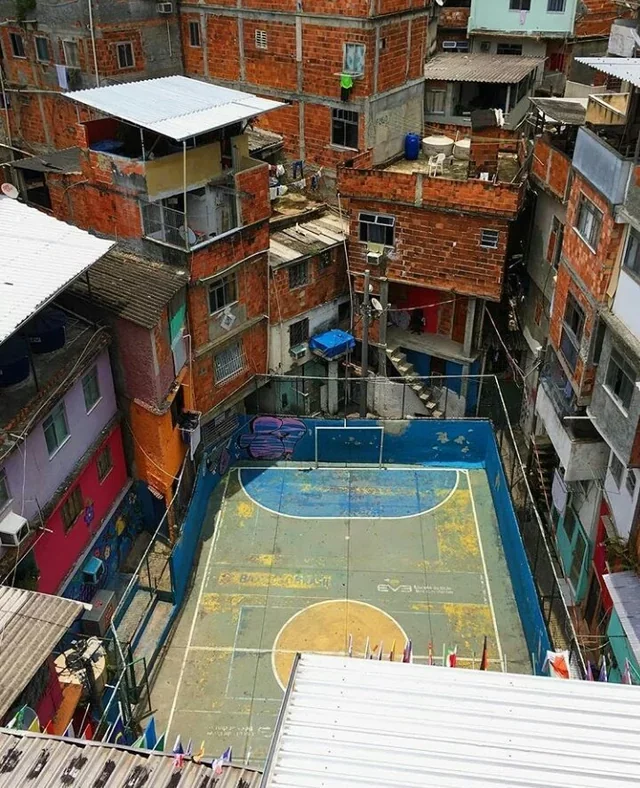
I had never heard of fustal. But there the picture I posted is of one of those courts in a slum in Brazil. He said you have to develop quicker feet, plan ahead faster to pass the ball, and make lightening like decisions.
And the Indian guy beamed. And agreed. He said:
"I learned Kalari. And we had very little rooms to practice in. The weapons hall was the biggest, but we did unarmed techniques in an area the size of an American Phone booth or closet. Because in our cities, they are crowded. Nobody has giant apartments like over here in the West. So when we have to fight in Urban areas, we can fight in a hallway, a lift (that is what he called an elevator), or a very small room. Americans need space. We don't have it. "
So that led to sparring in a mop closet in the gym. And it was hilarious.
The Indian guy and the Brazilian guy were right.
The Indian guy kicked everyone's asses. It was like he was a stick figure, and his legs and arms went straight up, or just a bit to the side. Blocks, counters, jabs, punches, kicks...he wailed on the Green Beret in a space that was probably five or six feet square. He even used the little squared off area inside the closet that had a little wall about six inches high around it -where you dumped the mop water.
By the end of the week, a dozen American guys were showing up to learn from those two guys how to fight in very small physical spaces.
And I learned how something as simple as how much room you have to move around, determines your tactics and strategies. I hope never to have to fight in a phone booth, but I know it can be done. I saw it.
And my nephew tells me that America now has Fustal Courts, because to make it to the World Cup, you need the skills formed on that tiny court. So we copied from the Brazilians a couple decades ago.
I don't know if Kalari is popular or not. But I know their practitioners can win a fight in an elevator (lift).
Me, I just take notes.
So what does a guy from Brazil, another guy from India, and a kid from Cleveland have in common. Well, not much. But if they are all in Armies...and then meet for hand to hand Combat training, just for fun- well, you get this story.
I boxed when I was little. I sucked. I could take a punch. And that was a good thing, because everyone else pounded on me. Later I wrestled. I sucked there too. But...nobody ever pinned me. And I learned how maneuver on the ground, which is where I found myself most fights. I took exactly six weeks of Karate training...to learn one specific counter for an attack a bully pulled on me every Friday at School. That is another story. I will tell it someday, but not today.
Today I want to talk about Special Forces and fighting styles. Not the Krav Maga stuff of those elite Operators. But how different folks fight in different situations.
So at one of my Units, they had a bunch of Grunts from different Armies to come over and train a little, but mostly just to familiarize those guys to American Infantry weapons and tactics. I was there as a note taker.
One of the guys I met was a Green Beret, and a Black Belt in Tae Kwan Do. He also did jujitsu, boxing and who knows what other marital arts. He was using me as a volunteer for some throws.
So when we broke for lunch a guy from the Indian Army, and a guy from Brazil came over to chat about some techniques. Over the next couple of days...they would meet up at the gym after Duty hours and talk about stuff they saw and did. I took notes. LOL
And the Indian guy, and the Brazilian Guy told the Green Beret that his techniques took up too much space and room. And that he didn't make decisions... or movements... quick enough.
Well, that led to some interesting stuff. The Brazilian guy understood right away. He said this:
"Yeah, I noticed that to when Playing football (soccer) against Americans. They don't have Fustal Courts, so they are slow and need more room."
I had never heard of fustal. But there the picture I posted is of one of those courts in a slum in Brazil. He said you have to develop quicker feet, plan ahead faster to pass the ball, and make lightening like decisions.
And the Indian guy beamed. And agreed. He said:
"I learned Kalari. And we had very little rooms to practice in. The weapons hall was the biggest, but we did unarmed techniques in an area the size of an American Phone booth or closet. Because in our cities, they are crowded. Nobody has giant apartments like over here in the West. So when we have to fight in Urban areas, we can fight in a hallway, a lift (that is what he called an elevator), or a very small room. Americans need space. We don't have it. "
So that led to sparring in a mop closet in the gym. And it was hilarious.
The Indian guy and the Brazilian guy were right.
The Indian guy kicked everyone's asses. It was like he was a stick figure, and his legs and arms went straight up, or just a bit to the side. Blocks, counters, jabs, punches, kicks...he wailed on the Green Beret in a space that was probably five or six feet square. He even used the little squared off area inside the closet that had a little wall about six inches high around it -where you dumped the mop water.
By the end of the week, a dozen American guys were showing up to learn from those two guys how to fight in very small physical spaces.
And I learned how something as simple as how much room you have to move around, determines your tactics and strategies. I hope never to have to fight in a phone booth, but I know it can be done. I saw it.
And my nephew tells me that America now has Fustal Courts, because to make it to the World Cup, you need the skills formed on that tiny court. So we copied from the Brazilians a couple decades ago.
I don't know if Kalari is popular or not. But I know their practitioners can win a fight in an elevator (lift).
Me, I just take notes.

 Weapons
 Martial Arts
 Special Forces
 Soccer
 Physical Training
Edited 10 h ago
Posted 10 h ago
Read This Next


 Continue with Facebook
 Continue with Google