
Posted on Sep 24, 2014

Do you believe that Sharia Law is compatible with our Constitution?

35.9K
566
320
6
6
0

I want to know whether anyone believes that Islam in America demanding Sharia Law will work in America with our Constitution and Bill of Rights. With the growing Muslim population (both legally and illegally) and all of the special treatment they get regarding their religion as compared to any other in America are you worried about whether our Constitution will survive?
Posted in these groups:  Constitution
 Islam
Islam
Constitution Islam
Posted >1 y ago
Responses: 91
2
2
0

Religious based laws (as opposed to laws that have clear material basis) are antithetical to a free republic. As an atheist I view religion, especially Abrahamic ones as toxic psychoses that should be treated as dangerous.
It wasn't atheists burning women at the stake or fighting the crusades, and it isn't the atheists beheading infidels. Those atrocities were done by the religious.
It wasn't atheists burning women at the stake or fighting the crusades, and it isn't the atheists beheading infidels. Those atrocities were done by the religious.
(2)
(0)
2
2
0

Sharia law and the Constitution are NOT compatible!!!! I have done some research and I found that the Muslim Holy book the Koran or Quran, began as a peaceful religion in Mecca. When the second part of the book was revealed, it was in Medina. Its that second revelation that turned it from a peaceful religion to a violent and intolerant religion. And that is about the time that Sharia law was enacted. Muslims claim that the Koran and sharia law are non-compromising and can not change. BS, it can to by the way people act and interpret it. We are 2000 years better educated and the Koran, Sharia law, the Torah, and the Bible are not absolute.
(2)
(0)
2
2
0

As compatible as Jane Fonda and I. As oil and water. As Madeline Murrey and the Pope. Ahhh... you get it.
What Constitution? It has effectively been neutered by legal work arounds. It has been an illusion for a few years now. All of your rights can be removed with the stroke of a pen.
What Constitution? It has effectively been neutered by legal work arounds. It has been an illusion for a few years now. All of your rights can be removed with the stroke of a pen.
(2)
(0)
2
2
0

PO1 Steven Kuhn,
As it stands now, no. Many of the "punishments" under Sharia Law would violate State laws in the areas where the Muslim population resides and quite possibly be interpreted as violations of Civil Rights Laws by the Federal Government.
I do not fret the Constitution. There are many who will stand and fight if our feedoms become infringed upon.
SFC Joseph M. Finck USA (Ret)
As it stands now, no. Many of the "punishments" under Sharia Law would violate State laws in the areas where the Muslim population resides and quite possibly be interpreted as violations of Civil Rights Laws by the Federal Government.
I do not fret the Constitution. There are many who will stand and fight if our feedoms become infringed upon.
SFC Joseph M. Finck USA (Ret)
(2)
(0)
2
2
0

Clearly not. The constitution demands separation of church and state. Sharia law asserts that religion IS the state.
(2)
(0)
2
2
0

Sharia Law is not compatible with our Constitution or any part of our country. My belief is that if the Muslims want Sharia Law they should go back where they came from where it's already practiced.
(2)
(0)
2
2
0
Constitutionally speaking, it is illegal under any circumstance to allow a state religion of any kind here in the United States. It is also illegal to prevent the free exercise of religion. I have not been able to really check it out, but I believe the only time prohibitions exist is when certain religious practices are incompatible with existing civil law, such as offering a human sacrifice or blood atonement for a sin. Like ancient Jewish laws, Sharia demands literal death when certain religious laws are broken. We do not observe such laws here in the US because U.S. civil law recognizes death under those circumstances as murder, which demands capital punishment in some states, or a very long prison sentence.
(2)
(0)
SMSgt Kevin Connair
It violates all basic human rights. It is incompatible with individual liberty. See: http;//http://www.politicalislam.com
(1)
(0)
LTC (Join to see)
TSgt (Join to see), those things are not illegal, they are unconstitutional, i.e. no one goes to jail or gets fined if they happen, the courts just won't let it stand.
You are almost dead on when you say that the "only time prohibitions exist is when certain religious practices are incompatible with existing civil law." You are absolutely right to say "practices," vis a vis "beliefs," because only practices can be regulated by law. Regulations are not, however, confined to civil law. They extend also to criminal law.
One problem with the premise of this entire discussion is that the line between permissible religious practices and government regulation has been pushed back, allowing a great deal of religious practices to escape regulation (more accurately, religious belief operated as a vehicle to escape healthcare regulation and taxation). This is not a problem in theory. We don't want Congress or the Executive coming in to stop Mass or Sabbath prayers, and that means that Hare Krishnas get to do their thing and Santeria practitioners can sacrifice animals. It also means that government will probably be barred from stepping in to stop perceived infringements on certain women's rights in Muslim households, for example.
Religious freedom is a tricky proposition because it is all about finding a way to upset the fewest people.
You are almost dead on when you say that the "only time prohibitions exist is when certain religious practices are incompatible with existing civil law." You are absolutely right to say "practices," vis a vis "beliefs," because only practices can be regulated by law. Regulations are not, however, confined to civil law. They extend also to criminal law.
One problem with the premise of this entire discussion is that the line between permissible religious practices and government regulation has been pushed back, allowing a great deal of religious practices to escape regulation (more accurately, religious belief operated as a vehicle to escape healthcare regulation and taxation). This is not a problem in theory. We don't want Congress or the Executive coming in to stop Mass or Sabbath prayers, and that means that Hare Krishnas get to do their thing and Santeria practitioners can sacrifice animals. It also means that government will probably be barred from stepping in to stop perceived infringements on certain women's rights in Muslim households, for example.
Religious freedom is a tricky proposition because it is all about finding a way to upset the fewest people.
(3)
(0)
TSgt (Join to see)
@MAJ Ryan Kile -- Thanks for the clarification. What you said is what I was trying to say.
(1)
(0)
2
2
0

PO1 Steven Kuhn to answer your question, no. Sharia Law does not allow for complete freedom of religion as our Constitution does, so it is not compatible on that basis alone.
However, I'm not sure that they get "special treatment" compared to any other religion. I have several Muslim friends, and they are simply good people. They were born in America, yet they often experience extreme prejudice at the hands of many of our fellow Americans who can't or won't distinguish between a normal Muslim and the radicals they see beheading people on television.
I am disheartened every time I see or hear of some of my ignorant countrymen and women talking about Muslims as if they are all radical terrorists or that they all want Sharia Law (not directed at you btw). The truth is that the vast majority of Muslims are normal people just like us. But back to my original point: I think it seems like they get "special" treatment because the media (and Americans in general) make a bigger deal about anything remotely controversial that happens involving a Muslim community in the United States.
Lastly, anyone that seriously thinks that the country is being taken over by Muslims or that there is a possibility of the United States being ruled by Sharia Law is out of their minds. With all due respect.
However, I'm not sure that they get "special treatment" compared to any other religion. I have several Muslim friends, and they are simply good people. They were born in America, yet they often experience extreme prejudice at the hands of many of our fellow Americans who can't or won't distinguish between a normal Muslim and the radicals they see beheading people on television.
I am disheartened every time I see or hear of some of my ignorant countrymen and women talking about Muslims as if they are all radical terrorists or that they all want Sharia Law (not directed at you btw). The truth is that the vast majority of Muslims are normal people just like us. But back to my original point: I think it seems like they get "special" treatment because the media (and Americans in general) make a bigger deal about anything remotely controversial that happens involving a Muslim community in the United States.
Lastly, anyone that seriously thinks that the country is being taken over by Muslims or that there is a possibility of the United States being ruled by Sharia Law is out of their minds. With all due respect.
(2)
(0)
SSG (Join to see)
The inquisitions are NOT Christianity. The actions of those individuals, which were perpetrated several hundred years ago, are not the actions of those who love. While I do acknowledge those horrible actions occurred, I nevertheless denounce them as barbaric and evil, let alone NOT Christian in any fashion.
(2)
(0)
Lt Col (Join to see)
Gerhard, that's kind of my point. Any of these religions is capable of this level of atrocity in service to their own brand of what "God demands". God's will has been used for any number of artocities in the past...we just happen to live in a time where most Christians have moved past that (probably because Christianity came to dominate the nations that overwhelmingly control most of the world, directly or indirectly).
Andres, you can claim it wasn't Christianity, or true Christianity, or your brand of Christianity, or modern Christianity. The bottom line is that it was a group of leaders who believed they were Christian, and strongly believed that what they were doing was supported by the bible, just as ISIS strongly believes what they are doing is supported by the Koran. All I'm saying is that there is not a wide gulf between any kind of religious extremists. The only reason we think such a difference exists is because there aren't enough Christian extremists to exert any kind of real force in the world, while there are plenty of radical Muslims out there willing to make a statement with a gun instead of a speech, book, or peaceful protest.
Andres, you can claim it wasn't Christianity, or true Christianity, or your brand of Christianity, or modern Christianity. The bottom line is that it was a group of leaders who believed they were Christian, and strongly believed that what they were doing was supported by the bible, just as ISIS strongly believes what they are doing is supported by the Koran. All I'm saying is that there is not a wide gulf between any kind of religious extremists. The only reason we think such a difference exists is because there aren't enough Christian extremists to exert any kind of real force in the world, while there are plenty of radical Muslims out there willing to make a statement with a gun instead of a speech, book, or peaceful protest.
(1)
(0)
SMSgt Kevin Connair
The "inquisition" was a tyrannical political action, not one driven by the religion. If you take sections of nearly any book or religious text out of context, you can misuse it. You need to explore the core teachings to truly understand that many of the world's great religions have failures because humans failed in the application of the altruistic roots of the religion. That is not the case for islam - peace is the exception, and it is never for "non-believers". Islam has been fighting (aggressively seeking conquest) everything and everyone since the "prophet" started it (over 1400 years ago). Here's the contrast: Look at the defining moments: the "prophet" started islam in part by killing anyone who disagreed with his tyrannical conquest plans, Christianity was started by Christ offering himself up to die to redeem mankind's sins. Self sacrifice and the ultimate expression of love vs. homicidal tyranny - no comparison. By the way: Islam is first and foremost a tyrannical political system with a religious veneer. It is absolutely incompatible with individual liberty. Christianity, and many of the worlds other great religions are not incompatible - that is how you can judge if something is truly a religion or a political system masquerading as a religion. See: http://www.politicalislam.com for further information.
(1)
(0)
SSG Gerhard S.
Cpt. Jason Williams though much of what you wrote is true I would contend that there IS a gulf of 800 years between the inquisition and the murderous barbery of Isis today. That IS a significant and indisputable fact.
(1)
(0)
2
2
0
I find it highly incompatible with the constitution and our way of life. Now if they want to practice shira law in spirit i.e. not eating pork and being compelled to due the 5 pillars than have at it. But if the intent were to try to run a parallel judicial system based off this law than NO! I can't see where you have certain rights afforded to you in the US that would be allowed in such a kangaroo court. Sharia law allows for the murder of wives from their husbands in the name of family honor. The execution of apostates. Corporal punishment for minor infractions of the Koran.
I could go on and on. The Sharia law goes with the constitution like gasoline and water with a lit match.
No they should not get any special treatment on this matter other than what is consistent with the free practices of other religions.
I could go on and on. The Sharia law goes with the constitution like gasoline and water with a lit match.
No they should not get any special treatment on this matter other than what is consistent with the free practices of other religions.
(2)
(0)
2
2
0

I deleted my original comment because it was too deep in legalese.
Incompatible is a tall order. I'll let it suffice to say Islam is not necessarily Sharia, and religions are protected under the First Amendment and the Religious Freedom Restoration Act.
Incompatible is a tall order. I'll let it suffice to say Islam is not necessarily Sharia, and religions are protected under the First Amendment and the Religious Freedom Restoration Act.
(2)
(0)
MAJ (Join to see)
PO1 Kuhn, I don't know how I missed this, but you made a number of patently false and misleading comments above. They should not be allowed to stand unchallenged. I see that MAJ Kile attempted such, but also made one particular error with point 1 and didn't really go into detail on other points, so I will.
\\1. Congress ordered American Bibles to be printed for the use in our schools to teach our children morality then ordered enough copies for everyone in all three branches of office.\\
No, they didn't. The priter, Robert Aitken, *asked* Congress to do so. The most Congress gave him was to have his version looked over by a minister to confirm whether it was accurate, and give him permission to print that along with his bibles. Why? Because printing was a challenge then, so the ability to produce a bible was a large task that showed the printer's skill. Congress acknowledged as much when the recommendation said that the work showed "an instance of the progress of arts in this country."
With the end of the war (and thus the embargos that prevented supply of all manner of things -- bibles included -- from coming in) Aitken had a glut of them that he couldn't sell. He tried to convince Congress again to buy them for personnel in all the branches of Government, which they declined. He tried to get Washingtn to urge Congress to buy them as departing gifts to Soldiers, but he declined as well. Aitken ended up taking a severe loss, unable to sell his bibles because he failed to get Congress to bail him out.
\\2. The Capitol Building and the Treasury Office were used as Churches.\\
Misleading. In the early period of the district, there were few churches. They were on Sundays used for church services, but that waned once the district grew and more churches were prevalent. The buildings were also ued for other meetings that had nothing to do with religion or congressional business when there was a shortage of other accommodations.
\\3. Many of the authors of the Declaration of Independence, Constitution, and Bill of Rights were authored and signed by men of faith and many were ordained ministers.\\
The signers being "men of faith" is irrelevant. In those days, pretty much everyone was *publicly* religious even when they were *privately* not. To do otherwise was career suicide. Jefferson even made a point of visibly attending churches after he was smeared by politica opponents for being a "howling atheist", an infidel, and more.
Very few were ministers. This is a common lie. Most of them were college educated, though, and the colleges of the day were *all* what we would call seminaries today. They studied and attained degrees in other things in most cases.
\\4. No where in the Constitution does it separate Church and State with the exception of limiting the federal government's power to enforce a "Nationally mandated religion" for America.\\
The concept of separation of Church & State is there because it is entirely false that the 1st Amendment's Establishment clause *only* prohibits a national church.
The drafters of the Bill of Rights went over possible wording for each amendment several times. The language that *would* have meant that only an official state church was prohibited was in fact proposed, and voted *against*. The language they put instead, about *respecting* an establishment, has a specific legal understanding (and did then as well) that precludes favoritism for religion in any form.
When trying to interpret potential uncertaincies in what a clause might mean, you must figure out legislative intent. In doing that, you cannot ignore the important clues they left, such as letters on the subject and drafting notes on the clause itself. To ignore those is dishonest. To pay attention to them shows that the concept of separation is on sound legal ground.
\\Also, the Supreme Court reaffirmed with legal precedent (something the Supreme Court did not do from 1962 on) the need for the Bible to teach pure Morality to our children.\\
Citation please? Yeah, I didn't think so. For one, SC precedent is only about what is *law*, not what things they consider *important*.
But the reason this is a plain lie is because the legal precedents go *against* what you said. Abington School District v. Schempp, from 1963 (AFTER the point you said there was no precedent) is the current precedent on the bible in school, which bans its use for religious instruction, but allows its personal use (bibles are not banned as many assume) as well as its use as historical literature.
\\1. Congress ordered American Bibles to be printed for the use in our schools to teach our children morality then ordered enough copies for everyone in all three branches of office.\\
No, they didn't. The priter, Robert Aitken, *asked* Congress to do so. The most Congress gave him was to have his version looked over by a minister to confirm whether it was accurate, and give him permission to print that along with his bibles. Why? Because printing was a challenge then, so the ability to produce a bible was a large task that showed the printer's skill. Congress acknowledged as much when the recommendation said that the work showed "an instance of the progress of arts in this country."
With the end of the war (and thus the embargos that prevented supply of all manner of things -- bibles included -- from coming in) Aitken had a glut of them that he couldn't sell. He tried to convince Congress again to buy them for personnel in all the branches of Government, which they declined. He tried to get Washingtn to urge Congress to buy them as departing gifts to Soldiers, but he declined as well. Aitken ended up taking a severe loss, unable to sell his bibles because he failed to get Congress to bail him out.
\\2. The Capitol Building and the Treasury Office were used as Churches.\\
Misleading. In the early period of the district, there were few churches. They were on Sundays used for church services, but that waned once the district grew and more churches were prevalent. The buildings were also ued for other meetings that had nothing to do with religion or congressional business when there was a shortage of other accommodations.
\\3. Many of the authors of the Declaration of Independence, Constitution, and Bill of Rights were authored and signed by men of faith and many were ordained ministers.\\
The signers being "men of faith" is irrelevant. In those days, pretty much everyone was *publicly* religious even when they were *privately* not. To do otherwise was career suicide. Jefferson even made a point of visibly attending churches after he was smeared by politica opponents for being a "howling atheist", an infidel, and more.
Very few were ministers. This is a common lie. Most of them were college educated, though, and the colleges of the day were *all* what we would call seminaries today. They studied and attained degrees in other things in most cases.
\\4. No where in the Constitution does it separate Church and State with the exception of limiting the federal government's power to enforce a "Nationally mandated religion" for America.\\
The concept of separation of Church & State is there because it is entirely false that the 1st Amendment's Establishment clause *only* prohibits a national church.
The drafters of the Bill of Rights went over possible wording for each amendment several times. The language that *would* have meant that only an official state church was prohibited was in fact proposed, and voted *against*. The language they put instead, about *respecting* an establishment, has a specific legal understanding (and did then as well) that precludes favoritism for religion in any form.
When trying to interpret potential uncertaincies in what a clause might mean, you must figure out legislative intent. In doing that, you cannot ignore the important clues they left, such as letters on the subject and drafting notes on the clause itself. To ignore those is dishonest. To pay attention to them shows that the concept of separation is on sound legal ground.
\\Also, the Supreme Court reaffirmed with legal precedent (something the Supreme Court did not do from 1962 on) the need for the Bible to teach pure Morality to our children.\\
Citation please? Yeah, I didn't think so. For one, SC precedent is only about what is *law*, not what things they consider *important*.
But the reason this is a plain lie is because the legal precedents go *against* what you said. Abington School District v. Schempp, from 1963 (AFTER the point you said there was no precedent) is the current precedent on the bible in school, which bans its use for religious instruction, but allows its personal use (bibles are not banned as many assume) as well as its use as historical literature.
(1)
(0)
MSG Brad Sand
MAJ (Join to see)
Hammurabi was a king who reigned in Babylonia between 1792 and 1750 B.C., so we are able to assume that this was codified, and as such can be considered historiographical source. The Exodus and the Ten Commandments traditionally estimated to have been given around 1446 B.C. and while three hundred years seems like a long time in the modern world, in the large transmutation of idea of the period they are contemporary and show enough separation to not have directly come one from the other. We both know that the 800 BCE number is grossly inaccurate so I will not even go there but you miss the larger importance of the Ten Commandment, as a purely legal document, all the other sources were completely lost or forgotten. If someone was to ask a Roman at the height of the Empire about any of the Codes you listed you get a blank stare. The same society was would have a knowledge of the Ten Commandments…the same can be said for a Medieval Frank, Renaissance Florentine, Reformation Swede, Colonial Virginian, a French Republican, or any Western nation, or former colony, today. The same cannot be said for one of the codes you listed.
You are factually and intellectually incorrect about there being any long-standing interpretation about the US Government not favoring any religion. Supreme Court rulings for the entire first century of American existence boldly declared that "Christianity was a part of the common law of the land" and it has only been in the last few decades that there has been a concerted effort by Atheist to establish their minority belief as the State belief system. A belief system that forces the removal of historical legal images from court houses, removes the religion from religious holidays…while continuing to celebrate the holiday (?).
Sir, none of the Ten Commandments is Unconstitutional, not one. Even the first four do not go to establishing a State government? If your standards is that there cannot use something because someone used it before, then all your postings are plagiarism because every word was written by before we were born. I only wish you were as intellectually honest as you pretend to be.
Hammurabi was a king who reigned in Babylonia between 1792 and 1750 B.C., so we are able to assume that this was codified, and as such can be considered historiographical source. The Exodus and the Ten Commandments traditionally estimated to have been given around 1446 B.C. and while three hundred years seems like a long time in the modern world, in the large transmutation of idea of the period they are contemporary and show enough separation to not have directly come one from the other. We both know that the 800 BCE number is grossly inaccurate so I will not even go there but you miss the larger importance of the Ten Commandment, as a purely legal document, all the other sources were completely lost or forgotten. If someone was to ask a Roman at the height of the Empire about any of the Codes you listed you get a blank stare. The same society was would have a knowledge of the Ten Commandments…the same can be said for a Medieval Frank, Renaissance Florentine, Reformation Swede, Colonial Virginian, a French Republican, or any Western nation, or former colony, today. The same cannot be said for one of the codes you listed.
You are factually and intellectually incorrect about there being any long-standing interpretation about the US Government not favoring any religion. Supreme Court rulings for the entire first century of American existence boldly declared that "Christianity was a part of the common law of the land" and it has only been in the last few decades that there has been a concerted effort by Atheist to establish their minority belief as the State belief system. A belief system that forces the removal of historical legal images from court houses, removes the religion from religious holidays…while continuing to celebrate the holiday (?).
Sir, none of the Ten Commandments is Unconstitutional, not one. Even the first four do not go to establishing a State government? If your standards is that there cannot use something because someone used it before, then all your postings are plagiarism because every word was written by before we were born. I only wish you were as intellectually honest as you pretend to be.
(0)
(0)
CPT Ray Doeksen
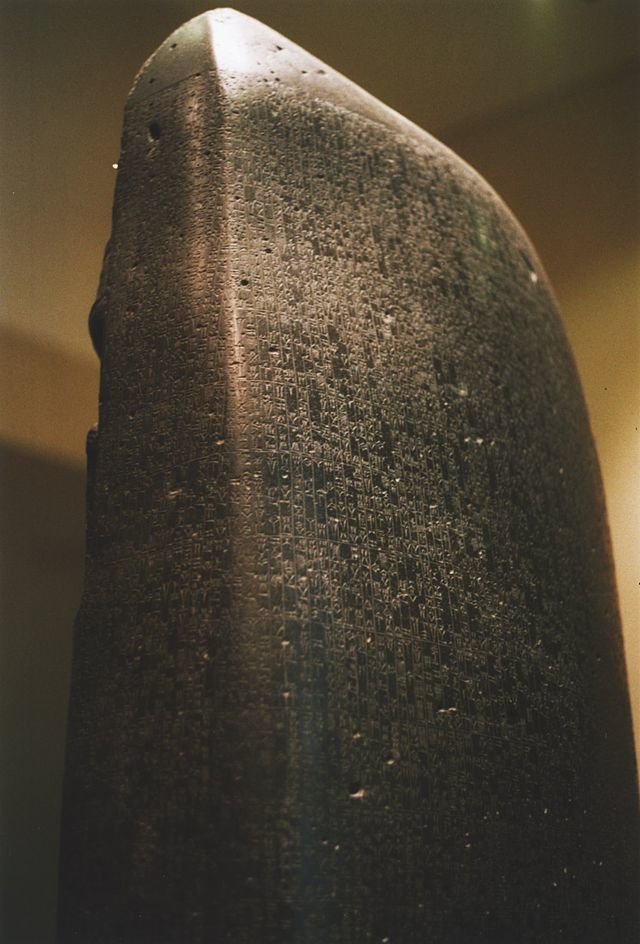


We don't have to assume that Hammurabi's code was ... codified, because there are artifacts that survive, that exist to this day, that have them inscribed. (they're real written/carved documents)
(2)
(0)
PO1 Steven Kuhn
MAJ (Join to see) Sorry for taking so long to return to your post. I was not ignoring you, just sometimes things slip through the cracks. With regards to the printing of the Bible in America, yes the printer did ask permission, but it was authorized by Congress for the use in our schools to teach our children morality. I do not know what different references we are using, but the annals of Congress record it. Also, a copy of the Bible was handed out to each member serving in any part of our three executive branches of government. As for the Capitol Building and Treasury Offices being used as Churches it is not so important that there were limited Churches as the people reporting on the event had their own churches to go to but decided to attend these larger public services. It is the fact that religion was (and is to a majority of Americans) an important part of our lives. They used these buildings to demonstrate that while the government could not force a religion on the people, the people were still free to practice their religion whenever and where ever they chose to. I would give you a list of the significance of many of the pictures and monuments on Capitol Hill, but if I did then you might take offense and petition them down. The bottom line, for all posturizing being done on both sides is that the Christian religion played a vital part in the formation of this nation. We made some mistakes along the way, but Christianity is woven into the fabric of our nation. If true American History were taught, it would have to include the Bible to show the motivation behind the decisions our Founding Fathers made. I have given references, I have given quotes, and I have spoken what I believe to be the truth. Everything America was built upon stems from the principles of Christianity. Now I will admit that the America of today would have our Forefathers rolling in their graves, but it does not change the facts of history.
r/
Steve
r/
Steve
(0)
(0)
Read This Next


 Continue with Facebook
 Continue with Google