
Posted on Mar 18, 2015

Intergenerational PTSD can be passed down to the next generation.

3.05K
15
25
1
1
0
Intergenerational PTSD and the impact of Childhood Trauma
in the family systems. The transference of PTSD trauma exposure creates an environment for emotional abuse, including neglect, which transcends into childhood trauma being the main ingredient for transmission of PTSD from parent to child. (Berstein, D. P., Jelley, H., & Handlesman, L. (1997).
in the family systems. The transference of PTSD trauma exposure creates an environment for emotional abuse, including neglect, which transcends into childhood trauma being the main ingredient for transmission of PTSD from parent to child. (Berstein, D. P., Jelley, H., & Handlesman, L. (1997).
Posted 11 y ago
Responses: 5
1
1
0

It is time that this problem is not seen as weakness and then we are amazed at some kind of psychotic break. The mindset which implies being strong as a countermeasure to the residual effects of PTSD. The fact that command officers knew or the psychological effects of war and violence are about the same as skull fractures and brain trauma and concussion syndrome.
Yeah I have seen it and it puts you at risk w/o support from the medical community and not making it so stigmatized that VA's have panic buttons for VA personnel, in the case of a Veteran having a bad day.
Yeah I have seen it and it puts you at risk w/o support from the medical community and not making it so stigmatized that VA's have panic buttons for VA personnel, in the case of a Veteran having a bad day.
(1)
(0)
CH (CPT) Heather Davis
When I was a little girl a certain male tone would set me off in to an avalanche un controlling crying. I now understand it was due to triggers, and my amygdala was being high jacked.
Walker says, “I believe one of the key processes of recovering from complex PTSD is deconstructing the toxic superego/critic and reconstructing and replacing it with a healthy ego/executive function that is user friendly to the individual. As this is achieved, one’s narrative about one’s life becomes more complete, accurate, congruent, and capable of generating healthy self-compassion and self-protection.”
Walker says, “I believe one of the key processes of recovering from complex PTSD is deconstructing the toxic superego/critic and reconstructing and replacing it with a healthy ego/executive function that is user friendly to the individual. As this is achieved, one’s narrative about one’s life becomes more complete, accurate, congruent, and capable of generating healthy self-compassion and self-protection.”
(0)
(0)
1
1
0

Charles Figley, Ph.D. at Florida State has published a good bit on this subject. He led a lot of the intial studies of VietNam Vets. I have heard him speak at continuing education events over the years and I would absolutely agree that secondary post-traumatic stress is a legitimate concern. Professionally, I am a licensed Marriage & Family Therapist and with almost 20 years of experience and most of that has been specific to working with individuals and families sorting through trauma.
(1)
(0)
CH (CPT) Heather Davis
I love Dr. Figley, and many women in the military due to low estrogen are susceptible for PTSD. The impact of childhood trauma, and then to be re-victimized by sexual assault, and then to be deployed multiple times leaves the individual with complex PTSD. The outcome is many counselors may not have the back ground to uncover the root cause.
(1)
(0)
CH (CPT) Heather Davis
The symptomatology of complex PTSD includes a conception of emotional flashbacks—emotional and intrusive recollections of overwhelming feeling states of childhood: fear, shame, alienation, rage, grief, and/or depression. Walker (2009) calls these sudden and often prolonged emotional regressions to the frightening and abandoned feelings of childhood “amygdala hijackings.” The amygdala performs a primary role in the formation and storage of memories associated with emotional events, suggesting that prolonged fear may result in permanent changes in the brain, with lingering synapse hyperreactivity.
The tendency to overreact may be rooted in permanent fear conditioning, both emotionally and physiologically, with a number of resultant sympathetic nervous system responses (e.g., rapid heartbeat, respiration, cortisol production, immobility). The psychic imprinting of PTSD results in changed brain chemistry; the amygdala triggers the nervous system and panic, and prolonged panic may result in permanent panic.
The tendency to overreact may be rooted in permanent fear conditioning, both emotionally and physiologically, with a number of resultant sympathetic nervous system responses (e.g., rapid heartbeat, respiration, cortisol production, immobility). The psychic imprinting of PTSD results in changed brain chemistry; the amygdala triggers the nervous system and panic, and prolonged panic may result in permanent panic.
(0)
(0)
1
1
0

Interesting concept.... once exposed to trauma, at higher risk. Makes sense, however, I would like to see if data supports this for actual child hood trauma other then sexually abused children.... auto accident, death of friend or neighbor.... Not to belittle sexual trauma in children, but it seems that every time I turn around, some criminal is trying to blame his/her activity to a dark past of sexual abuse in the home. Does this carry over to other forms of trauma? If so, then I would pose that you can't protect them all. PTSD is a risk that every person runs the risk of....not just combat military.
(1)
(0)
CH (CPT) Heather Davis
“We found strong evidence that the ADRB2 gene SNP (defined as Single Nucleotide Polymorphism)was associated with PTSD in our group of male soldiers who were predominantly of European American ancestry,” said Sandro Galea, MD, DrPH, chair of Epidemiology at the Mailman School of Public Health and senior author. “Of particular note is the finding that the identical interaction took place in the control group of civilians. Together these outcomes suggest that the ADRB2 gene interacts with childhood adversity and either result in a vulnerability or resilience to developing PTSD symptoms following adult trauma.”
(1)
(0)
CH (CPT) Heather Davis
MAJ Nelson:
Sir, respectfully many Soldiers when deployed have repressed memories the environmental stressors and multiple deployments cause flooding. This is the release or triggers of childhood trauma memories. PTSD is complex the article below is indicating that it can be linked by a genetic link. Intergenerational PTSD comes from Military parents unknowingly passing it down to the next generation.
Sir, respectfully many Soldiers when deployed have repressed memories the environmental stressors and multiple deployments cause flooding. This is the release or triggers of childhood trauma memories. PTSD is complex the article below is indicating that it can be linked by a genetic link. Intergenerational PTSD comes from Military parents unknowingly passing it down to the next generation.
(0)
(0)
PO3 Taylor Clark
Haven't been diagnosed with PTSD but I have been accused of it what I have been diagnosed with is Borderline Personality Disorder and they say it has roots in trauma. I wasn't physically abused in Any way I was psychologically and verbally abused, because the only on standing in my step dad's way was my mother. Now I don't think my mother ever got diagnosed but for a good portion of my childhood she did exhibit symptoms. I don't know if this helps at all.
(0)
(0)
CH (CPT) Heather Davis
PO3 Clark:
Many veterans get misdiagnosed with personality disorder when they have childhood PTSD.
Many veterans get misdiagnosed with personality disorder when they have childhood PTSD.
(0)
(0)
1
1
0
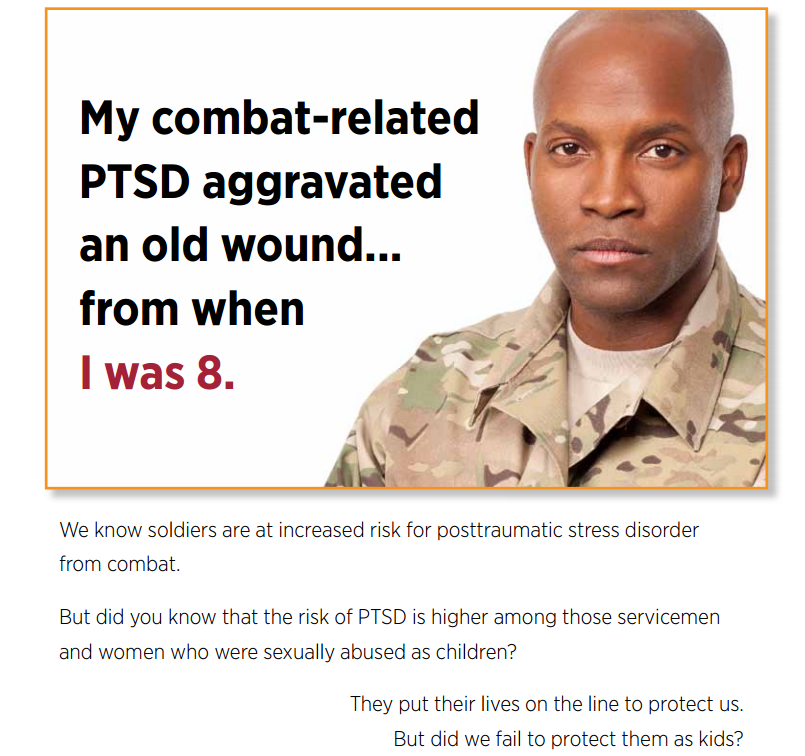
For those that have been impacted by child molestation often when deployed memories are released it is known as flooding.
(1)
(0)
CH (CPT) Heather Davis
The PTSD impacts the psychological, behavioral, and adaptive styles of combat veterans manifest from detachment to the range of intense involvement in the veteran's relationships. The direct impact of war-related PTSD transcended into disruptive family environments, marital instability, family psychopathology and the cause for behavioral maladjustments and impacts the strong attachment in the overall relationships. (Rosenheck & Fontanta, 1998b, p. 227).
(1)
(0)
CH (CPT) Heather Davis
The impact of intergenerational PTSD is the aftermath of war that each generation is left to grapple with the unresolved memories of childhood trauma, childhood neglect and broken relationships resulting in divorce and the loss of loved ones that come back changed by war. This paper gives insight into the vicious cycle of severe physical injuries that cripple the interaction of the Veteran parents and their families. Interpersonal relationships are affected by the profound disruptive nature of trauma. The United States has a total Active-Duty military force of approximately 1.4 million, with an additional 848,000 total National Guard force and 95,324 total reserve force (Department of Defense (DOD), 2008). There are 1.3 million dependent military children, with as many as 700,000 children younger than five years (Kruzel, 2008). These are the families who live within the reality of frequent separations through peacetime deployments and combat training exercises; these are the families who wait anxiously for loved ones to return from war. http://siadapp.dmdc.osd.mil/personnel/Military/ms0.pdf
(1)
(0)
CH (CPT) Heather Davis
For example, a highly educated, 45-year-old professional woman described an incident in which her father, whose parenting was characterized by emotional unavailability, railed at her for some of her parenting techniques. She became immobilized and described being reduced to an emotional pile of rubble, feeling that she was again a 10-year-old girl and totally incapable of responding appropriately. Is this perhaps an example of an amygdala hijacking?
Walker says, “I believe one of the key processes of recovering from complex PTSD is deconstructing the toxic superego/critic and reconstructing and replacing it with a healthy ego/executive function that is user friendly to the individual. As this is achieved, one’s narrative about one’s life becomes more complete, accurate, congruent, and capable of generating healthy self-compassion and self-protection.”
That interpretation is reminiscent of ego reconstructive goals of psychodynamic approaches, providing the secure object relation, but it also goes further. The approach combines the best of the theoretical frameworks of psychodynamic and postmodern. Some may see these theoretical approaches as being contradictory, with one soundly rooted in the past and the other fluidly rooted in the future. I prefer to view them as using the past and the present to create the future.
Walker says, “I believe one of the key processes of recovering from complex PTSD is deconstructing the toxic superego/critic and reconstructing and replacing it with a healthy ego/executive function that is user friendly to the individual. As this is achieved, one’s narrative about one’s life becomes more complete, accurate, congruent, and capable of generating healthy self-compassion and self-protection.”
That interpretation is reminiscent of ego reconstructive goals of psychodynamic approaches, providing the secure object relation, but it also goes further. The approach combines the best of the theoretical frameworks of psychodynamic and postmodern. Some may see these theoretical approaches as being contradictory, with one soundly rooted in the past and the other fluidly rooted in the future. I prefer to view them as using the past and the present to create the future.
(1)
(0)
0
0
0

CH (CPT) Heather Davis
Studies found that within the avoidance cluster, emotional numbing significantly contributes to problems in marriage and parent-child relationships. Self-exposure and emotional sharing abandon the Veteran finding them with avoidance and emotional numbing, which create detachment, distancing, and conflict between couples. (Frederickson, Chamberlain, & Long, 1996).
(0)
(0)
SFC Michael Hasbun
Ok... this is all making more sense to me now. Apologies, the OP had my brain going in a few different directions..
(1)
(0)
CH (CPT) Heather Davis
I know about this topic, my entire family system is a poster child for intergenerational PTSD.
(1)
(0)
CH (CPT) Heather Davis
Every generation fought in a war, and all of the children were under the age of five when they came home.
(0)
(0)
Read This Next


 Continue with Facebook
 Continue with Google