
Posted on Sep 8, 2021
What suggestions do you have for renaming DoD installations honoring Confederate officers?

161K
6.02K
1.88K
1K
1K
0
Doesn't matter if you agree with this move or not - it's been directed and it's happening. What are your suggestions for renaming the following bases?
- Fort Bragg
- Fort Rucker
- Fort Benning
- Fort Gordon
- Fort Hood
- Fort Polk
- Fort A.P. Hill
- Fort Belvoir
- Fort Lee
- Fort Pickett
- Fort Bragg
- Fort Rucker
- Fort Benning
- Fort Gordon
- Fort Hood
- Fort Polk
- Fort A.P. Hill
- Fort Belvoir
- Fort Lee
- Fort Pickett
 Civil War
Posted >1 y ago
Responses: 855

0
0
0

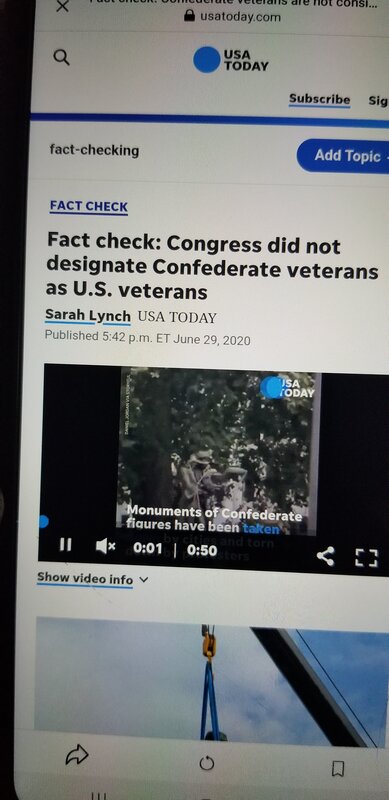
Fact check: Congress did not designate Confederate veterans as U.S. veterans
Sarah Lynch
USA TODAY
A statue of Confederate General Robert E. Lee is removed from Lee Circle Friday, May 19, 2017, in New Orleans. Lee's was the last of four monuments to Confederate-era figures to be removed under a 2015 City Council vote on a proposal by Mayor Mitch Landrieu.
The claim: In 1958, Congress passed a law giving Confederate veterans the same legal status as U.S. veterans. Thus, damaging Confederate monuments defiles U.S. veterans.
In the wake of George Floyd’s death, protestors toppled a statue of Confederate President Jefferson Davis in Richmond, Virginia. Cities from Jacksonville, Florida, to Louisville, Kentucky, removed statues of Confederate soldiers. This is not the first push to remove these monuments –– after a white nationalist rally in Charlottesville, Virginia, turned deadly in 2017, a number of Confederate monuments came down.
ADVERTISEMENTSCROLL TO CONTINUE WITH CONTENT
Floyd’s killing at the hands of police reinvigorated the movement to remove certain statues and monuments, and inspired debate, resulting in an executive order from President Donald Trump on Friday aimed at protecting such monuments from violence and vandalism.
A Facebook post from Donnie Johnson on June 11 claims that with U.S. Public Law 85-425, Section 410, in 1958, Congress gave Confederate veterans the same legal status as U.S. veterans. “Those desecrating
U.S. Public Law 85-425, Section 410, actually provided pensions to Confederate widows
The law that the Facebook post cites –– U.S. Public Law 85-425, Section 410 –– amended Section 432 of the Veterans’ Benefit Act of 1957 (Public Law 85-56), which grants pensions to
This amendment to the Veterans’ Benefit Act does indeed expand the definition of “veteran” to include “a person who served in the military or naval forces of the Confederate States of America during the Civil War.” However, the act also clearly specifies that this inclusion applies “for the purpose of this section, and section 433,” which Jessica Owley, professor of law at the University of Miami, interpreted as a limited extension.
“This language indicates that this definition of veteran only applies for this specific reason. Congress specifically chose to state that this definition was for the purposes of the pensions,” Owley said.
While Confederate veterans receive some benefits, they are still not recognized as U.S. veterans
This Facebook post specifically mentions Confederate graves and monuments, likely in reference to a decision from Congress that provided for “headstones or markers at the expense of the United States for the unmarked graves” of Confederate soldiers in the Civil War. While this act did grant Confederate veterans some benefits also allotted to U.S. war veterans, it does not confer on Confederate veterans equal status as U.S. veterans.
When President Andrew Johnson granted pardon and amnesty to all Confederate soldiers in 1868, this restored to them “all rights, privileges, and immunities under the Constitution and the laws which have been made in pursuance thereof;” however, this did not grant them veteran status.
A large group of protesters gather around the statue of Confederate General Robert E. Lee on Monument Avenue near downtown in Richmond, Virginia on Tuesday, June 2, 2020.
The definition of “veteran,” as specified by the U.S. Department of Veteran Affairs, does not include Confederate armed forces. Les' A. Melnyk, chief of public affairs and outreach for the National Cemetery Administration, part of the Department of Veterans Affairs, provided further clarification:
“While federal law authorizes some benefits for former Confederates, such as the marking of unmarked graves of Confederate service members outside VA national cemeteries, this does not confer U.S. Veteran status for other VA benefits to those affected,” Melnyk
False
The claim that Confederate veterans maintain the same legal status as U.S. veterans is FALSE. Confederate veterans' widows and children received pensions after congressional action, but that action in itself did not declare those soldiers to be full U.S. veterans. The very definition of a U.S. veteran never expanded to include Confederate soldiers –– even when they were granted amnesty by President Andrew Johnson.
fact-checked sources:
Donnie Johnson, Facebook post
BBC News, June 11, 2020 - Confederate and Columbus statues toppled by US protesters
Business Insider, June 10, 2020 - 10 Confederate leaders who still have monuments and places named after them all over the US
New York Times, Aug. 28, 2017 - From 2017: Confederate Monuments Are Coming Down Across the United States. Here’s a List.
The White House, Executive Order on Protecting American Monuments, Memorials, and Statues and Combating Recent Criminal Violence
U.S. Public Law 85-425, Section 410
Veterans’ Benefit Act of 1957
Veterans’ Benefits, §2306
Library of Congress, December 25, 1868, proclamation
U.S. Department of Veteran Affairs, Determining Veteran Status
U.S. Department of Justice, 1666. DESTRUCTION OF GOVERNMENT PROPERTY -- 18 U.S.C. § 1361
Veterans’ Memorial Preservation and Recognition Act of 2003
North Carolina General Assembly, § 100-2.1.
Sarah Lynch is an intern for the Asbury Park Press and the editor-in-chief for the Marist Circle at Marist College. Reach her at [login to see] or via Twitter at @sarahdlynch.
Sarah Lynch
USA TODAY
A statue of Confederate General Robert E. Lee is removed from Lee Circle Friday, May 19, 2017, in New Orleans. Lee's was the last of four monuments to Confederate-era figures to be removed under a 2015 City Council vote on a proposal by Mayor Mitch Landrieu.
The claim: In 1958, Congress passed a law giving Confederate veterans the same legal status as U.S. veterans. Thus, damaging Confederate monuments defiles U.S. veterans.
In the wake of George Floyd’s death, protestors toppled a statue of Confederate President Jefferson Davis in Richmond, Virginia. Cities from Jacksonville, Florida, to Louisville, Kentucky, removed statues of Confederate soldiers. This is not the first push to remove these monuments –– after a white nationalist rally in Charlottesville, Virginia, turned deadly in 2017, a number of Confederate monuments came down.
ADVERTISEMENTSCROLL TO CONTINUE WITH CONTENT
Floyd’s killing at the hands of police reinvigorated the movement to remove certain statues and monuments, and inspired debate, resulting in an executive order from President Donald Trump on Friday aimed at protecting such monuments from violence and vandalism.
A Facebook post from Donnie Johnson on June 11 claims that with U.S. Public Law 85-425, Section 410, in 1958, Congress gave Confederate veterans the same legal status as U.S. veterans. “Those desecrating
U.S. Public Law 85-425, Section 410, actually provided pensions to Confederate widows
The law that the Facebook post cites –– U.S. Public Law 85-425, Section 410 –– amended Section 432 of the Veterans’ Benefit Act of 1957 (Public Law 85-56), which grants pensions to
This amendment to the Veterans’ Benefit Act does indeed expand the definition of “veteran” to include “a person who served in the military or naval forces of the Confederate States of America during the Civil War.” However, the act also clearly specifies that this inclusion applies “for the purpose of this section, and section 433,” which Jessica Owley, professor of law at the University of Miami, interpreted as a limited extension.
“This language indicates that this definition of veteran only applies for this specific reason. Congress specifically chose to state that this definition was for the purposes of the pensions,” Owley said.
While Confederate veterans receive some benefits, they are still not recognized as U.S. veterans
This Facebook post specifically mentions Confederate graves and monuments, likely in reference to a decision from Congress that provided for “headstones or markers at the expense of the United States for the unmarked graves” of Confederate soldiers in the Civil War. While this act did grant Confederate veterans some benefits also allotted to U.S. war veterans, it does not confer on Confederate veterans equal status as U.S. veterans.
When President Andrew Johnson granted pardon and amnesty to all Confederate soldiers in 1868, this restored to them “all rights, privileges, and immunities under the Constitution and the laws which have been made in pursuance thereof;” however, this did not grant them veteran status.
A large group of protesters gather around the statue of Confederate General Robert E. Lee on Monument Avenue near downtown in Richmond, Virginia on Tuesday, June 2, 2020.
The definition of “veteran,” as specified by the U.S. Department of Veteran Affairs, does not include Confederate armed forces. Les' A. Melnyk, chief of public affairs and outreach for the National Cemetery Administration, part of the Department of Veterans Affairs, provided further clarification:
“While federal law authorizes some benefits for former Confederates, such as the marking of unmarked graves of Confederate service members outside VA national cemeteries, this does not confer U.S. Veteran status for other VA benefits to those affected,” Melnyk
False
The claim that Confederate veterans maintain the same legal status as U.S. veterans is FALSE. Confederate veterans' widows and children received pensions after congressional action, but that action in itself did not declare those soldiers to be full U.S. veterans. The very definition of a U.S. veteran never expanded to include Confederate soldiers –– even when they were granted amnesty by President Andrew Johnson.
fact-checked sources:
Donnie Johnson, Facebook post
BBC News, June 11, 2020 - Confederate and Columbus statues toppled by US protesters
Business Insider, June 10, 2020 - 10 Confederate leaders who still have monuments and places named after them all over the US
New York Times, Aug. 28, 2017 - From 2017: Confederate Monuments Are Coming Down Across the United States. Here’s a List.
The White House, Executive Order on Protecting American Monuments, Memorials, and Statues and Combating Recent Criminal Violence
U.S. Public Law 85-425, Section 410
Veterans’ Benefit Act of 1957
Veterans’ Benefits, §2306
Library of Congress, December 25, 1868, proclamation
U.S. Department of Veteran Affairs, Determining Veteran Status
U.S. Department of Justice, 1666. DESTRUCTION OF GOVERNMENT PROPERTY -- 18 U.S.C. § 1361
Veterans’ Memorial Preservation and Recognition Act of 2003
North Carolina General Assembly, § 100-2.1.
Sarah Lynch is an intern for the Asbury Park Press and the editor-in-chief for the Marist Circle at Marist College. Reach her at [login to see] or via Twitter at @sarahdlynch.
(0)
(0)
LTC Tom Hartley
Isn't that just semantics? Word games can be played all day. In the end, they were US Citizens who served in a formal US military. By your definition, those serving in the Continental Army were not US veterans, since the country had not been liegally formed.
(0)
(0)
SrA Alvin Cook
The soldiers of the continental army were technically rebels and traitors to Great Britian just as the confederates were to the US. The difference was continental soldiers were not actually fighting their neighbors. Colonist did not have full citizenship. The confederates fought to keep the economic benefits of slavery. That is IMMORAL ! To ignore that and to honor them DISHONORS those American soldiers who fought and died for the Union.
(0)
(0)
SrA Alvin Cook
LTC Tom Hartley by your reasoning the British should have a monument or something to Honor George Washington and the continental congress as they were British subjects at the time of their rebellion.
(0)
(0)
0
0
0
0
0
0
Here's a fact check. Undeniable. Congress NEVER designated Confederate veterans as US veterans.
(0)
(0)
0
0
0

So I guess the Civil War didnt happen. We rationalize this is because of slavery. We (americans or colonists etc.) did not bring the slaves to America. The African Chiefs Actually sold their people to Potuguise, Dutch, etc. who in turn brought them to America. My question is why are we renaming militaty bases. What has this crazy world come to?
(0)
(0)
SrA Alvin Cook
So WHY were bases named after confederates in the FIRST PLACE? They were enemy combatants. Traitors to the UNITED STATES who fought and killed AMERICAN soldiers because they wanted to keep slavery as slaves were a valuable commodity to them ! So WHY do they deserve to be honored ?
(0)
(0)
0
0
0

0
0
0

I don't have a problem with it. We were and are American military. There were a lot of damn good men on both sides who fought bravely.
(0)
(0)
0
0
0
Leave the names of these military instalations alone. Keep the names as they are. Don't mess with real history. Why change the name to please a few crybabys abd boogerlipers when the masses want the names to stay. I'm sick of people ignoring history and wanting to change it because it hurts their fragile feelings. None of us were around durring the civil war. Let sleeping dogs lie.
(0)
(0)
0
0
0

Just have the Forts and such named after Native Sons to the state the Fort is in that have served with unquestionable distinction.
As well as Served after the Civil War. With these two conditions, and proper vetting, the State can take Pride in the Fort being renamed after either a Native born or a person that had lived in the state from their youth.
The Vetting is to ensure the Vet kept on the up-and-up as it were. Many times through no fault of their own these honorable persons fall on hard times/ gain a criminal record(s) or such. Sad to say, in today's world , all one needs to do to be thought a criminal/ hater is have said a word or name in the Past that is now something to fully vilify a person .
As well as Served after the Civil War. With these two conditions, and proper vetting, the State can take Pride in the Fort being renamed after either a Native born or a person that had lived in the state from their youth.
The Vetting is to ensure the Vet kept on the up-and-up as it were. Many times through no fault of their own these honorable persons fall on hard times/ gain a criminal record(s) or such. Sad to say, in today's world , all one needs to do to be thought a criminal/ hater is have said a word or name in the Past that is now something to fully vilify a person .
(0)
(0)
SP5 Delphis Kaczowski
They can't even pronounce the names of some of our Medal of Honor/Purple Heart. Also, they are 10 to 14 letters long.
(0)
(0)
0
0
0

0
0
0

HERE'S The BEST IDEA Ever..... "
And It's EASY To Remember.
"DON'T"
And It's EASY To Remember.
"DON'T"
(0)
(0)
Read This Next


 Continue with Facebook
 Continue with Google