
Posted on May 28, 2015

Why don't all members of the Air Force have to be fully qualified to be a rifleman in case of hostile events?

392K
4.23K
1.93K
562
562
0

I have noticed through the years of being in the Air Force (Security Forces member here) that most people in the Air Force are clueless when it comes to M-4/M-16/M-9. This is outrageous! What are they supposed to do if the enemy comes knocking on our door step and everyone needs to fight. I have taught classes on the M-4 with communication airmen and have seen them completely mess up clearing out the weapon, loading it (magazine upside down or rounds the wrong way), and just completely incapable of achieving a zero on target after four rounds of firing. I am a big fan of how the Army and Marines teach that your are always a rifleman first. It almost seems like some of the Airmen don't expect to carry a weapon (ummmm why did you join the military in the first place)? I wish the Air Force would pick up on this to make us a more combat ready force. But, enough of me what are your thoughts?
 Rifleman
 3P: Security Forces
 Air Force
Edited >1 y ago
Posted >1 y ago
Responses: 907
0
0
0

I agree with you. I was an AF aircraft technician 1980s and 1990s. I think, especially those of us around our primary weapons, being aircraft and misslies, should also be trained to defend those weapons systems if the need arises. When I was overseas during the Col War, we did train several times on the M-16. I also trained with the 45 due to extra duty as a cargo load monitor. I believe they later switcch to the 9mm. I also think the AF should have a special ops unit like the Navy Seals. Combat Controllers and PJs are good. But they have certain missions. The German Luftwaffe had the first paratrrop units in war. They were elite. The AF should also have a small elite offensive airbore unit. Death from above. They could hit certain targets behind enemy lines, orsecure certain areas until relieved. Smaller than the Rangers. But very highly skilled in airborne strikes. Why should the other branches get all the elite strike units. The air belongs to the AF.
(0)
(0)
0
0
0

Fully Qualified Riflemen, I think you underestimate what that term means or the level of constant traing require to keep trained to that level.
Where exactly hare guy already working 80 a weak on the flight-line going to find the time to have full time training i as a rifleman,
Even AF Security forces do not train to that level of ground combat proficiency, And Marine Or Army rifleman would laugh at anyone who thought that they did. THE USAF has trouble keeping enough skilled techs on the job now so taking them away from those jobs to cover a flaky "what if" would cripple it.
Where exactly hare guy already working 80 a weak on the flight-line going to find the time to have full time training i as a rifleman,
Even AF Security forces do not train to that level of ground combat proficiency, And Marine Or Army rifleman would laugh at anyone who thought that they did. THE USAF has trouble keeping enough skilled techs on the job now so taking them away from those jobs to cover a flaky "what if" would cripple it.
(0)
(0)
0
0
0
Honestly just feel like it isn't at the top of the to do list for the great majority of Air Force personnel. It's been said before we aren't a ground force, while yes I would pick up an M-16 if the need arises my duties only required me to carry an M-9, plus you being security forces, how would you like to deal with keeping the entire force current and qualified on a weapon they never use? Additionally how many times I hear you guys don't even have enough rounds to spare for your own selves to practice on, just imagine how many more would need to be set aside to keep everyone current? Just not where the Air Force will dump their slush funds, there's bigger fish to fry
(0)
(0)
0
0
0
I thought that all but medical personnel had to be qualified on M16/M4. I know qualified is a loose word to use, but qualified is qualified.
(0)
(0)
0
0
0

I didn't see any difference with Naval personnel either. Most I have met hadn't touched a small arm since boot camp and that included people who were careerists.
I guess I'm surprised since I was a SEABEE and we did regular range time and infantry training. We weren't infantry by any measurement but could at least defend our camps and work sites to some extent.
I guess I'm surprised since I was a SEABEE and we did regular range time and infantry training. We weren't infantry by any measurement but could at least defend our camps and work sites to some extent.
(0)
(0)
0
0
0
I understand the thought process but my thoughts about this skill are its better to have it and not need it than to need it and not have it. If you get selected for deployment you have a 1-2 day training on that weapon system..... That being said would you put your life in that person hand WITH FULL CONFIDENCE OF THEIR SKILLS WITH THE WEAPON.
(0)
(0)
0
0
0

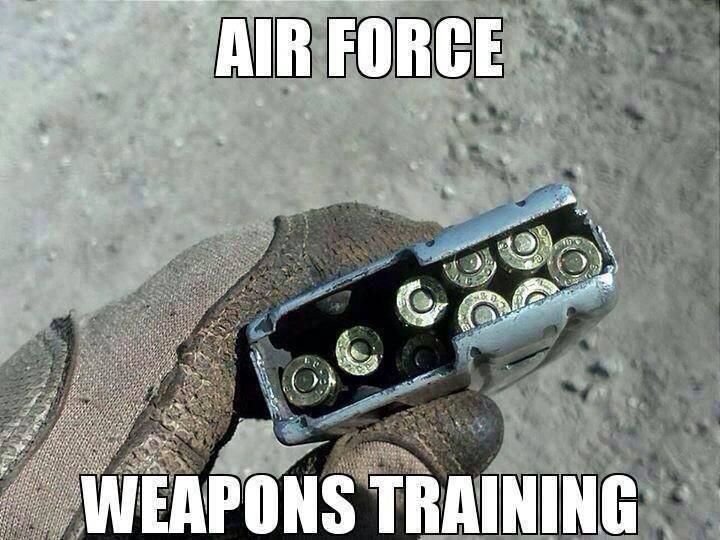
The Photo just has me cracking up.... Ok I'm Navy and at Boot camp we all qualified with the 9. My First command we had no need to qualify it was a cost and necessity not needed we fixed planes State Side and had the Corps and MA's Guarding the base. Then I went to Africa I had to be Qualified on several Weapons and platforms for that. My next 2 commands were all Intel weenies again No need for a weapon, Then I hit a Ship where I requalify on and got initial quals on other weapons. 3 years 2 Deployments where everyone is responsible for the safety of the ship. Now i'm at a base State side that I have no need to be weapons qualed. Why should the Military spend the money on Ammo when I have no need nor will I ever carry a weapon here? When I get to my next Ship I will requalify and be back to carrying a weapon on watch. I think there are those areas that we do not need to train waste money and qualify every year on a Weapon. They don't need it the chance of them needing it is so microscopic as to not matter. If a State side base is over run and they need to know how to shoot.... well we have larger issue at that point don't we?
Now I personal own a small arsenal of small arms and long guns, I go to the range and practice on a fairly regular basis. When my friends and I show up at the range we routinely get asked who we are about to invade lol. We all have CCW's and we all carry when not on Post. I take personal pride in exercising my 2A and in properly qualifying myself. But that's just me.
Now I personal own a small arsenal of small arms and long guns, I go to the range and practice on a fairly regular basis. When my friends and I show up at the range we routinely get asked who we are about to invade lol. We all have CCW's and we all carry when not on Post. I take personal pride in exercising my 2A and in properly qualifying myself. But that's just me.
(0)
(0)
0
0
0
When I was in the USAF, all the new recruits had to do was to fire a few .22 LR rounds down range in boot camp, and that was the extent of their professional training with weapons for the majority of their military career. I was initially assigned to the 46th Communications Group at Barksdale AFB, LA, and volunteered to serve on our units "Contingency Group" for deployments, operations, and so on. It was only as part of this contingency group that I received additional training such as the use of actual .223/5.56 rounds, use of the shotgun, various revolvers, and various pistols and other weapons. The USAF at that time only trained these state-side groups (and certain overseas groups) in CBRN environments, protective clothing, how to pack and hump a ruck, and related tasks. I was utterly appalled at the attitude the USAF had at the time of the lack of common military skills. I was delighted to hear when the USAF was forced to enhance entry-level training in arms, and delighted that (20 years later) they adopted a more realistic view of tactical training. Prior to joining the USAF I was on civilian rifle and pistol teams, and I was an avid hunter so I was already skilled with infantry weapons of how to shoot a proper course of fire, range safety, and so on.
(0)
(0)
0
0
0

Using WWII and Korea as their model, many, if not most, people who enlisted in the AF did so with the idea that they would not have to carry/fire a weapon. Along with SF there are a few career fields where knowledge of weaponry is paramount. I'm thinking of TACP and weather folks who regularly pull duty with the Army, including being on the front line areas. Today's battlefield has changed, and it began changing with the Vietnam experience with mortars and rockets being lobbed into airfields. Having retired in 1995 I'm not sure what is taught as "supplementary" during weapons training, but certainly the idea of being somewhere in the sandbox of the Middle East and having to actually protect yourself and others has to be placed into the psyche of those who are doing annual qualification. The concept of situational awareness can b e as important as knowing how to use the weapon. Good luck to you and others as you deal with the "soccer mom kids" who make up today's AF.
(0)
(0)
0
0
0

Read This Next


 Continue with Facebook
 Continue with Google