

Posted on Mar 18, 2016

Why did Irishmen fight on both sides of the Civil War?

11K
77
35
23
23
0

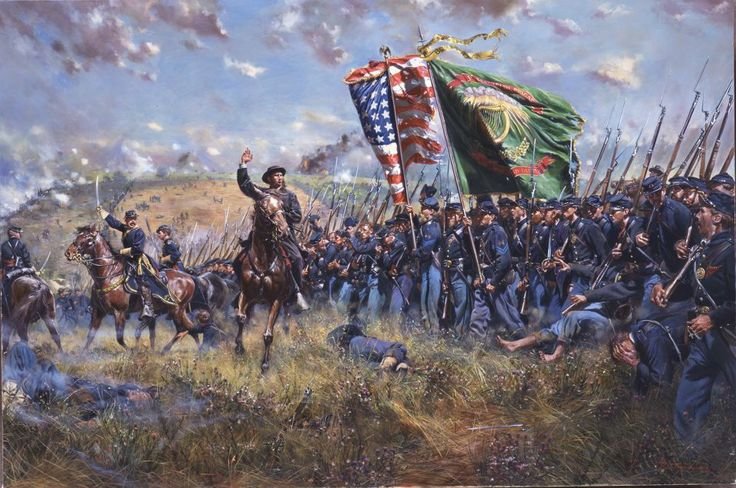
Yesterday, in honor of St. Patrick's Day and my Irish heritage, I posted a picture of Mort Kunstler's "Rebel Sons of Erin" as the Colonel on horseback in the print was a distant cousin of mine. My direct ancestors served in the Armies of the north, but I did have relatives on both sides.
One of my cousins posted the following comment, "I cannot understand how Irish immigrants who were abused for hundreds of years by the English could fight for a army which wanted to preserve slavery. I know the Irish fought on both sides, seems strange to me." Here is my reply:
Makes perfect sense to me.
I suspect if you mined the diaries and letters of Irish soldiers from both sides you'd find their reasons for joining and fighting were very similar. They are the same reasons man throughout his "civilized" history has taken up arms against his fellow man:
In some cases it was because leaders, or strong men, whom they respected told them it was right and their duty.
Perhaps they went along with the crowd as they saw their friends and relatives take up arms.
Perhaps it was because they feared being thought of by their women as cowardly or unmanly if they did not take up arms.
Perhaps it was because their native or adopted sympathies lay more with the city or state in which they lived than in the ideal of a nation comprised of states that they did not know of or care about.
Perhaps in some instances it actually was because they believed men of color were not on the same plane was white men and should be subjugated and used for manual labor.
Perhaps they gained some personal self-worth by seeing others as less than themselves, particularly since so many saw and treated them as the bottom rung.
Man is born with inalienable rights. But, man is also born with an enormous capacity to do horrendous, evil things to his fellow man, especially if he feels justified in doing them. The slave and the enslaver are common to all races, ethnicities, and religions.
Da'esh enslaves Christians and Yazidis in the name of Allah and his prophet. In the 17th and 18th Centuries black Africans on the western coast of that continent ventured inland, captured other Africans, and sold them to the Portuguese for want of power and riches. The list of enslavement, genocide, atrocities, etc., etc., spans all cultures and all centuries.
If our generation, or our culture, or our nation, believes that we have moved beyond such horrendous capacities for evil, than we are arrogant, egotistical, naive, and doomed.
Duty, Honor, Country, is our call to arms. But it has been such for millennia.
Thucydides writing of the Peloponnesian Wars 2,500 years ago famously stated, "The strong do what they can and the weak suffer what they must."
It is still true today.
One of my cousins posted the following comment, "I cannot understand how Irish immigrants who were abused for hundreds of years by the English could fight for a army which wanted to preserve slavery. I know the Irish fought on both sides, seems strange to me." Here is my reply:
Makes perfect sense to me.
I suspect if you mined the diaries and letters of Irish soldiers from both sides you'd find their reasons for joining and fighting were very similar. They are the same reasons man throughout his "civilized" history has taken up arms against his fellow man:
In some cases it was because leaders, or strong men, whom they respected told them it was right and their duty.
Perhaps they went along with the crowd as they saw their friends and relatives take up arms.
Perhaps it was because they feared being thought of by their women as cowardly or unmanly if they did not take up arms.
Perhaps it was because their native or adopted sympathies lay more with the city or state in which they lived than in the ideal of a nation comprised of states that they did not know of or care about.
Perhaps in some instances it actually was because they believed men of color were not on the same plane was white men and should be subjugated and used for manual labor.
Perhaps they gained some personal self-worth by seeing others as less than themselves, particularly since so many saw and treated them as the bottom rung.
Man is born with inalienable rights. But, man is also born with an enormous capacity to do horrendous, evil things to his fellow man, especially if he feels justified in doing them. The slave and the enslaver are common to all races, ethnicities, and religions.
Da'esh enslaves Christians and Yazidis in the name of Allah and his prophet. In the 17th and 18th Centuries black Africans on the western coast of that continent ventured inland, captured other Africans, and sold them to the Portuguese for want of power and riches. The list of enslavement, genocide, atrocities, etc., etc., spans all cultures and all centuries.
If our generation, or our culture, or our nation, believes that we have moved beyond such horrendous capacities for evil, than we are arrogant, egotistical, naive, and doomed.
Duty, Honor, Country, is our call to arms. But it has been such for millennia.
Thucydides writing of the Peloponnesian Wars 2,500 years ago famously stated, "The strong do what they can and the weak suffer what they must."
It is still true today.
 Military History
 Civil War
 American History
 Command Post
Edited >1 y ago
Posted >1 y ago
Responses: 17
6
6
0

Excellent post, Sir.
My own ancestors hail from Scotland, Ireland and England...we found ourselves on opposite sides from Naseby and Culloden, to King's Mountain and Shiloh. I think that when it's all said and done, a person will fight for the cause closest to home.The exceptions (and there have been a few in our family history) probably arise when issues of moral principle are at stake. During the Revolution, one of my ancestors chose to remain loyal to the Crown...his son fought for Liberty. During the Civil War, one of my ancestors fought for the North, despite being a Southerner; mostly because he and his family were opposed to slavery on religious grounds. I'm sure that on the other side of the stone wall at Fredericksburg were Irishmen who believed that any President that could raise an army to force his own people to compliance was no different from a British king. Some of their countrymen charging up the slope doubtless felt the presumed right of one group of people to lord over another was what had propelled them to leave Erin to begin with.
My own ancestors hail from Scotland, Ireland and England...we found ourselves on opposite sides from Naseby and Culloden, to King's Mountain and Shiloh. I think that when it's all said and done, a person will fight for the cause closest to home.The exceptions (and there have been a few in our family history) probably arise when issues of moral principle are at stake. During the Revolution, one of my ancestors chose to remain loyal to the Crown...his son fought for Liberty. During the Civil War, one of my ancestors fought for the North, despite being a Southerner; mostly because he and his family were opposed to slavery on religious grounds. I'm sure that on the other side of the stone wall at Fredericksburg were Irishmen who believed that any President that could raise an army to force his own people to compliance was no different from a British king. Some of their countrymen charging up the slope doubtless felt the presumed right of one group of people to lord over another was what had propelled them to leave Erin to begin with.
(6)
(0)
6
6
0

The whole war effort of the Slave Power was dependent on getting the poor whites to fight for them. To some degree the poor whites cherished their social position, if not real high, above that of blacks. So they fought against their own best interests.
Walt
Walt
(6)
(0)
LTC Paul Labrador
I think this issue is glossed over or ignored by many folks who say that the Civil War was not about slavery because most of the Southern soldiers were poor non-slave owners.
(1)
(0)
Capt Walter Miller
If you get to the right sources it is plain enough. The poor whites simply couldn't tolerate being social equals with the blacks.
Walt
Walt
(1)
(0)
PO2 Ron Burling
At the height of "The Lost Cause" literary movement, a Southern group dedicated to revising the history of the Confederacy, no less a figure than John Singleton Mosby wrote a letter refuting their best efforts, stating the reason for the war was the South's only argument with the North, slavery.
(0)
(0)
SSG Don Maggart
Money plain and Simple the Bonuses paid at their entrance to the War were Small but they think they made a big difference ... Research instead the Scots/Irish in America on Youbloob We have never Surrendered and we recover our Dead...
(0)
(0)
5
5
0

Families of all kinds were split by the civil war. It is what happens when a nation tears itself apart. Brother kills brother. Both literally and figuritively.
(5)
(0)
4
4
0

I think a lot of who they fought for was based simply on where they landed and settled in the US. Irish in the North generally adopted Northern attitudes and supported the North, the same for those in the South. Regionality was much stronger back in those days.
(4)
(0)
SGT(P) (Join to see)
I agree sir. Granted my family were all 3rd and 4th generation by the time of the civil war, but they fought for the south simply because Grandpa bought a ticket to SC and its where we live now.
(1)
(0)
PO2 Ron Burling
Spot on, Sir! Americans of that era didn't see themselves as we do today, their first loyalty was to their state, that is why so many officers resigned the US Army and joined the Confederate service, like Robert E. Lee, usually via the militia of their respective states. I am uncertain just when we started to view ourselves as we do today, the modern outlook was widely adopted by WWII, but seemingly less so for WWI.
(0)
(0)
LTC Paul Labrador
PO2 Ron Burling - We started seeing ourselves as "Americans" right around the turn of the century, during the Spanish-American war.
(0)
(0)
4
4
0

To ascribe one motivation to all Irish makes as much sense as ascribing one characteristic to all blacks or Jews or whomever. It's prejudging. Prejudice. Thus, your speculations are opposite of prejudice. They are rational. One that I might add, if permitted, is they fought for money. Ireland has a long history of struggle with inadequate resources and poverty, and its people have frequently found themselves hired out as mercenaries fighting for opposing sides which may have given rise to a popular prejudice regarding the Irish. It is best told in a joke... Why did God invent whiskey? So that Ireland wouldn't rule the world.
(4)
(0)
4
4
0

While the Civil War will always be primarily about slavery, the men in the South fought for many reasons as you have noted above. What would you do today if we were being invaded by a "foreign" Army? Those Army Values of Loyalty, Devotion, Respect, Selfless Service, Honor, Integrety, and Personal Courage have always been highly regarded traits in the south. The cause may have been unjust but as today, do you judge the Soldiers for the sins of their leaders as in Vietnam or respect them for their own braveness as in Operation Iraqi Freedom? There is a reason that the South provides way more than its fair share of our recruits for the military. With the exception of one state, Maine, the New England States are the worse for recruiting.
(4)
(0)
Capt Seid Waddell
CSM William Payne, when I was in it was said that the U.S. military fought with a Southern accent. I certainly found that to be the case.
(1)
(0)
3
3
0

Many fought for both sides because they too were slaves. Not all of them but most were. Fleeing the potato famine, families fled with a little more than just the shirt on their back and having no choice but to rely on slavery to survive. When someone says "slavery" you can't so naively think all slaves being whipped by their masters and being treated like horse-crap. You also have to take in to account. Some of the southern plantation owners paid their slaves as Indigent Servants. This also included Irish men and women. Fighting for the Southern states, they could have whole heartedly believed in States' rights and that's why they fought. Or to protect the their new found way of life and families by taking up arms.
(3)
(0)
3
3
0
2
2
0

Irish emigrants also fought for the Mexicans during the prior war to the Civil War. The Irish emigrants often had few or limited options coming to the American shores for they were fleeing famine. I think that the primary reason the Irish fought on both sides were to find an opportunity to advance. They all had no clear allegiance to any side and so it is safe that they were willing to be convinced. The major port of disembarkation upon arrival would also be key as to where allegiance was made. It is hard to fight for the South from New York City or for the Union from Charleston!
(2)
(0)
2
2
0

Great Post. The reason why Irish fought on both sides? Becausew they fought for their community. whether it was North or South. The North happened to have more ports for immigration, so those that came to the Country in the late 1700s and early 1800s were more likely to be Northerners. By the way, the biggest ethnic group to fight for the Union by far were not the Irish, but Germans.
The Irish NEEDED to be seen as loyal immigrants, so Irish leaders made it a point to greatly publicize the feats of Irish units. The Irish Brigade was heaped with praise for their performance, and Thomas Meagher was lauded as a great leader. In truth they were perhaps average fighters, and Meagher's conduct was questionable at both Antietam and Fredericksburg. The Brigade itself was decimated and and had to be temprarily disbanded in 1864. Meagher himself resigned in 1863 in protest after not being allowed to recruit replacements. He drowned in the Missourri River in 1867.
Irish immigrants bore a lot of he brunt of the draft and were a large part of the New York City Draft Riots/Race Riots in 1863.
There were several Company/Battalion sized units in Southern Regiment's that Consisted of Irishmen. The 1st La Special Bn ( La Tigers, La Zouaves) had many Irish in it's ranks, as did Companies in the 1st Tenn and 33rd Va. Co I of the 8th Ala was known as "The Emerald Guard" and originally worn Green uniforms and had a flag that had the Harp of Erin on one side.
A good book on Irish Confederates is "Clear the Confederate Way.. The Irish in the Army of Northern Virginia " by Kelly O'Grady.
The Irish NEEDED to be seen as loyal immigrants, so Irish leaders made it a point to greatly publicize the feats of Irish units. The Irish Brigade was heaped with praise for their performance, and Thomas Meagher was lauded as a great leader. In truth they were perhaps average fighters, and Meagher's conduct was questionable at both Antietam and Fredericksburg. The Brigade itself was decimated and and had to be temprarily disbanded in 1864. Meagher himself resigned in 1863 in protest after not being allowed to recruit replacements. He drowned in the Missourri River in 1867.
Irish immigrants bore a lot of he brunt of the draft and were a large part of the New York City Draft Riots/Race Riots in 1863.
There were several Company/Battalion sized units in Southern Regiment's that Consisted of Irishmen. The 1st La Special Bn ( La Tigers, La Zouaves) had many Irish in it's ranks, as did Companies in the 1st Tenn and 33rd Va. Co I of the 8th Ala was known as "The Emerald Guard" and originally worn Green uniforms and had a flag that had the Harp of Erin on one side.
A good book on Irish Confederates is "Clear the Confederate Way.. The Irish in the Army of Northern Virginia " by Kelly O'Grady.
(2)
(0)
Read This Next


 Continue with Facebook
 Continue with Google