
Posted on Feb 7, 2026

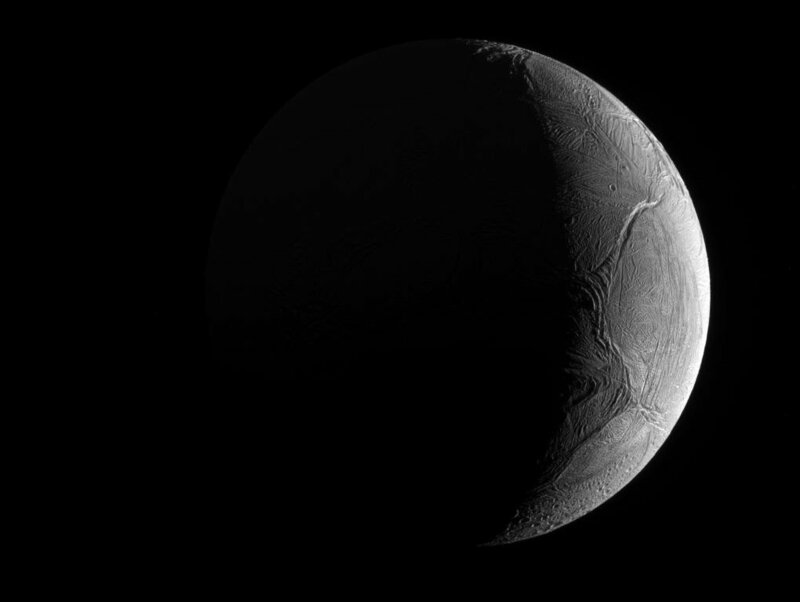
APOD: 2026 February 7 - Crescent Enceladus

858
35
11
11
11
0
Good morning, Rallypoint, and welcome to the February 7, 2026 edition of Astronomy Picture of the Day (APOD).
Like yesterday's look at Cassiopeia A, Enceladus has made repeat past appearances on APOD. But why would anyone be interested in a small moon (300 miles in diameter) that orbits the planet Saturn? The answer is a little long, but I hope you will enjoy the journey to it.
Let’s start on Planet Earth. Hydrothermal vents are located along the sea floor along the tectonic plate boundaries that form the Earth’s outer crust. These boundaries mark where the plates are either pulling apart (obduction) or colliding (subduction). In both cases, there is a large amount of heat involved. And also in both cases, we have found that life flourishes around hydrothermal vents.
Cassini arrived at its destination in 2004 and began its 13-year study of Saturn and its moons. A magnetometer was one of the instruments configured on the spacecraft. In February 2005, that instrument detected evidence of something (an atmosphere?) pushing against Saturn’s magnetic field around Enceladus. A second instrument reported thousands of hits from tiny particles of dust or ice. This piqued the interest of researchers, and so it was decided that Cassini would return to Enceladus for a closer look.
That closer look came in July 2005. Two more things were revealed: plumes of water vapor and particles extended into space from the South Pole of Enceladus, and a marked temperature gradient about surface fractures about the South Pole that appeared to be feeding the water vapor cloud. No Earth-bound telescope could have seen this.
During another flyby three years later, Cassini’s instruments sampled the plumes directly. The results were surprising: the data revealed a brew of water vapor, carbon dioxide, carbon monoxide, and other organic (e.g. Carbon-based) materials. Grains of silica were also detected, suggesting that hydrothermal vents may be a possible source of the data being collected. The temperature gradients were observed to run the entire length of the fissures that appeared to be feeding the plumes.
On October 28th, 2015, mission managers decided to send Cassini directly through the plumes. This entailed some risk to the spacecraft, but it was a chance they were willing to take. By doing this, they discovered something that had previously been completely unknown about Enceladus and provided direct confirmation of previous findings. No Earth-based telescopes could have detected the contents found in the geysers of water that emanate from the moon’s South Pole. We can now say we have been there.
The sum of all this: Enceladus appears to harbor a sub-surface ocean of water, complete with organic material and an energy source. Given what we know of hydrothermal vents on Earth, there could be life in that ocean…under the frozen surface.
Like yesterday's look at Cassiopeia A, Enceladus has made repeat past appearances on APOD. But why would anyone be interested in a small moon (300 miles in diameter) that orbits the planet Saturn? The answer is a little long, but I hope you will enjoy the journey to it.
Let’s start on Planet Earth. Hydrothermal vents are located along the sea floor along the tectonic plate boundaries that form the Earth’s outer crust. These boundaries mark where the plates are either pulling apart (obduction) or colliding (subduction). In both cases, there is a large amount of heat involved. And also in both cases, we have found that life flourishes around hydrothermal vents.
Cassini arrived at its destination in 2004 and began its 13-year study of Saturn and its moons. A magnetometer was one of the instruments configured on the spacecraft. In February 2005, that instrument detected evidence of something (an atmosphere?) pushing against Saturn’s magnetic field around Enceladus. A second instrument reported thousands of hits from tiny particles of dust or ice. This piqued the interest of researchers, and so it was decided that Cassini would return to Enceladus for a closer look.
That closer look came in July 2005. Two more things were revealed: plumes of water vapor and particles extended into space from the South Pole of Enceladus, and a marked temperature gradient about surface fractures about the South Pole that appeared to be feeding the water vapor cloud. No Earth-bound telescope could have seen this.
During another flyby three years later, Cassini’s instruments sampled the plumes directly. The results were surprising: the data revealed a brew of water vapor, carbon dioxide, carbon monoxide, and other organic (e.g. Carbon-based) materials. Grains of silica were also detected, suggesting that hydrothermal vents may be a possible source of the data being collected. The temperature gradients were observed to run the entire length of the fissures that appeared to be feeding the plumes.
On October 28th, 2015, mission managers decided to send Cassini directly through the plumes. This entailed some risk to the spacecraft, but it was a chance they were willing to take. By doing this, they discovered something that had previously been completely unknown about Enceladus and provided direct confirmation of previous findings. No Earth-based telescopes could have detected the contents found in the geysers of water that emanate from the moon’s South Pole. We can now say we have been there.
The sum of all this: Enceladus appears to harbor a sub-surface ocean of water, complete with organic material and an energy source. Given what we know of hydrothermal vents on Earth, there could be life in that ocean…under the frozen surface.
APOD: 2026 February 7 - Crescent Enceladus
Posted from apod.nasa.gov Space
Space Science
 Photography
 Astronomy
Posted 4 d ago
Responses: 4
6
6
0

5
5
0

How Fascinating, Maj William W. 'Bill' Price! We never stop learning about the things we heretofore never knew! So much more to learn about our Solar System and it's planets!
(5)
(0)
A1C Medrick "Rick" DeVaney
And The More We Learn The More We Realize How Little We've Known Before.
And I For One, Get Dumber By The Minute.
And I For One, Get Dumber By The Minute.
(0)
(0)
3
3
0

Maj William W. 'Bill' Price I understood a little bit in this article. So our space probe Cassini was sent inside the plumes on Enceladus (a dark moon) that previously we gathered data by circling it and retrieved evidence of water. Upon entering the plumes we found an ocean and there could possibly be a life form. Correct?
(3)
(0)
Maj William W. 'Bill' Price
PO3 Phyllis Maynard The plumes are ejecting water vapor and silica particles from the South Pole of Enceladus. In its orbits around Saturn, Cassini passed through those plumes and provided confirmation of previous observations. We know of hydrothermal vents on Earth, where they are located, and how they function. Is that what we are seeing on Enceladus? Given what we know of these processes on Earth, the data suggests the answer is yes.
(2)
(0)
PO3 Phyllis Maynard
Maj William W. 'Bill' Price I am going to ask questions from here on out. It is hard trying to understand on my own when I do not have a clue how to understand the lingo and the professional references. I may be your dimmest student. :)
(1)
(0)
Maj William W. 'Bill' Price
PO3 Phyllis Maynard Ask away. I try to take out the lingo and professional references. You will help me get better.
(2)
(0)
Read This Next


 Continue with Facebook
 Continue with Google