
Posted on Feb 7, 2025

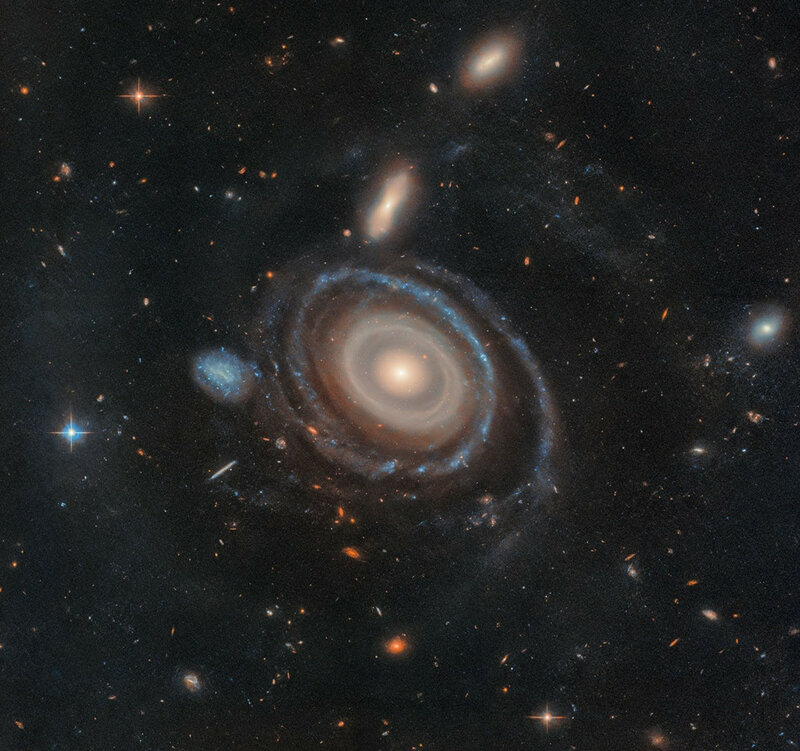
APOD: 2025 February 7 - LEDA 1313424: The Bullseye Galaxy

1.02K
17
5
12
12
0
Good Red Friday morning, Rallypoint, and welcome to this edition of Astronomy Picture of the Day (APOD) for February 7, 2025.
This composite image from the Hubble Space Telescope and ground-based Keck Observatory (located atop Mauna Kea in Hawai'i) provide visual evidence for a remarkable story. The Bullseye Galaxy lies some 567 million light-years away toward the constellation Pisces. The image, along with its accompanying paper, were released this past Tuesday (February 4th). Here's a quote from the paper:
"NASA's Hubble Space Telescope has captured a cosmic bullseye! The gargantuan galaxy LEDA 1313424 is rippling with nine star-filled rings after an "arrow" — a far smaller blue dwarf galaxy — shot through its heart. Astronomers using Hubble identified eight visible rings, more than previously detected by any telescope in any galaxy, and confirmed a ninth using data from the W. M. Keck Observatory in Hawaii. Previous observations of other galaxies show a maximum of two or three rings.
Hubble and Keck Observatory’s follow-up observations also helped the researchers prove which galaxy plunged through the center of the Bullseye — a blue dwarf galaxy to its center-left. This relatively tiny interloper traveled like a dart through the core of the Bullseye about 50 million years ago, leaving rings in its wake like ripples in a pond. A thin trail of gas now links the pair, though they are currently separated by 130,000 light-years."
This composite image from the Hubble Space Telescope and ground-based Keck Observatory (located atop Mauna Kea in Hawai'i) provide visual evidence for a remarkable story. The Bullseye Galaxy lies some 567 million light-years away toward the constellation Pisces. The image, along with its accompanying paper, were released this past Tuesday (February 4th). Here's a quote from the paper:
"NASA's Hubble Space Telescope has captured a cosmic bullseye! The gargantuan galaxy LEDA 1313424 is rippling with nine star-filled rings after an "arrow" — a far smaller blue dwarf galaxy — shot through its heart. Astronomers using Hubble identified eight visible rings, more than previously detected by any telescope in any galaxy, and confirmed a ninth using data from the W. M. Keck Observatory in Hawaii. Previous observations of other galaxies show a maximum of two or three rings.
Hubble and Keck Observatory’s follow-up observations also helped the researchers prove which galaxy plunged through the center of the Bullseye — a blue dwarf galaxy to its center-left. This relatively tiny interloper traveled like a dart through the core of the Bullseye about 50 million years ago, leaving rings in its wake like ripples in a pond. A thin trail of gas now links the pair, though they are currently separated by 130,000 light-years."
APOD: 2025 February 7 - LEDA 1313424: The Bullseye Galaxy
Posted from apod.nasa.gov NASA
NASA Space
Space Science
 Photography
 Astronomy
Posted 12 mo ago
Responses: 4
3
3
0

2
2
0

0
0
0

I've Yet To Understand How I's Possible To See What Occurred In The Past.
Wouldn't It Not HAVE To Be Done Faster Than The Speed Of Light?
Wouldn't It Not HAVE To Be Done Faster Than The Speed Of Light?
(0)
(0)
Read This Next


 Continue with Facebook
 Continue with Google