

18
18
0
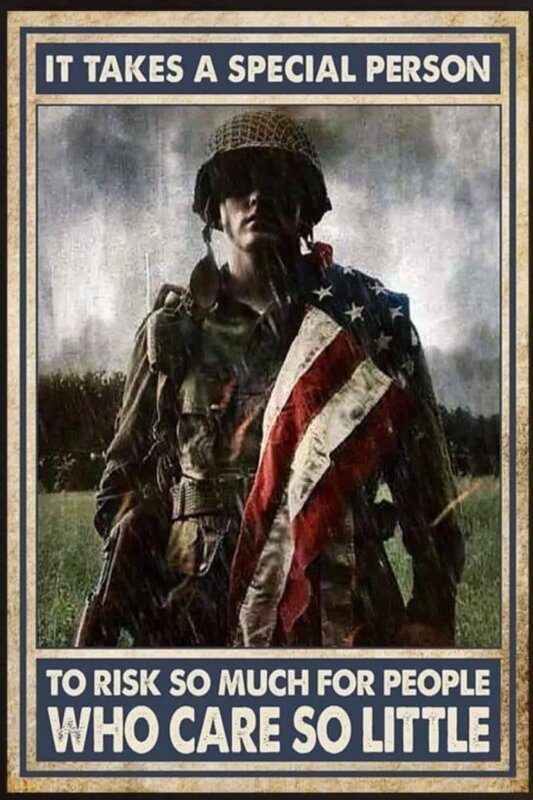
This kind of defined the Vietnam war era.
Posted in these groups:  Vietnam War
Vietnam War
Posted 8 d ago
Responses: 8

5
5
0

SGT Ed Matyjasik I have had these feelings. But, being in a culture of veterans who supported each other helped me when I was newly discharged from the military over 40 years ago.
(5)
(0)
5
5
0
4
4
0
PO3 Edward Riddle
PO3 Phyllis Maynard - It's really too bad you had to learn the hard way, Sister Phyllis. Oh, what it does to the psyche.
(1)
(0)
PO3 Phyllis Maynard
PO3 Edward Riddle yes, for many years my psyche was tormented. I found relief when I started helping veterans as a Disabled Veterans Service Officer for 11 years, as a Chapter Service Officer. I worked for every veteran, in honor of him and for all I did not have the opportunity to do for him
(1)
(0)
PO3 Edward Riddle
PO3 Phyllis Maynard - Good for you my dear Sister Phyllis. I'm sure he would have been very proud of you. Good on ya Girl!!
(0)
(0)
SGT Aaron Atwood
PO3 Edward Riddle Everyone's experience is likely different, and not all of this happened to me, but it definitely happened to other veterans I knew and interacted with particularly during my college years...
Social neglect and being oblivious. This isn't necessarily unique to the GWOT generation, but eventually we got to where there were adults of similar age who didn't even know we were regularly deploying to Iraq or Afghanistan. It became enough of an issue that various military cartoon creators drew content about it. Broken and Unreadable, Terminal Lance, Bohica Blues, and likely others all have at least one comic about it.
Tension in the classroom. I didn't really experience this, but I know of fellow student veterans who took a class or two on Arabic or Middle Eastern culture, and there were constant arguments between themselves and the professor, who was a Middle Eastern immigrant and made his views on combat veterans visible to the whole class. No idea if he's still there. Other than some select faculty I've more or less stopped following the happenings at my college once I came back to active duty.
Expanding in the college experience: requiring us to take certain classes even though we have prior knowledge necessary to get waived from the class, partial credit, etc. I thought I had it bad, but I was lucky compared to the nursing student veterans who basically learned nothing new for years. At least for me that was generally limited to just my freshman year, but the point of college is to learn and eventually become an intellectual epitome as opposed to going over knowledge and information you already know.
Job situations. This may be something else you're familiar with. Imagine the culture shock, being new to the civilian world after such and such years of service, and your employer's only concern or inquiry about your service is you checking the box on the application that you served in the Armed Forces. No questions about your work being relevant to the job at hand, or any missions you may have taken part in that area relevant to a project the employer is working on, and so on and so forth.
"My way or the highway." This is something I generally experienced when taking some martial arts lessons for way too much money right after I initially got out. Rather than capitalizing on the fact that I had already been formally trained, to a certain extent, in hand to hand combat and pointing out the differences and how I could use my past experience: the instructor believed me to have a cup that was already full, per se. For that and other reasons (mainly it costed way, way too much) I stopped going to those classes about a week or two later.
Kind of expanding on the social neglect: adults of similar age, especially college students, quickly and visibly getting tired of your stories from your time in; regardless of the relevance to a question the professor asked. I know that we all know that fellow veterans listen best to other veterans, but we still only make up a very small part of the overall population, and when we need to talk to someone, usually for our internal or mutual benefit, it would help if some non-veterans around our age were willing to listen.
This is arguably the fault of the retailers and other business organizations, but every time they'd advertise a military discount or some other related benefit: they ask for a military ID. I can't really give them that when I was required to turn mine in upon leaving active duty. I wouldn't get a VA card until years later. It's not like I could keep a full-sized copy of my DD214 handy at all times, and even just carrying it around one day out of the year felt ridiculous.
This is excluding the stereotypical predators who know we have government money burning a hole in our pockets; whether it's GI Bill money, the remnants of our final paycheck, etc., and do what they can to squeeze it all out of your pockets.
Those are just some examples, and I'm sure a number of them are familiar.
Social neglect and being oblivious. This isn't necessarily unique to the GWOT generation, but eventually we got to where there were adults of similar age who didn't even know we were regularly deploying to Iraq or Afghanistan. It became enough of an issue that various military cartoon creators drew content about it. Broken and Unreadable, Terminal Lance, Bohica Blues, and likely others all have at least one comic about it.
Tension in the classroom. I didn't really experience this, but I know of fellow student veterans who took a class or two on Arabic or Middle Eastern culture, and there were constant arguments between themselves and the professor, who was a Middle Eastern immigrant and made his views on combat veterans visible to the whole class. No idea if he's still there. Other than some select faculty I've more or less stopped following the happenings at my college once I came back to active duty.
Expanding in the college experience: requiring us to take certain classes even though we have prior knowledge necessary to get waived from the class, partial credit, etc. I thought I had it bad, but I was lucky compared to the nursing student veterans who basically learned nothing new for years. At least for me that was generally limited to just my freshman year, but the point of college is to learn and eventually become an intellectual epitome as opposed to going over knowledge and information you already know.
Job situations. This may be something else you're familiar with. Imagine the culture shock, being new to the civilian world after such and such years of service, and your employer's only concern or inquiry about your service is you checking the box on the application that you served in the Armed Forces. No questions about your work being relevant to the job at hand, or any missions you may have taken part in that area relevant to a project the employer is working on, and so on and so forth.
"My way or the highway." This is something I generally experienced when taking some martial arts lessons for way too much money right after I initially got out. Rather than capitalizing on the fact that I had already been formally trained, to a certain extent, in hand to hand combat and pointing out the differences and how I could use my past experience: the instructor believed me to have a cup that was already full, per se. For that and other reasons (mainly it costed way, way too much) I stopped going to those classes about a week or two later.
Kind of expanding on the social neglect: adults of similar age, especially college students, quickly and visibly getting tired of your stories from your time in; regardless of the relevance to a question the professor asked. I know that we all know that fellow veterans listen best to other veterans, but we still only make up a very small part of the overall population, and when we need to talk to someone, usually for our internal or mutual benefit, it would help if some non-veterans around our age were willing to listen.
This is arguably the fault of the retailers and other business organizations, but every time they'd advertise a military discount or some other related benefit: they ask for a military ID. I can't really give them that when I was required to turn mine in upon leaving active duty. I wouldn't get a VA card until years later. It's not like I could keep a full-sized copy of my DD214 handy at all times, and even just carrying it around one day out of the year felt ridiculous.
This is excluding the stereotypical predators who know we have government money burning a hole in our pockets; whether it's GI Bill money, the remnants of our final paycheck, etc., and do what they can to squeeze it all out of your pockets.
Those are just some examples, and I'm sure a number of them are familiar.
(1)
(0)
Read This Next


 Continue with Facebook
 Continue with Google