

Astronomy

Astronomy
Posted on Jan 14, 2026

APOD: 2026 January 14 – M51: The Whirlpool Galaxy

586
24
4
9
9
0
Good morning, Rallypoint, and welcome to the January 14, 2026 edition of Astronomy Picture of the Day (APOD).
What later became known as the Whirlpool Galaxy was discovered on October 13, 1773, by French astronomer Charles Messier. He was hunting for objects that could confuse comet hunters and designated this finding in his catalogue as M51.
The galaxy is one of the easiest Messier objects to find, as it lies in the vicinity of the constellation Ursa Major (aka the Big Dipper). M51 is positioned just southwest of Alkaid, Eta Ursae Majoris, the star that marks the end of the Big Dipper’s handle. An imaginary line drawn from Alkaid in the direction of Cor Caroli, the brightest star in the constellation Canes Venatici (Hunting Dogs), leads directly to M51.
The Whirlpool Galaxy is visible with binoculars in good conditions. It is quite bright and appears face-on, which makes it a popular target among amateur astronomers and astrophotographers. M51 is also the brightest example of an interacting spiral galaxy in the sky.
What later became known as the Whirlpool Galaxy was discovered on October 13, 1773, by French astronomer Charles Messier. He was hunting for objects that could confuse comet hunters and designated this finding in his catalogue as M51.
The galaxy is one of the easiest Messier objects to find, as it lies in the vicinity of the constellation Ursa Major (aka the Big Dipper). M51 is positioned just southwest of Alkaid, Eta Ursae Majoris, the star that marks the end of the Big Dipper’s handle. An imaginary line drawn from Alkaid in the direction of Cor Caroli, the brightest star in the constellation Canes Venatici (Hunting Dogs), leads directly to M51.
The Whirlpool Galaxy is visible with binoculars in good conditions. It is quite bright and appears face-on, which makes it a popular target among amateur astronomers and astrophotographers. M51 is also the brightest example of an interacting spiral galaxy in the sky.
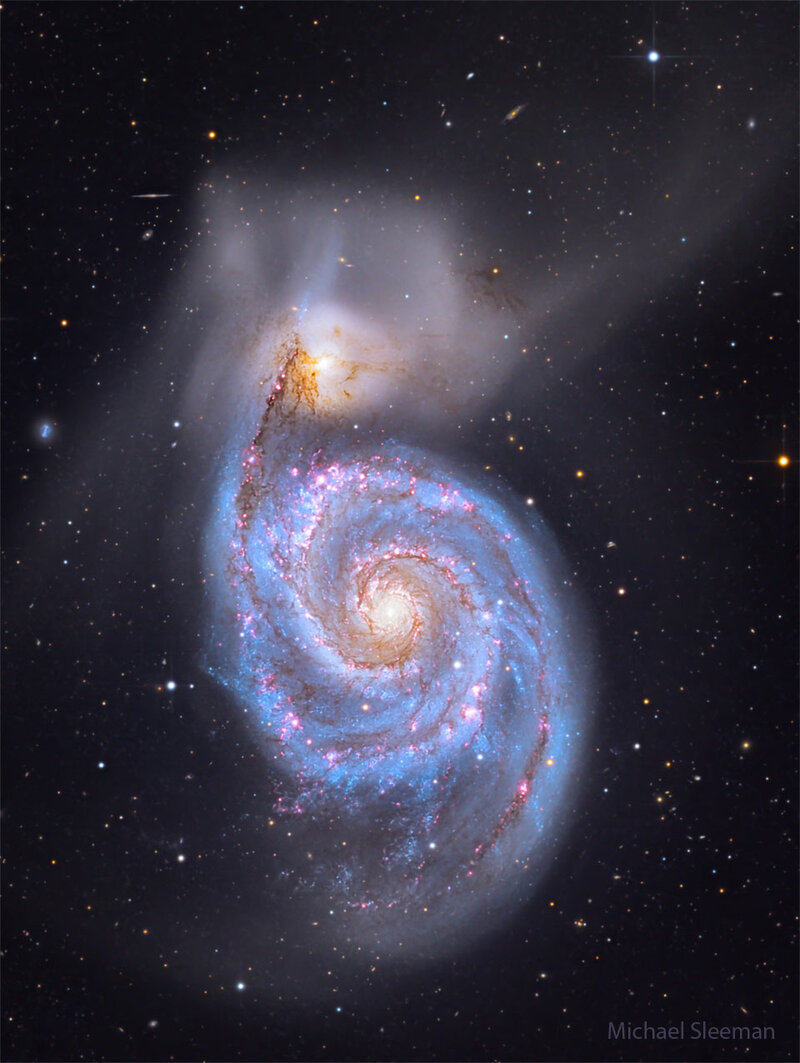
APOD: 2026 January 14 – M51: The Whirlpool Galaxy
Posted from apod.nasa.gov Space
Space Science
 Photography
 Astronomy
Posted 1 mo ago
Responses: 3
5
5
0

4
4
0

Man oh man, Messier objects - haven't heard that since I was a kid. Like most Autistics my Uber Hobbies last about 2 years give or take a year. So after I built my two telescopes and one Radio telescope using Mr. DiGriggorio's Grape Trellis, I moved on. So some of this I was able to follow, the rest is over my head.
(4)
(0)
A1C Medrick "Rick" DeVaney
SGT Kevin Hughes '
Tiz A Quandary, No Doubt; And The Distances These Place Are From One To The Other's, Absolutely Baffling
Tiz A Quandary, No Doubt; And The Distances These Place Are From One To The Other's, Absolutely Baffling
(3)
(0)
3
3
0

We Can See The Whirl Pool Galaxy With Binoculars?
Now THAT I'd Love To See. Normally They Refer To "Light Years" When Talking About Distances, Now That's 1 Thing I Can't Even Fathom In My Mind. ~~ It's Like Trying To Figure Out How Much 1 Quad-Trillion Dollars Is.
Now THAT I'd Love To See. Normally They Refer To "Light Years" When Talking About Distances, Now That's 1 Thing I Can't Even Fathom In My Mind. ~~ It's Like Trying To Figure Out How Much 1 Quad-Trillion Dollars Is.
(3)
(0)
Read This Next


 Continue with Facebook
 Continue with Google