

Astronomy

Astronomy
Posted on Mar 7, 2025

APOD: 2025 March 7 - Planetary Nebula Abell 7

4.15K
18
2
11
11
0
Good Red Friday afternoon, Rallypoint, and welcome to this edition of Astronomy Picture of the Day (APOD) for March 7, 2025.
Astronomer William Herschel is credited with the first use of the term "planetary nebulae." Here is what he said about them back in 1785:
"These are celestial bodies of which as yet we have no clear idea and which are perhaps of a type quite different from those that we are familiar with in the heavens. I have already found four that have a visible diameter of between 15 and 30 seconds. These bodies appear to have a disk that is rather like a planet, that is to say, of equal brightness all over, round or somewhat oval, and about as well defined in outline as the disk of the planets, of a light strong enough to be visible with an ordinary telescope of only one foot, yet they have only the appearance of a star of about ninth magnitude."
We now believe that a planetary nebula is what results as a star sluffs off its outer shell of gas at a late stage of life. New stars are predominantly Hydrogen and Helium. As they age, stars create heavier elements via nuclear fusion which are eventually expelled by stellar winds. What are some of those elements we can see (via spectral analysis)? Carbon, nitrogen, and oxygen are three important ones (look at the basic composition of an amino acid and you will see what I mean). These heavier elements have marked effects on stellar evolution and fusion reactions. As a result, planetary nebulae such as Abell 7 likely play an important role in galactic evolution.
This image of Abell 7 is from 2013.
Astronomer William Herschel is credited with the first use of the term "planetary nebulae." Here is what he said about them back in 1785:
"These are celestial bodies of which as yet we have no clear idea and which are perhaps of a type quite different from those that we are familiar with in the heavens. I have already found four that have a visible diameter of between 15 and 30 seconds. These bodies appear to have a disk that is rather like a planet, that is to say, of equal brightness all over, round or somewhat oval, and about as well defined in outline as the disk of the planets, of a light strong enough to be visible with an ordinary telescope of only one foot, yet they have only the appearance of a star of about ninth magnitude."
We now believe that a planetary nebula is what results as a star sluffs off its outer shell of gas at a late stage of life. New stars are predominantly Hydrogen and Helium. As they age, stars create heavier elements via nuclear fusion which are eventually expelled by stellar winds. What are some of those elements we can see (via spectral analysis)? Carbon, nitrogen, and oxygen are three important ones (look at the basic composition of an amino acid and you will see what I mean). These heavier elements have marked effects on stellar evolution and fusion reactions. As a result, planetary nebulae such as Abell 7 likely play an important role in galactic evolution.
This image of Abell 7 is from 2013.
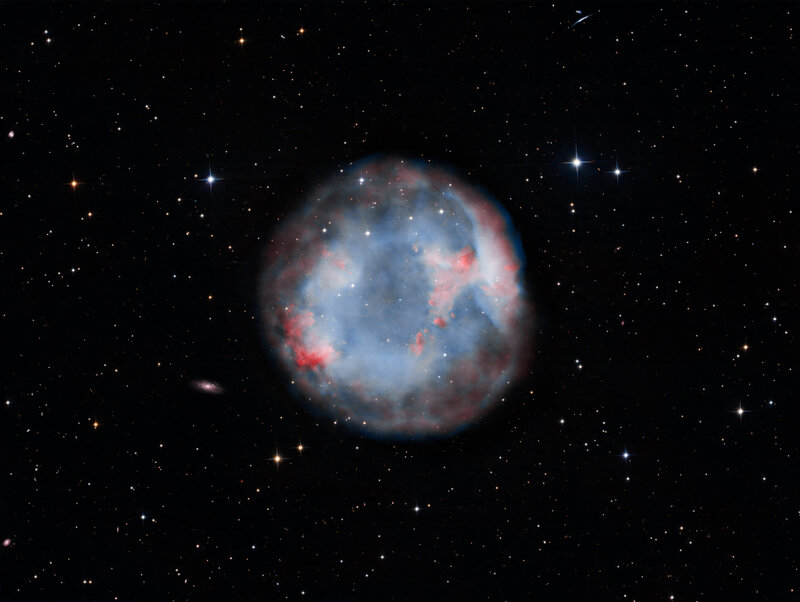
APOD: 2025 March 7 - Planetary Nebula Abell 7
Posted from apod.nasa.gov NASA
NASA Space
Space Science
 Photography
 Astronomy
Edited 11 mo ago
Posted 11 mo ago
Responses: 2
4
4
0

The image of the Planetary Nebula Abell 7 looks strikingly like a Planet itself with land and oceans... Just how it looked when I first glanced at it... Another great APOD, Maj William W. 'Bill' Price!
(4)
(0)
3
3
0

~ Doesn't Change Me Much ~
~ I'm Still Fascinated, Still Confused And Still Find It Totally Amazing.~
~ I'm Still Fascinated, Still Confused And Still Find It Totally Amazing.~
(3)
(0)
Read This Next


 Continue with Facebook
 Continue with Google