

Citizenship

Citizenship
Posted on Feb 19, 2026

FDR orders Japanese Americans into internment camps | February 19, 1942 | HISTORY

0
8
5
3
3
0
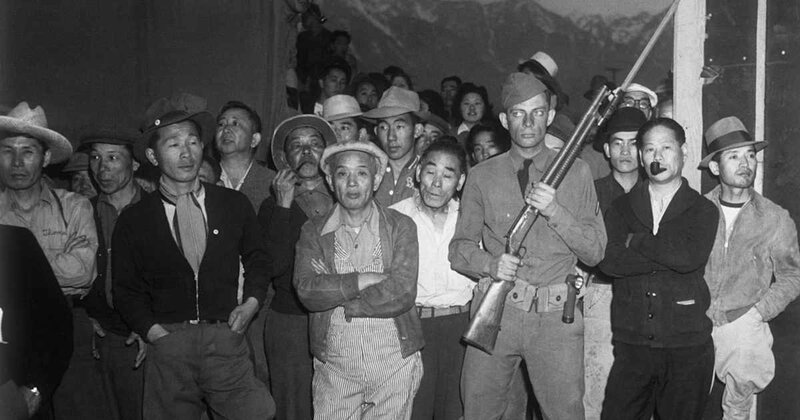
On February 19, 1942, President Franklin D. Roosevelt signs Executive Order 9066, initiating a controversial World War II policy with lasting consequences for Japanese Americans. The document ordered the forced removal of resident "enemy aliens" from parts of the West vaguely identified as military areas.
After the bombing of Pearl Harbor by the Japanese in 1941, Roosevelt came under increasing pressure by military and political advisors to address the nation’s fears of further Japanese attack or sabotage, particularly on the West Coast, where naval ports, commercial shipping and agriculture were most vulnerable. Included in the off-limits military areas referred to in the order were ill-defined areas around West Coast cities, ports and industrial and agricultural regions. While 9066 also affected Italian and German Americans, the largest numbers of detainees were by far Japanese Americans.
On the West Coast, long-standing racism against Japanese Americans, motivated in part by jealousy over their commercial success, erupted after Pearl Harbor into furious demands to remove them en masse to Relocation Centers for the duration of the war.
Japanese immigrants and their descendants, regardless of American citizenship status or length of residence, were systematically rounded up and placed in prison camps. Evacuees, as they were sometimes called, could take only as many possessions as they could carry and were forcibly placed in crude, cramped quarters. In the western states, camps on remote and barren sites such as Manzanar and Tule Lake housed thousands of families whose lives were interrupted and in some cases destroyed by Executive Order 9066. Many lost businesses, farms and loved ones as a result.
After the bombing of Pearl Harbor by the Japanese in 1941, Roosevelt came under increasing pressure by military and political advisors to address the nation’s fears of further Japanese attack or sabotage, particularly on the West Coast, where naval ports, commercial shipping and agriculture were most vulnerable. Included in the off-limits military areas referred to in the order were ill-defined areas around West Coast cities, ports and industrial and agricultural regions. While 9066 also affected Italian and German Americans, the largest numbers of detainees were by far Japanese Americans.
On the West Coast, long-standing racism against Japanese Americans, motivated in part by jealousy over their commercial success, erupted after Pearl Harbor into furious demands to remove them en masse to Relocation Centers for the duration of the war.
Japanese immigrants and their descendants, regardless of American citizenship status or length of residence, were systematically rounded up and placed in prison camps. Evacuees, as they were sometimes called, could take only as many possessions as they could carry and were forcibly placed in crude, cramped quarters. In the western states, camps on remote and barren sites such as Manzanar and Tule Lake housed thousands of families whose lives were interrupted and in some cases destroyed by Executive Order 9066. Many lost businesses, farms and loved ones as a result.
FDR orders Japanese Americans into internment camps | February 19, 1942 | HISTORY
Posted from history.com WWII World War Two
 Japan
Japan Citizenship
 American History
Posted 2 d ago
Responses: 4
2
2
0
And we're repeating that sad day now... except w/o the compelling argument of world war. Even sadder...
(2)
(0)
PO3 Edward Riddle
What in the Hell are you talking about? Where are the concentration camps, and please don't mention any lawful prisons.
(0)
(0)
2
2
0

1
1
0

The EO also affected German and Italian Americans, though not to the extent of how it affected Japanese Americans.
(1)
(0)
Read This Next


 Continue with Facebook
 Continue with Google