
Posted on Oct 16, 2019

How does a military veteran lead civilians?

6.72K
100
65
12
12
0
I am a veteran with over 15 years of combined service. I am currently going to school and studying journalism.
I am taking a class which entails working on the school newspaper. I am the Editor in Chief for this semester and have been told by the other staff members my style comes across as controlling, demanding and unappreciative.
They have also told me they see us as equals rather my subordinates and even got offended when I referred to them as such. The faculty advisor came to me nearly in tears and told me how offensive that remark was.
I attempted to set up a meeting with them to try to resolve this and I even got pushback on that, being told I was acting unprofessionally and that it was unrealistic of me to expect them to try to meet at a time I was available.
In hindsight I think I should have asked for a meeting at the beginning of the semester to clearly define our roles and responsibilities, but I'm concerned this situation is past the point of any peaceful solution.
Does anyone have guidance on how I should proceed in this?
Thank you.
I am taking a class which entails working on the school newspaper. I am the Editor in Chief for this semester and have been told by the other staff members my style comes across as controlling, demanding and unappreciative.
They have also told me they see us as equals rather my subordinates and even got offended when I referred to them as such. The faculty advisor came to me nearly in tears and told me how offensive that remark was.
I attempted to set up a meeting with them to try to resolve this and I even got pushback on that, being told I was acting unprofessionally and that it was unrealistic of me to expect them to try to meet at a time I was available.
In hindsight I think I should have asked for a meeting at the beginning of the semester to clearly define our roles and responsibilities, but I'm concerned this situation is past the point of any peaceful solution.
Does anyone have guidance on how I should proceed in this?
Thank you.
 Chain of Command
 Civilians
 Leadership
Posted 6 y ago
Responses: 29
0
0
0

YOU KNOW WHAT PERFESSIOMALIZM IS. I WOULD JUST GET THE BEST GRADE AND MOVE ON.
(0)
(0)
0
0
0

You my friend seem to be s victim of the weakening of our culture where rules are no longer taught, much less enforced. These "kids" you're likely in school with are used to having things their way and have done so since they were about 18 months old. No discipline at home, none allowed in the schools, so when you try to treat them like and teach them to be responsible they throw up the "I'm offended" flag and leave to to feel like a criminal. Stick to your "guns", require some order, and if they can't put up with it just remind them that when they graduate their likelihood of real employment in their utopian filed of endeavour probably won't happen if they can't show teamwork and discipline.
(0)
(0)
0
0
0

Well, you learned one lesson. You are not a Sergeant and your fellow students aren't Privates. You were using combat leadership when you needed to use staff leadership. OK, you've tried to get a meeting with the entire group and that didn't work, try going the more time consuming, but more flattering to your people, route by going to them individually (it's a great ego stroker if nothing else), consider what opinion each person you talk with might have of you and if the person is one of your detractors, do what you need to do to start anew. When you seem to be at least a truce, explain what your vision for the paper is for the semester you're the editor (don't over emphasize that) and see if you can get each individual to buy into that vision. Once they get on board, you've got to get the individual to think that he came up with their role in achieving your vision, when in fact your planting the seeds of what you want them to do in their mind. Good luck!
(0)
(0)
0
0
0

The fact is you are all students and therefor are equals. You have been appointed as the editor-in-chief. You do not determine their pay and write their checks. Even in an environment where you are the "boss" and paid accordingly, you are most effective if you solicit their ideas, incorporate them when you can and demonstrate your appreciation for their contributions and effort. When doing so, they will do anything with you and for you. You also apparently made an error in calling for a meeting at a specific time without consulting them first. The best way to handle that would have been to say you wanted to get everyone together and soliciting the best times for each of them. In the civilian world, if you have to show them your stripes, you shouldn't have them. Being assertive is necessary, being aggressive is counter productive. Particularly in a school environment it is important to be flexible, be personal and listen. I once worked for a District Manager who would walk the floor with us and solicit ideas on things we can do to take it up a notch. It seems we always had it in us to do so. We loved seeing him. It turns out that, in talking to other stores, they had the same new ideas we did on how to improve. Damn, he was good. He went on to become President of our company. Truly hope this helps. Best of luck.
(0)
(0)
0
0
0

Who is your boss? Have they told you what they want and when do they want it? Treat others are you want to be treated.
(0)
(0)
0
0
0

I had this big thing typed up and now it's gone. Dang it!
In short, you are a student and so are they. You all are the same "rank" and your title is titular, you have the position without authority. I wouldn't call anyone a subordinate, civilian or military side. If I have to remind someone of my position or rank.....I've done something wrong. Or they are naive and don't realize consequences to their actions. Can you as a student discipline or do anything to them? Probably not.
Also I found that although I've been in mid-tier management for over 10 years with employees up to 150 under my wing and also a squad leader for maybe 8-10 years even without the title, I made it an effort to show appreciation even for the standard being completed. I dont take my military leadership background and use that as a reason or excuse for being firm and hitting appointments on time. That begins the idea of how strict you may be when you actually may not. If anything the best feature you bring from the military is professionalism.
At this point get some humble pie snd have at it. Ask if they can be free to meet individually if they wish and on their time. They are students. With other classes. And a life. And homework. Work to their schedule and explain how you came of strong and wish to make it right. What do they want from you. Instead of what you want from them.
In short, you are a student and so are they. You all are the same "rank" and your title is titular, you have the position without authority. I wouldn't call anyone a subordinate, civilian or military side. If I have to remind someone of my position or rank.....I've done something wrong. Or they are naive and don't realize consequences to their actions. Can you as a student discipline or do anything to them? Probably not.
Also I found that although I've been in mid-tier management for over 10 years with employees up to 150 under my wing and also a squad leader for maybe 8-10 years even without the title, I made it an effort to show appreciation even for the standard being completed. I dont take my military leadership background and use that as a reason or excuse for being firm and hitting appointments on time. That begins the idea of how strict you may be when you actually may not. If anything the best feature you bring from the military is professionalism.
At this point get some humble pie snd have at it. Ask if they can be free to meet individually if they wish and on their time. They are students. With other classes. And a life. And homework. Work to their schedule and explain how you came of strong and wish to make it right. What do they want from you. Instead of what you want from them.
(0)
(0)
0
0
0

You are trying to lead peers, where you are just that, peers. You have to use different leadership tools. You are providing direction and motivation. You have to get them all on board with the same goal. You're coming from a background where the mission is universal, it isn't mutually understood or its imperative nature. You have to get them to agree on that mission and the mutually defined objectives. Get buy in. Once you have buy in, you go back To what was agreed on.
Journalism students are already going to be non-hierarchical and resistant to central control.
Advice: bring them together. Apologize. Explain what you were trying to do. Explain that you were taking on the role of editor. What would he have done if they were in your shoes? Take some lumps. Ask them what they think that means. Unless the are cowards, you'll get feedback. Take it in. You are trying to repair, while trying to have them understand you had a job to do that they them selves could be asked To perform.
Reiterate what the mission is, get agreement on that. Then build it Barney style. So if this is our mission, these are the things we must do to achieve it. Get input from them even I find you hate it. Get buy in. Build a situation where they are building assignments within a agreed frame work. Set deadlines collaboratively. Write it all down. Collaborate and buy in. That is what you need. They are likely non-linear thinkers and may not fully appreciate the publication process. You need to get them on board so you ain't fighting them the whole way.
Before you meet, see the advisor and explain what you are doing. So you are not fighting them too.
Journalism students are already going to be non-hierarchical and resistant to central control.
Advice: bring them together. Apologize. Explain what you were trying to do. Explain that you were taking on the role of editor. What would he have done if they were in your shoes? Take some lumps. Ask them what they think that means. Unless the are cowards, you'll get feedback. Take it in. You are trying to repair, while trying to have them understand you had a job to do that they them selves could be asked To perform.
Reiterate what the mission is, get agreement on that. Then build it Barney style. So if this is our mission, these are the things we must do to achieve it. Get input from them even I find you hate it. Get buy in. Build a situation where they are building assignments within a agreed frame work. Set deadlines collaboratively. Write it all down. Collaborate and buy in. That is what you need. They are likely non-linear thinkers and may not fully appreciate the publication process. You need to get them on board so you ain't fighting them the whole way.
Before you meet, see the advisor and explain what you are doing. So you are not fighting them too.
(0)
(0)
0
0
0

Wouldn't even bother with today's kids... I am 63 and still under the GI bill. Just tired of these crybabies.. You better agree with them 100% or the tantrums will rage. I complained about the kids using the F word during writing class and the whole class including the instructor turned on me. I have come close to blows numerous times.. The kids are always high on Pot vape. I have been called a lot of names from pedifile, MF, Ignorant and whitey ( by white kids)... ( Even though Iam part African American) .. most of the kids are good... but they are PC brainwashed... and f-crazy... as with your crying instructor.
(0)
(0)
0
0
0

Wow. Based upon your story, I’d have to agree with them. I’m also wondering about your preferred leadership style. You are a student; just like them. Your job is to publish the paper. Your job is not to to teach, coach, or mentor your peers. Apologise for being a dick. Remind them that you’re now learning how to “ manage”, not lead, and there will be a transition period. Ask them for a re-do and get your paper published, as a team.
(0)
(0)
0
0
0

Way too much information to put in one post. Also, several books to read will take more time than you have left in the semester. John C Maxwell:
* Ethics 101
* Developing the leader within you
* Developing the leaders around you
* The 5 levels of leadership
* The 21 Irrefutable Laws of Leadership
(https://www.speakersbase.com/uploads/3567e22e8083ad294bab525f9c0b631c57f40f2b [login to see] .pdf)
And so many other leadership/relationship books!
There are so many aspects of military leadership to be found in the above books. In the civilian world it is more about delivery then it is execution. It is learning the strengths and weaknesses early on and how to amplify those strengths for growth.
You have the skills to be a great leader. You need to learn a different approach to delivery. Real simple - but not easy.
* Ethics 101
* Developing the leader within you
* Developing the leaders around you
* The 5 levels of leadership
* The 21 Irrefutable Laws of Leadership
(https://www.speakersbase.com/uploads/3567e22e8083ad294bab525f9c0b631c57f40f2b [login to see] .pdf)
And so many other leadership/relationship books!
There are so many aspects of military leadership to be found in the above books. In the civilian world it is more about delivery then it is execution. It is learning the strengths and weaknesses early on and how to amplify those strengths for growth.
You have the skills to be a great leader. You need to learn a different approach to delivery. Real simple - but not easy.

Speakersbase is the place where you can store and share your content, videos, pictures, slides, tweets, ... with your audience. It's your homebase as a speaker.
(0)
(0)
MSgt James Slawson
Books do not make a leader. Leaders make leaders! You learn from experience, although you do need to take a lot of leadership classes and training in the civilian sector, those around us and those we can reach out to are much more valuable. Your insights and knowledge will help more than any book can provide.
(0)
(0)
SSgt (Join to see)
MSgt James Slawson - Agreed.
However, books are a great source as well. It stimulates thoughts and gives you a much broader understanding and a lot more detailed questions to ask your mentor. I also utilize audios and videos. There is no such thing as not enough information.
However, books are a great source as well. It stimulates thoughts and gives you a much broader understanding and a lot more detailed questions to ask your mentor. I also utilize audios and videos. There is no such thing as not enough information.
(0)
(0)
MSgt James Slawson
I agree there is never enough information and books are great however I would value your inputs on a subject more than a book. In today’s world hiring managers look for experience over a degree.
(0)
(0)
SSgt (Join to see)
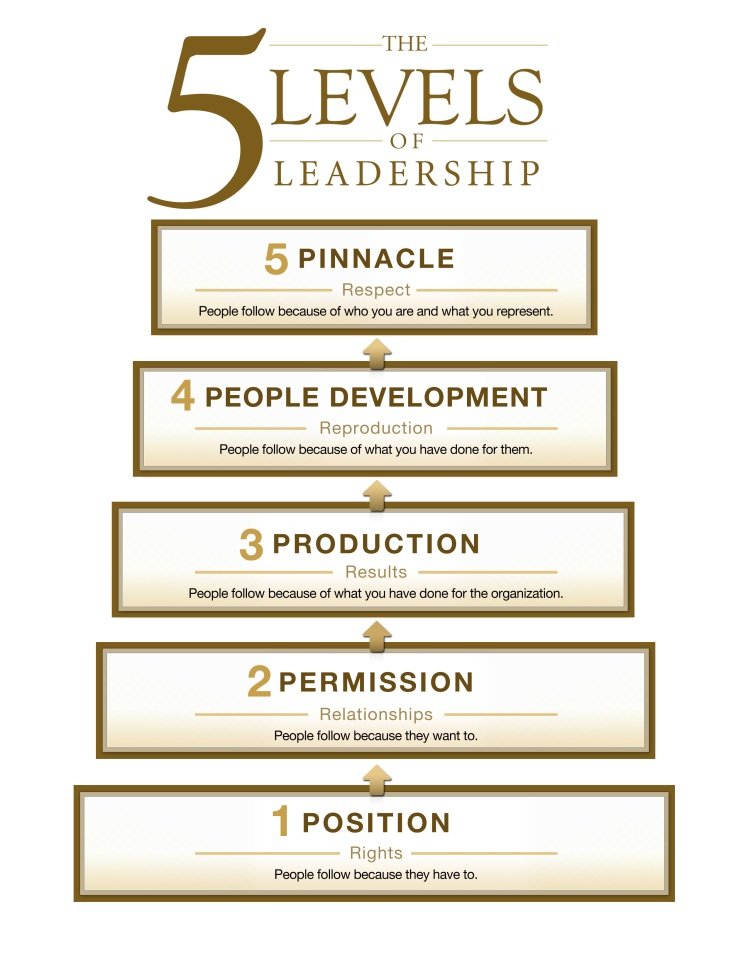
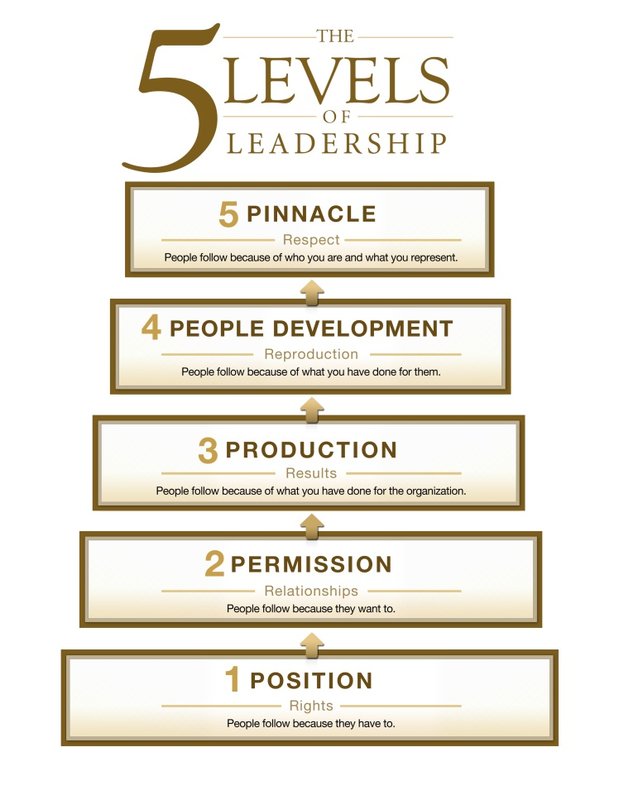
And for those I mentor a lot of my input, beyond the immediate question at hand, is to dig into the books/audios/videos. And yes, I agree, managers do look for experience. And good managers look for those that have built up a font of resources to pull from.
What the 5 Levels of Leadership teach us is that there is a progression to every new position you find yourself in. You can be the best leader in your unit, then change to another and you have to start all over again at the level of Positional Leadership. When you try to treat the new (to you) team the same way you treated your old team you run into problems. They have not yet granted Permission for you to lead.
Of course, this is somewhat circumvented in the military because of the rank on your shoulder. In the civilian world you are now, and forever will be, a PFC. Private Freaking Civilian.
From the book:
---------------------------------------------
Level 2 – Permission
Making the shift from Position to Permission brings a person’s first real step into leadership. Leadership is influence, and when a leader learns to function on the Permission level, everything changes. People do more than merely comply with orders. They actually start to follow. And they do so because they really want to. Why? Because the leader begins to influence people with relationship, not just position.
When people feel liked, cared for, included, valued, and trusted, they begin to work together with their leader and each other. And that can change the entire working environment. The old saying is really true: people go along with leaders they get along with.
---------------------------------------------
Level 4 is where you really start to develop people. This is where you start bringing the Level 1s and 2s to the next level. And Level 5 is where you, as a leader, start creating true leaders, bringing them to level 3 and 4. If you try to bypass any of that you will sit there wondering why your team only does the minimums, bicker, in-fight, only go as far as the clearly laid out corporate policies dictate - and not one step forward.
What the 5 Levels of Leadership teach us is that there is a progression to every new position you find yourself in. You can be the best leader in your unit, then change to another and you have to start all over again at the level of Positional Leadership. When you try to treat the new (to you) team the same way you treated your old team you run into problems. They have not yet granted Permission for you to lead.
Of course, this is somewhat circumvented in the military because of the rank on your shoulder. In the civilian world you are now, and forever will be, a PFC. Private Freaking Civilian.
From the book:
---------------------------------------------
Level 2 – Permission
Making the shift from Position to Permission brings a person’s first real step into leadership. Leadership is influence, and when a leader learns to function on the Permission level, everything changes. People do more than merely comply with orders. They actually start to follow. And they do so because they really want to. Why? Because the leader begins to influence people with relationship, not just position.
When people feel liked, cared for, included, valued, and trusted, they begin to work together with their leader and each other. And that can change the entire working environment. The old saying is really true: people go along with leaders they get along with.
---------------------------------------------
Level 4 is where you really start to develop people. This is where you start bringing the Level 1s and 2s to the next level. And Level 5 is where you, as a leader, start creating true leaders, bringing them to level 3 and 4. If you try to bypass any of that you will sit there wondering why your team only does the minimums, bicker, in-fight, only go as far as the clearly laid out corporate policies dictate - and not one step forward.
(0)
(0)
Read This Next


 Continue with Facebook
 Continue with Google