
Posted on Jun 6, 2015

Today is/was D-Day, on 6 June 1944. What does D-Day mean to you? To us?

20K
165
52
15
15
0
Today is D-Day, or what we now call D-Day... What does D-Day mean to the US today? What does it mean to veterans today? What do you think of on D-Day?
http://taskandpurpose.com/8-iconic-photos-from-the-invasion-of-normandy-71-years-ago/
http://taskandpurpose.com/8-iconic-photos-from-the-invasion-of-normandy-71-years-ago/
 Military History
 American History
 WWII World War Two
 D-Day
D-Day
Edited >1 y ago
Posted >1 y ago
Responses: 15
2
2
0

I think of the June 6th D-Day as one of the most known days of hell on earth. I have no idea how I would have reacted had I been there. I'd like to say that I'd perform admirably, but the sheer horror of the situation was too much for men much tougher than me. I'm just awe struck in the planning, performance, and execution of the invasion. Psychologically, that invasion signified to the American public that we had the upper hand in Europe and the war would eventually be won by the allies. Had we been turned back, I feel like there might have been enormous politial pressure to try to end the war under a flag of truce (worst case scenario). Of course we'll never know because failure was never an option and surrender is not in our creed.
Much like the disaster of the Hurtgen Forest being overshadowed by the Battle of the Bulge, the Battle for Okinawa was going on at the same time as the Normandy invasion. Losing Okinawa sealed the fate of Japan, just as the D-Day success signaled the beginning of the end in Europe. April-June of 1944 defined the US military as absolutely, positively, 100% certifiably, badass. Back to back World War champs. Greatest Generation RESPECT!!!
Much like the disaster of the Hurtgen Forest being overshadowed by the Battle of the Bulge, the Battle for Okinawa was going on at the same time as the Normandy invasion. Losing Okinawa sealed the fate of Japan, just as the D-Day success signaled the beginning of the end in Europe. April-June of 1944 defined the US military as absolutely, positively, 100% certifiably, badass. Back to back World War champs. Greatest Generation RESPECT!!!
(2)
(0)
COL Charles Williams
I suspect SFC Mark Merino and everyone else, we would have been fine. This is why I say this... On 911 all of us old Soldiers were discussing how young Soldiers were not up to the task, like we were back in the day.... Which, as you know, was just not true.
On D-Day, our combat experience on a large scale was limited... But everyone there was trained well, knew the mission and commanders intent, and knew the task and purpose.
I agree these were the greatest, but I also believe if we had to, we would have done it too. The American Soldier is amazing.
On D-Day, our combat experience on a large scale was limited... But everyone there was trained well, knew the mission and commanders intent, and knew the task and purpose.
I agree these were the greatest, but I also believe if we had to, we would have done it too. The American Soldier is amazing.
(0)
(0)
2
2
0

SFC (Join to see) Sir, I ran across this story and video.
Pointe du Hoc; June 6, 1944
Jonn Lilyea | June 6, 2015
Rangers Mission for D-Day, 6 June 1944
The Ranger Group, attached to the 116th Infantry and commanded by Lt. Col. James E. Rudder, was given the mission to capture Pointe du Hoc and destroy the guns. The Ranger Group was made up of two battalions: the 2d Rangers, under direct command of Col. Rudder, and the 5th Rangers, under Lt. Col. Max F. Schneider. Three companies (D, E, and F) of the 2d Battalion (Task Force A) were to land from the sea at H-Hour and assault the cliff position at Pointe du Hoc. The main Ranger force (5th Battalion and Companies A and B of the 2d, comprising Task Force B) would wait off shore for a signal of success, then land at the Point. The Ranger Group would then move inland, cut the coastal highway connecting Grandcamp and Vierville, and await the arrival of the 116th Infantry from Vierville before pushing west toward Grandcamp and Maisy.
One DUKW was hit and sunk by 20-mm fire from a cliff position near the Point. The nine surviving LCAs came in and managed to land in parallel on a 400-yard front on the east side of Point du Hoc, landing about 0705. Allied naval fire had been lifted since H-Hour, giving the Germans above the cliff time to recover. Scattered small-arms fire and automatic fire from a flanking machine-gun position hammered the LCAs, causing about fifteen casualties as the Rangers debarked on the heavily cratered strip of beach. The grapnel rockets were fired immediately on touchdown. Some of the water-soaked ropes failed to carry over the cliff, but only one craft failed to get at least one grapnel to the edge. In one or two cases, the demountable extension ladders were used. The DUKWs came in but could not get across the cratered beach, and from the water’s edge their extension ladders would not reach the top of the cliff.
Despite all difficulties, the Rangers used the ropes and ladders to scramble up the cliff. The German defenders were shocked by the bombardment and improbable assault, but quickly responded by cutting as many ropes as they could. They rushed to the cliff edge and poured direct rifle and machine gun fire on the Rangers, augmented by grenades tossed down the slope. The Rangers never broke, continuing to climb amidst the fire as Ranger BAR men picked off any exposed Germans. The destroyer USS Satterlee (DD-626) observed the Rangers’ precarious position, closed to 1500 yards and took the cliff top under direct fire from all guns, a considerable assist at a crucial time.
Within ten minutes of the landing the first Americans reached the top of the cliffs.
http://thisainthell.us/blog/?p=60227&utm_source=feedburner&utm_medium=email&utm_campaign=Feed%3A+thisainthell%2FnTMY+%28This+ain%27t+Hell%2C+but+you+can+see+it+from+here%29
Pointe du Hoc; June 6, 1944
Jonn Lilyea | June 6, 2015
Rangers Mission for D-Day, 6 June 1944
The Ranger Group, attached to the 116th Infantry and commanded by Lt. Col. James E. Rudder, was given the mission to capture Pointe du Hoc and destroy the guns. The Ranger Group was made up of two battalions: the 2d Rangers, under direct command of Col. Rudder, and the 5th Rangers, under Lt. Col. Max F. Schneider. Three companies (D, E, and F) of the 2d Battalion (Task Force A) were to land from the sea at H-Hour and assault the cliff position at Pointe du Hoc. The main Ranger force (5th Battalion and Companies A and B of the 2d, comprising Task Force B) would wait off shore for a signal of success, then land at the Point. The Ranger Group would then move inland, cut the coastal highway connecting Grandcamp and Vierville, and await the arrival of the 116th Infantry from Vierville before pushing west toward Grandcamp and Maisy.
One DUKW was hit and sunk by 20-mm fire from a cliff position near the Point. The nine surviving LCAs came in and managed to land in parallel on a 400-yard front on the east side of Point du Hoc, landing about 0705. Allied naval fire had been lifted since H-Hour, giving the Germans above the cliff time to recover. Scattered small-arms fire and automatic fire from a flanking machine-gun position hammered the LCAs, causing about fifteen casualties as the Rangers debarked on the heavily cratered strip of beach. The grapnel rockets were fired immediately on touchdown. Some of the water-soaked ropes failed to carry over the cliff, but only one craft failed to get at least one grapnel to the edge. In one or two cases, the demountable extension ladders were used. The DUKWs came in but could not get across the cratered beach, and from the water’s edge their extension ladders would not reach the top of the cliff.
Despite all difficulties, the Rangers used the ropes and ladders to scramble up the cliff. The German defenders were shocked by the bombardment and improbable assault, but quickly responded by cutting as many ropes as they could. They rushed to the cliff edge and poured direct rifle and machine gun fire on the Rangers, augmented by grenades tossed down the slope. The Rangers never broke, continuing to climb amidst the fire as Ranger BAR men picked off any exposed Germans. The destroyer USS Satterlee (DD-626) observed the Rangers’ precarious position, closed to 1500 yards and took the cliff top under direct fire from all guns, a considerable assist at a crucial time.
Within ten minutes of the landing the first Americans reached the top of the cliffs.
http://thisainthell.us/blog/?p=60227&utm_source=feedburner&utm_medium=email&utm_campaign=Feed%3A+thisainthell%2FnTMY+%28This+ain%27t+Hell%2C+but+you+can+see+it+from+here%29
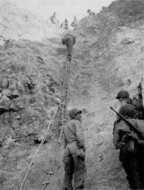
Republished almost every year; Rangers Mission for D-Day, 6 June 1944 The Ranger Group, attached to the 116th Infantry and commanded by Lt. Col. James E
(2)
(0)
1
1
0

I've been to Normandy, seen the sites, walked the beaches at 0630 when the operation began. You get a complete different prospective when standing at the water's edge looking up at that long, flat beach understanding the cross fire, direct/indirect fire being placed on the incoming soldiers. Movies, books tell you a lot, but standing there, if you don't feel the fear, then you're missing something. It made me ask, "How did they do it?"
(1)
(0)
1
1
0
COL Charles Williams, when I think of D-day, I think about all those brave souls who took beach and continued pounding while their buddies were getting killed and wounded all around them. I think of the video clip always shown where the soldier is advancing on the beach, even though there is machine gun ammo hitting all around him, and gets killed. I think of all the parents of those young heros who got the telegram that their son is MIA or KIA. Having been in combat myself, I can feel what those kids were thinking as they offloaded those carriers and had to run through the the water and sand, praying it's not their time, but continuing on while they watch the horror surrounding them. Theirs was not in vain, as Korea and Vietnam was. They represented the freedom everyone wants, by winning their war.
(1)
(0)
SGT (Join to see)
MAJ Ken Landgren, No Sir, I can't even come close to what it took to accomplish those missions. Imagine how long before the missions, this was being planned, coordinated, and done. Nothing like it in American, or World history.
(0)
(0)
SGT (Join to see)
What an amazing story and amazing man. He really was a good POTUS too. He played golf a lot but was a great leader.
(0)
(0)
0
0
0

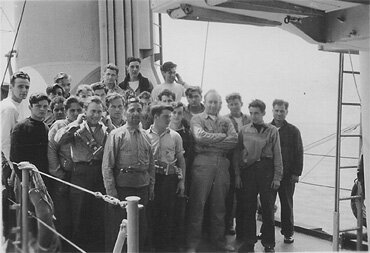
This is a picture of some of the survivors of the USS Corry DD463. This was taken after they were rescued from the water after the Corry was sunk off the coast of Utah beach. My father is the last guy in the front row, right side. If anyone is interested, there is a great story to be found by googling USS Corry DD 463
(0)
(0)
Read This Next


 Continue with Facebook
 Continue with Google