

18
18
0
Good afternoon RP. Today's image is titled "First Horizon-Scale Image of a Black Hole." A black hole is a great amount of matter packed into a very small area, resulting in a gravitational field so strong that nothing, not even light, can escape. An event horizon marks a boundary that when crossed, all light-like paths become warped by gravity and fall further towards the center of the black hole. This image is a visualization of the area around the black hole at the center of galaxy M87 on a scale below that expected for its event horizon.
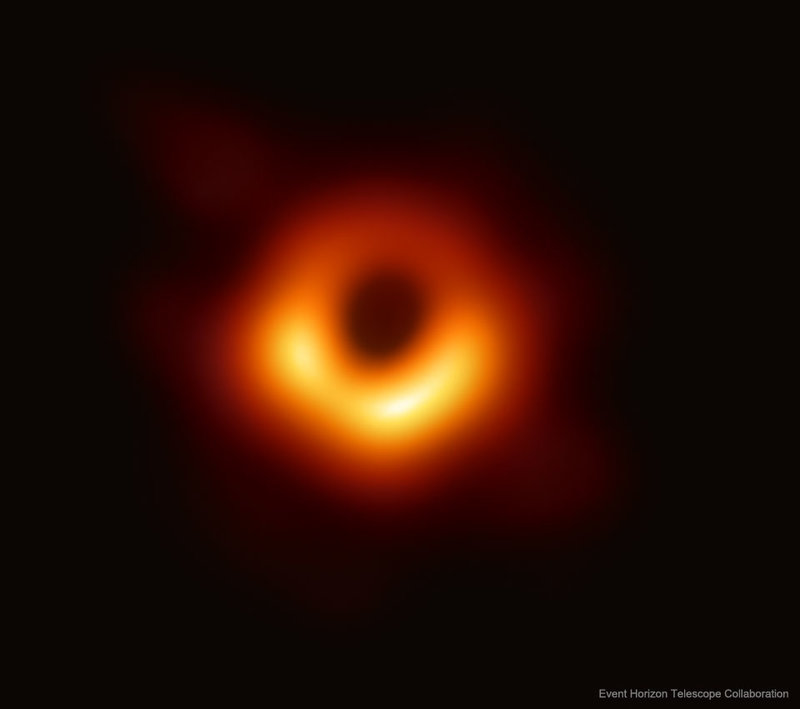
Astronomy Picture of the Day
Posted from apod.nasa.gov NASA
NASA Space
Space Science
 Photography
 Astronomy
Posted 7 y ago
Responses: 9

3
3
0

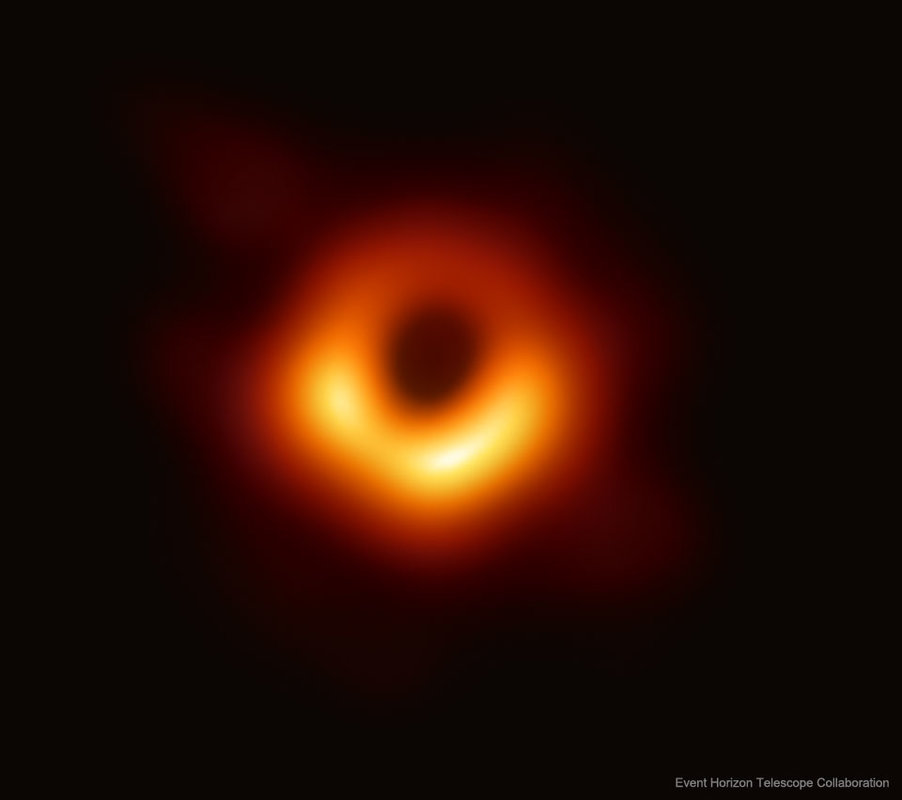
Thank you, my friend Maj William W. 'Bill' Price for sharing the NASA picture of the day for April 11, 2019 entitled "First Horizon-Scale Image of a Black Hole."
Image: First Horizon-Scale Image of a Black Hole - image credit - Event Horizon Telescope Collaboration
"Explanation: What does a black hole look like? To find out, radio telescopes from around the Earth coordinated observations of black holes with the largest known event horizons on the sky. Alone, black holes are just black, but these monster attractors are known to be surrounded by glowing gas. The first image was released yesterday and resolved the area around the black hole at the center of galaxy M87 on a scale below that expected for its event horizon. Pictured, the dark central region is not the event horizon, but rather the black hole's shadow -- the central region of emitting gas darkened by the central black hole's gravity. The size and shape of the shadow is determined by bright gas near the event horizon, by strong gravitational lensing deflections, and by the black hole's spin. In resolving this black hole's shadow, the Event Horizon Telescope (EHT) bolstered evidence that Einstein's gravity works even in extreme regions, and gave clear evidence that M87 has a central spinning black hole of about 6 billion solar masses. The EHT is not done -- future observations will be geared toward even higher resolution, better tracking of variability, and exploring the immediate vicinity of the black hole in the center of our Milky Way Galaxy."
FYI COL Mikel J. Burroughs LTC Orlando Illi Maj Bill Smith, Ph.D. Maj William W. 'Bill' Price CPT Jack Durish Capt Tom Brown CMSgt (Join to see) MSG Andrew White SFC William Farrell SGT (Join to see) Sgt Albert Castro SSgt Boyd Herrst] SSG Ray Adkins SGT Charles H. Hawes SSG Martin Byrne PO1 William "Chip" Nagel CPT Gabe SnellLTC Greg Henning
Image: First Horizon-Scale Image of a Black Hole - image credit - Event Horizon Telescope Collaboration
"Explanation: What does a black hole look like? To find out, radio telescopes from around the Earth coordinated observations of black holes with the largest known event horizons on the sky. Alone, black holes are just black, but these monster attractors are known to be surrounded by glowing gas. The first image was released yesterday and resolved the area around the black hole at the center of galaxy M87 on a scale below that expected for its event horizon. Pictured, the dark central region is not the event horizon, but rather the black hole's shadow -- the central region of emitting gas darkened by the central black hole's gravity. The size and shape of the shadow is determined by bright gas near the event horizon, by strong gravitational lensing deflections, and by the black hole's spin. In resolving this black hole's shadow, the Event Horizon Telescope (EHT) bolstered evidence that Einstein's gravity works even in extreme regions, and gave clear evidence that M87 has a central spinning black hole of about 6 billion solar masses. The EHT is not done -- future observations will be geared toward even higher resolution, better tracking of variability, and exploring the immediate vicinity of the black hole in the center of our Milky Way Galaxy."
FYI COL Mikel J. Burroughs LTC Orlando Illi Maj Bill Smith, Ph.D. Maj William W. 'Bill' Price CPT Jack Durish Capt Tom Brown CMSgt (Join to see) MSG Andrew White SFC William Farrell SGT (Join to see) Sgt Albert Castro SSgt Boyd Herrst] SSG Ray Adkins SGT Charles H. Hawes SSG Martin Byrne PO1 William "Chip" Nagel CPT Gabe SnellLTC Greg Henning
(3)
(0)
3
3
0

3
3
0

Maj William W. 'Bill' Price
Good question SSG Byron Howard Sr. One possibility that I have read is that a black hole is one end of a wormhole. So an answer to your question may be "out the other end" of the wormhole.
(3)
(0)
SSG Byron Howard Sr
Maj William W. 'Bill' Price do you think the other end would have the opposite effect instead of pulling you in it would throw you out?
(2)
(0)
Read This Next


 Continue with Facebook
 Continue with Google