
Posted on Dec 7, 2017

Can you file an Article 138 complaint against your Commander for harrasment?

29.8K
34
26
4
4
0
 UCMJ
UCMJ JAG
JAG
Responses: 13
6
6
0

Short answer—yes
Long answer—also yes, but I would consider getting some legal advice before doing so. Harassment can be vague and subject to interpretation.
Caveat—I am not a lawyer, and I have been retired for a while. It has been many, many years since I attended Naval Justice School. So, other opinions may be helpful.
Long answer—also yes, but I would consider getting some legal advice before doing so. Harassment can be vague and subject to interpretation.
Caveat—I am not a lawyer, and I have been retired for a while. It has been many, many years since I attended Naval Justice School. So, other opinions may be helpful.
(6)
(0)
3
3
0

SSG (Join to see) 1st I am sorry I am late to the discussion.
Yes, Of course you can. While I have never done one, I have had them done against me, buy a Soldier(s) who thought I had stepped outside my bounds... If the senior commander wants to, he/she, will appoint a 15-6 Officer (or similar) to investigate.
But, as SGM Erik Marquez stated, I would consider you options, and seek legal advice as well. Also, remember, there are 2nd and 3rd order effects to everything we do.
For some perspective. I was a Company, Battalion, and Brigade Commander. I was also an enlisted Soldier, who was offered a BS Article 15, by a dumb ass commander, who did not know the facts, and proceed to quickly. He dropped the ART 15, when I refused it, after receiving guidance from TDS. TDS by the way, is not always on your side... Just my view.
938. ARTICLE 138. COMPLAINTS OF WRONGS
11. Miscellaneous Provisions
Any member of the armed forces who believes himself wronged by his commanding officer, and who, upon due application to that commanding officer, is refused redress, may complain to any superior commissioned officer, who shall foreword the complaint to the office exercising court- martial jurisdiction over the officer against whom it is made. The officer exercising general court-martial jurisdiction shall examine into the complaint and take proper measures for redressing the wrong complained of; and he shall, as soon as possible, send to the Secretary concerned a true statement of that complaint, with the proceedings thereon.
https://www.thebalance.com/article-138-complaint-ucmj-3332814
Yes, Of course you can. While I have never done one, I have had them done against me, buy a Soldier(s) who thought I had stepped outside my bounds... If the senior commander wants to, he/she, will appoint a 15-6 Officer (or similar) to investigate.
But, as SGM Erik Marquez stated, I would consider you options, and seek legal advice as well. Also, remember, there are 2nd and 3rd order effects to everything we do.
For some perspective. I was a Company, Battalion, and Brigade Commander. I was also an enlisted Soldier, who was offered a BS Article 15, by a dumb ass commander, who did not know the facts, and proceed to quickly. He dropped the ART 15, when I refused it, after receiving guidance from TDS. TDS by the way, is not always on your side... Just my view.
938. ARTICLE 138. COMPLAINTS OF WRONGS
11. Miscellaneous Provisions
Any member of the armed forces who believes himself wronged by his commanding officer, and who, upon due application to that commanding officer, is refused redress, may complain to any superior commissioned officer, who shall foreword the complaint to the office exercising court- martial jurisdiction over the officer against whom it is made. The officer exercising general court-martial jurisdiction shall examine into the complaint and take proper measures for redressing the wrong complained of; and he shall, as soon as possible, send to the Secretary concerned a true statement of that complaint, with the proceedings thereon.
https://www.thebalance.com/article-138-complaint-ucmj-3332814

How to File an Article 138 Complaint
Learn about Article 138, one of the most powerful rights under the rights under the UCMJ. Learn more about the procedures for filing a complaint.
(3)
(0)
COL Charles Williams
SSG (Join to see) - I hope all works out for you. Most leaders do the right thing, as do our Soldiers, but at times, some go off the rails. Hence the need for 138 and similar items of redress.
(1)
(0)
2
2
0

I had justification to file an Article 138 complaint against my at-the-time commander, and I probably should have. He formally counselled me on a DA 4856 in writing. When I proved by regulation I had done nothing wrong, he handed me my rebuttal back and said "you didn't have to go to all that trouble". WTAF? Water under the bridge now, that commander is long gone, and I'm long gone from that unit..... and two ranks above where I was when I got counselled.
(2)
(0)
2
2
0

Have you or any of the others you mentioned actually utilized the open door policy and spoken to your commander directly about it? At least give him/her a chance to address it if you haven't already done so.
If the grievance isn't clearly illegal, immoral, or unethical it is unlikely to go anywhere; so make sure you are correct before you decide to go this route. Talk to SJA; it may fall more in line with an IG or EO complaint.
If the grievance isn't clearly illegal, immoral, or unethical it is unlikely to go anywhere; so make sure you are correct before you decide to go this route. Talk to SJA; it may fall more in line with an IG or EO complaint.
(2)
(0)
SMSgt Lawrence McCarter
I've always made it My policy I don't ever write up anything for any alleged offense until talking with the individual first. A lot of stories have more than one side and often what is heard first is not correct. i don't delegate that task to anyone else either, If I don't have the backbone to face them Myself then I don't feel it should be done or dumped on another person to do. Also unless it crosses a certain threshold the idea is to correct not sink a career. There are some that taking it all the way is needed but they tend to the exception. Communicate with Your troops and have their back, I dislike ass kissers and backstabbers, rats and people that can't work as part of a team. I doubt I'll change My outlook but what I do seems to work and real respect is a two way street. Don't confuse looking out for Your people with lack of control, they know who is in charge and don't have to be constantly reminded or have to watch their back.
(0)
(0)
2
2
0

My question is where are your first line supervisors? you NCO support chain? Nobody has offered to talk with you advise or help you? You would have a stronger case if you use your support chain. You would be surprised at the support and pressure that can come back down on commanders when they are wrong. Your commanders Immediate supervisor doesn't want his/her career ended over stupidity.
(2)
(0)

SSG (Join to see) Sure you CAN, should you is another question.
Best be sure your "right" and justified in doing so, which means more than disagreeing, disliking or not enjoying the act or decision the CDR made you take issue with.
Seek advice of a lawyer familiar with UCMJ and specifically Art 138 proceedings.
If your ART 138 allegations are proved unfounded I would suggest you consider a new path other then Army Service
Best be sure your "right" and justified in doing so, which means more than disagreeing, disliking or not enjoying the act or decision the CDR made you take issue with.
Seek advice of a lawyer familiar with UCMJ and specifically Art 138 proceedings.
If your ART 138 allegations are proved unfounded I would suggest you consider a new path other then Army Service
(2)
(0)
2
2
0
You can do almost anything, no fragging though. Yes, some commanders are wrong, personally I was relieved for not following an order from the BC... I was the 2nd CO to go, as we both asked for that order in writing... it would have ruined the career of an E-6, who did nothing wrong. A Federal court decided in our favor (as the order was given in front of not only the IG, the Brigade Cdr., but a one star, who did nothing...) the Brigade Commander even wrote how to ruin this mans career on a bar napkin, which saved my bacon, as someone in the Pentagon asked for it). Years later, when long after my second pass over... which kind of forced me to go back to my 30% disability from Vietnam, and do the didi, which was upgraded to unemployability (100%), And I went back to a Civil Service position. Needless to say, being right, does not always make it a win. Depending on your position, request a transfer... that is (or used to be) a soldiers right.
You got to have your ducks in order, witnesses... willing to talk and put their careers on the line.
A discretionary act or omission by a commanding officer, under color of Federal military authority, that adversely affects the complainant personally and that is-
(1) In violation of law or regulation;
(2) Beyond the legitimate authority of that commanding officer;
(3) Arbitrary, capricious, or an abuse of discretion; or
(4) Materially unfair.
Sad to say, but you are going up a system that seldom loses. It takes very little to ruin your career... I witnessed a fellow officer asleep, a West Pointer, a Ranger... The BC picked up his legs so he could sleep more comfortably (we were in a DRF 1 status) the new officer jumped up and took a swing at the BC... to which the BC calmly told him that act just ruined his career.
Think long and hard before you file anything official... unless you really have witnesses and proof.
You got to have your ducks in order, witnesses... willing to talk and put their careers on the line.
A discretionary act or omission by a commanding officer, under color of Federal military authority, that adversely affects the complainant personally and that is-
(1) In violation of law or regulation;
(2) Beyond the legitimate authority of that commanding officer;
(3) Arbitrary, capricious, or an abuse of discretion; or
(4) Materially unfair.
Sad to say, but you are going up a system that seldom loses. It takes very little to ruin your career... I witnessed a fellow officer asleep, a West Pointer, a Ranger... The BC picked up his legs so he could sleep more comfortably (we were in a DRF 1 status) the new officer jumped up and took a swing at the BC... to which the BC calmly told him that act just ruined his career.
Think long and hard before you file anything official... unless you really have witnesses and proof.
(2)
(0)
Suspended Profile
When did they ban fragging? Warmest Regards, Sandy ;)
https://www.huffingtonpost.com/entry/the-forgotten-history-of-fragging-in-vietnam_us_5a1b77b6e4b0cee6c050939d
https://www.huffingtonpost.com/entry/the-forgotten-history-of-fragging-in-vietnam_us_5a1b77b6e4b0cee6c050939d
The Forgotten History Of 'Fragging' In Vietnam
Senate candidate Roy Moore was reportedly among those officers targeted by their own men.
SFC Jim Ruether
1LT Sandy Annala - Can you actually BAN fragging? Our bible says thou shalt not kill! If someone wants to kill or harm their commander, sergeant, first sergeant, squad leader their isn't much that can stop them. If we were all good people and had a conscience then perhaps you could BAN the killing or maiming of your superiors.
(0)
(0)
Suspended Profile
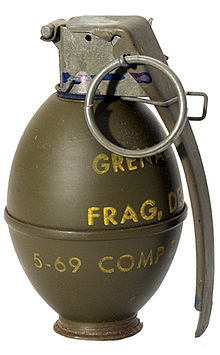
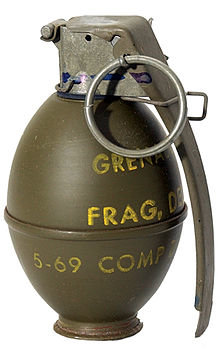
SFC Jim Ruether - Just saying fragging wasn't uncommon -- I knew of 900 plus incidents. We certainly never fragged anyone - but on occasion we quite literally picked up the pieces. Warmest Regards, Sandy :)
Fragging – the murder of officers and sergeants by their own troops – was in the news recently when it was reported that Roy Moore, currently campaigning in Alabama for a U.S. Senate seat, risked being killed by some of his subordinates in Vietnam.
After graduating from West Point in 1969, Moore served in Germany as a lieutenant and then he was promoted to captain and given command of the 188th Military Police Company in Vietnam in 1971. This came during the final years of the war when men who were violent, drug-addled, or disturbed became a significant presence in the Army and Marine Corps, causing a serious breakdown of discipline. In 1971, Colonel Robert D. Heinl wrote in Armed Forces Journal, “Our Army that now remains in Vietnam is in a state approaching collapse, with individual units avoiding or having refused combat, murdering their officers, drug-ridden, and dispirited where not near-mutinous.
In his autobiography So Help Me God, Roy Moore said that when he took command of his company in Vietnam, “drug use was widespread and insubordination was commonplace.” He immediately enforced strict discipline. “I administered many Article Fifteens, disciplinary charges filed against insubordinate or disobedient soldiers,” especially drug users.
As a result, he said, he received threats of death by fragging. “I became a marked man,” he said. Claiming that he was not intimidated, he refused to soften his discipline. He did, however, take precautionary measures to reinforce his sleeping area. “I placed sandbags under the bed and in the walls of my quarters.”
Moore learned that “a known drug user by the name of Kidwell” was planning to kill him. “Several weeks passed before I was called one evening and informed that Kidwell had shot First Sergeant Howard and was coming for me. Armed with an automatic rifle and my 45-caliber pistol, I proceeded to company headquarters, only to find that Kidwell had been taken into custody and was sitting in my office. I made arrangements for a prompt court martial and was relieved that First Sergeant Howard had survived.”
Fragging – the murder of officers and sergeants by their own troops – was in the news recently when it was reported that Roy Moore, currently campaigning in Alabama for a U.S. Senate seat, risked being killed by some of his subordinates in Vietnam.
After graduating from West Point in 1969, Moore served in Germany as a lieutenant and then he was promoted to captain and given command of the 188th Military Police Company in Vietnam in 1971. This came during the final years of the war when men who were violent, drug-addled, or disturbed became a significant presence in the Army and Marine Corps, causing a serious breakdown of discipline. In 1971, Colonel Robert D. Heinl wrote in Armed Forces Journal, “Our Army that now remains in Vietnam is in a state approaching collapse, with individual units avoiding or having refused combat, murdering their officers, drug-ridden, and dispirited where not near-mutinous.
In his autobiography So Help Me God, Roy Moore said that when he took command of his company in Vietnam, “drug use was widespread and insubordination was commonplace.” He immediately enforced strict discipline. “I administered many Article Fifteens, disciplinary charges filed against insubordinate or disobedient soldiers,” especially drug users.
As a result, he said, he received threats of death by fragging. “I became a marked man,” he said. Claiming that he was not intimidated, he refused to soften his discipline. He did, however, take precautionary measures to reinforce his sleeping area. “I placed sandbags under the bed and in the walls of my quarters.”
Moore learned that “a known drug user by the name of Kidwell” was planning to kill him. “Several weeks passed before I was called one evening and informed that Kidwell had shot First Sergeant Howard and was coming for me. Armed with an automatic rifle and my 45-caliber pistol, I proceeded to company headquarters, only to find that Kidwell had been taken into custody and was sitting in my office. I made arrangements for a prompt court martial and was relieved that First Sergeant Howard had survived.”
2
2
0
1
1
0
1
1
0

Read This Next


 Continue with Facebook
 Continue with Google