

Local hero? A bit curious about that rack...


http://dcourier.com/main.asp?SectionID=1&SubSectionID=1086&ArticleID=147322
He was eager to serve his country.
At only 14 years old, Ron Johnson lied about his age and enlisted with the Navy to fight the Japanese.
The legal age to join the military back then was 17 or 16 with parental consent. It was not uncommon, however, for young men to fib their way in, especially with the amount of anger Americans had right after the attack on Pearl Harbor, according to Johnson.
"Some were caught and sent to Leavenworth (a United States Disciplinary Barracks in Kansas)," Johnson said.
Fortunately for Johnson, he got away with it.
"I think it was because I was in combat all of the time and I was serving a purpose in combat and they didn't want to find out that I was only 14 years old," Johnson said.
Part of the reason may have also been that he was raised as an orphan in a Catholic convent, so when he used a fake name (Ronny Frascona) when enlisting, his records weren't the easiest to trace.
Johnson served from February 1942 as a gunner and dive bomber until the end of the war in August 1945.
He and his pilot never had to eject from their plane, but they did crash into the ocean five times (three of which were due to running out of gas).
"At that time of the war, which was the beginning, we often went beyond the call of duty or the intelligence or our brains," Johnson said.
One instance that made a significant impression on Johnson was when he rode on top of his plane rather than in it during a rescue mission.
When he was on the USS North Carolina, a fighter pilot had been shot down in the Bay of Truk and needed rescuing because he was wounded and within range of Japanese fire.
Johnson's pilot, Mr. Mead, devised a plan that put Johnson in great danger. Johnson agreed nonetheless.
Mead landed in the bay just outside the range of fire. Johnson tied a long rope around his waist. Mead tied the other end to the strut of the pontoon and Johnson swam to the wounded pilot. Once he reached the pilot, Mead dragged them to safety.
There was also the matter of getting all of them back on the USS Carolina in one piece. The King Fisher pontoon had only enough room for two people, a gunner and a pilot. Mead had to fly and the wounded pilot took the gunner's seat.
"My question was ... where are you going to put me?" Johnson recalls asking Mead.
Mead responded: "You're going to straddle the strut and I'm going to tie your hands and feet around it and your back is going to be to the propeller," Johnson said.
"What if we don't get off the ground and we crash?" Johnson continued.
"He said, 'Well, then you're dead,'" Johnson said.
"I said [sarcastically], 'Thanks a lot sir, I really agree with your plan here.'"
It was risky, but they managed to get into the air and make it back to the USS North Carolina safely.
After the war, Johnson continued to serve in the Navy from 1945 to 1950 as a boxer. Out of his 116 fights, he lost only once as an amateur and once professionally.
In May 1950, he re-enlisted with the airborne to fight in the Korean War that began in June 1950. He spent three years there leading a platoon.
Despite all of the action he saw, Johnson was only wounded once. Shrapnel from an exploding suicide plane in Okinawa struck him. However, he recovered quickly.
"The injuries weren't debilitating at all," Johnson said.
Johnson, 83, now lives with his wife, Caroline, in Cordes Lakes.
He used to frequently volunteer for organizations in his area before he went blind three years ago. Yet even today, he still helps out the community as much as he can with his fellow wartime veterans in the American Legion Post 122.
 WWII World War Two
 Korean War
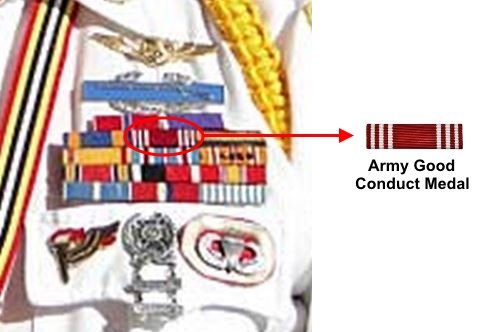
Bonus Material: The Army Reserve Component Achievement Medal is the Reserve equivalent to the the Army Good Conduct Medal. But the ARCAM can be awarded to Enlisted and Officers.
https://www.hrc.army.mil/TAGD/Army%20Reserve%20Component%20Achievement%20Medal%20ARCAM

Manual of Military Decorations" Department of Defense. July 1990. pp. D–12
Served ashore in China or who were attached to any of the vessels that operated in support of the operations in China between 7 July 1937, and 7 September 1939.[4]
1.The commemorative purposes for which the China Service Medal was established and authorized by General Order No. 176, dated 1 July 1942, are extended to include the services performed by personnel of the Navy, Marine Corps, and Coast Guard during the operations in China subsequent to 2 September 1945, and until a terminal date to be designated. It is further provided that the Secretary of the Navy may tender this medal to personnel of the Army or other components of the Armed Forces of the United States for service which he may determine to be commensurate with and consistent with the services for which the award is made to personnel in the naval service, and this provision for tender shall apply for all periods of time for which award of this medal is authorized. Served ashore in China or were attached to any of the vessels that operated in support of operations in China between September 2, 1945 and April 1, 1957.
2.The medal will be awarded to individuals who shall have been attached to, present, and serving on permanent duty with an organization of the naval service of the United States credited by the Secretary of the Navy with having participated in operations in China. Service In a passenger status, or as an observer, visitor, courier, escort, inspector, or other similar status when not permanently attached to an eligible unit, is not creditable toward eligibility for the above medal. Services performed in the Asiatic-Pacific area between 3 September 1945 and 2 March 1946, inclusive, shall not be credited toward individual eligibility for the China Service Medal unless the individual is already eligible for the Asiatic-Pacific Campaign Medal for services performed prior to 2 September 1945.
3.Organizations will, consistent with the above dates, be credited with qualifying service for services performed on shore in China and such adjacent islands and territories as are recognized to be Chinese, or in ships operating in such territorial waters or contiguous ocean areas, or in aircraft based upon and operating from such territories or ships.
4.The China Service Medal shall not be awarded for any service for which another service medal is authorized except as provided in paragraph 2 above and not more than one medal shall be awarded to any individual. No clasps, distinguishing devices, or other insignia are authorized to be worn on the corresponding service ribbon except that Individuals to whom the medal has been or may be awarded for service performed under General Order No. 176, of 1 July 1942, shall upon becoming eligible for this award for service performed subsequent to 2 September 1945, wear a bronze star signifying the second award on the ribbon of the medal and on the service ribbon.
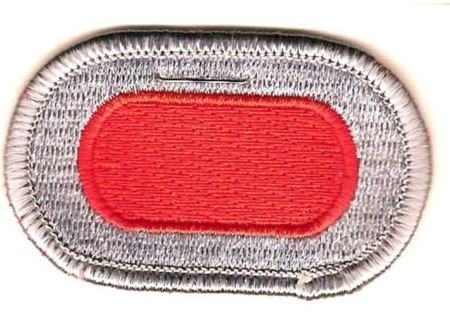
He must have been in another unit if he was in Korea but then why wear the flash of the 503rd PIR.

Constituted 24 February 1942 in the Army of the United States as the 503d Parachute Infantry (1st Battalion concurrently consolidated with the 503d Parachute Battalion [constituted 14 March 1941 in the Army of the United States and activated 22 August 1941 at Fort Benning, Georgia] and 2d Battalion consolidated with the 504th Parachute Battalion [constituted 14 March 1941 in the Army of the United States and activated 5 October at Fort...

http://www.pinstopin.com/us-navy-medals-and-ribbons-
chart/bmF2eWdpcmwqb3JnfG1pc2N8TmF2eSBSaWJib25zKmpwZw_bmF2eWdpcmwqb3JnfG1pc2N8bmF2eV9yaWJib25zKmh0bQ/
The consensus of the hive mind is that this guy's story jives with the rack with the exception of the China Service Medal (dates of service could not have qualified) and the Glider Patch on the black beret.
I can not comment on the China Service Medal, but as far as the patch on the beret, some American Legion posts use the beret instead of the overseas cap. I think the Glider Patch is a bit "out of uniform", but I don't have any heartburn about it.
Can we say that all the other hardware is possible?
At least he isn't wearing the trip-CIB...
http://gruntsandco.com/perspective-101sts-transition-air-assault-invention-air-assault-badge/
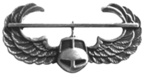
A Perspective on the 101st’s Transition to Air Assault and Invention of the Air Assault Badge -...
Doing some research on the post Vietnam decision to go to one airborne division I came across this fascinating article by Charles S. Bloodworth. I thought readers here would be interested. It features some relatively unknown history about the development of the air assault badge and the Army’s transitioning of the 101st from an airborne ...


https://en.wikipedia.org/wiki/Service_star

Service star - Wikipedia, the free encyclopedia
A service star is a miniature bronze or silver five-pointed star 316 inch in diameter that is authorized to be worn by members of the seven uniformed services of the United States on medals and ribbons to denote an additional award or service period.[1] The service star (316 inch star) may also be referred to as a campaign star or battle star depending on which award is authorized the 316 inch star and the manner in which the device is used...


 Continue with Facebook
 Continue with Google